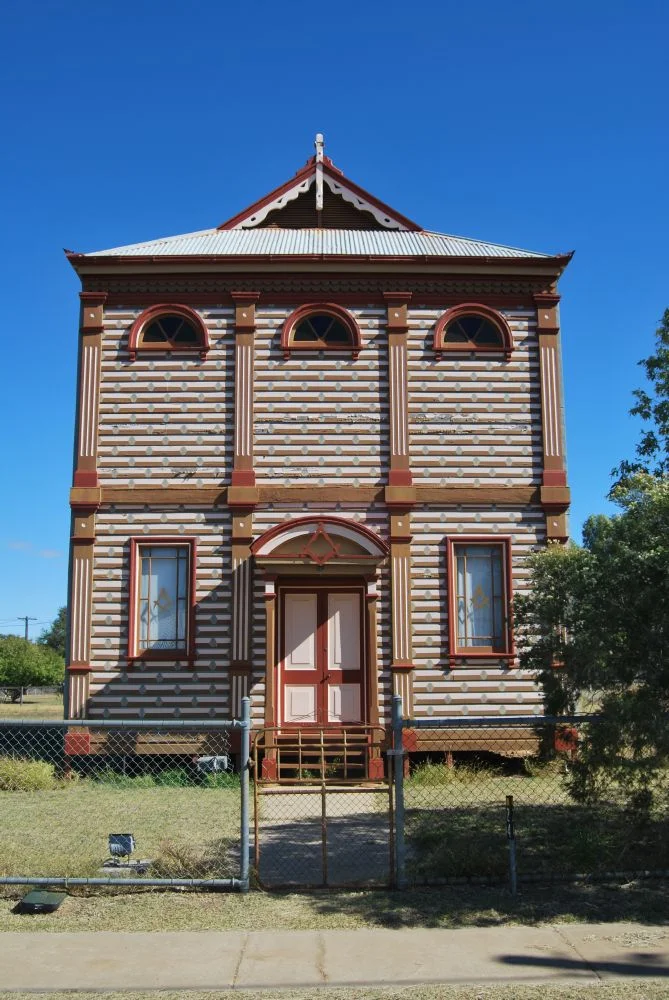

Barcaldine Masonic Temple
Walk up Beech Street and the Masonic temple seems to be made of cut stone, its facade divided into stately bays by fluted columns and crowned with a classical entablature. Lean closer. The stone is timber, painted board by board to mimic ashlar masonry, an illusion so committed that conservators repainted it in the 1980s rather than let it fade. The trick is the point. This is what classical grandeur looked like when it was carried into the Queensland outback on the back of a railway, built from what the bush could supply and dressed up to look like what the builders remembered.
The Lodge That Travelled
The story starts hundreds of miles east. In 1876 Robert Ballard, chief engineer of the line pushing west from Rockhampton, gathered a handful of fellow Freemasons and founded the Comet Lodge No. 1680 at Dingo Creek. The members were railway men, and they did something almost no other lodge has done: they took their building with them. As the rails advanced through the bush, the camps they served sprang up and vanished within a few years, so the Masons treated their lodge like the rest of the railway's rolling stock. They unbolted the timber structure, loaded it into railway trucks, and reassembled it at the next camp down the line. It moved to Cometville in 1878, Emerald in 1879, Bogantungan in 1881, Pine Hill in 1883, Jericho in 1885, and finally came to rest at Barcaldine in 1886, where it was refurbished and the wandering stopped. The lodge still holds its original warrant nearly 300 miles from the town it was granted for, a paper trail of a frontier that would not stay put.
Stone Out of Timber
By 1900 the travelling building had earned a permanent successor. The new and larger temple, said to follow the design of the original, was built that year for the sum of £720 and dedicated in 1901. It is a two-storey timber-framed hall on low stumps, plain corrugated iron down the back and sides, all its ambition concentrated on the street front. There the horizontal boards are painted to read as masonry, the gable carries scalloped bargeboards and finials, and tall round-arched windows light the upper storey. The painted mock-stonework is a genuinely rare technique in Queensland. It is vernacular architecture reaching for the classical with the only materials it had, and somehow pulling it off.
Inside the Working Lodge
The interior survives almost untouched, its original colour schemes intact. The ground-floor supper room wears a brown dado below a hand-painted floral frieze, with ochre-yellow boards above. A practical detail betrays the climate: near the central rear entrance, a section of hit-and-miss flooring let members knock the mud from their boots before climbing the stairs. A simple slatted timber stair rises in an L to the lodge room above, where curved ceilings spring from mock pilasters and the only daylight falls from small high windows and three semicircular openings at the front. It is a deliberately inward room, lit just enough for ritual and no more, exactly as a lodge room was meant to be.
The Social Heart of a Country Town
Heritage listing language can be dry, but the reason this place was added to the Queensland Heritage Register in 1992 is human. In towns like Barcaldine, the lodge was where the community gathered, a fixture of both the streetscape and the social calendar. Barcaldine itself was no ordinary town; in 1891 it became the crucible of the Great Shearers' Strike and, the following year, the birthplace of the Australian Labour movement when the party's manifesto was read beneath the Tree of Knowledge nearby. The temple stood through all of it, a quieter institution amid the upheaval, where men who built railways and worked the land met behind a painted stone front of their own making.
From the Air
The Barcaldine Masonic Temple stands at 39 Beech Street, central Barcaldine, at roughly 23.56 degrees south, 145.29 degrees east. Best viewed from 1,500 to 3,000 feet AGL on approach to the town, which reads clearly on the flat plain as a grid astride the railway line and the Capricorn Highway. Barcaldine Airport (YBAR, field elevation 271 m) lies just northwest of town with a single runway and basic services. Longreach Airport (YLRE) is roughly 100 km west and Emerald (YEML) lies to the east for fuel and longer runways. This is open inland Queensland: navigation references are sparse between towns, the railway is a reliable line feature, and dry-season visibility is usually excellent. Watch for afternoon thermals and dust haze in the summer wet.
Nearby Stories
- Beaconsfield Station Sheep Wash 31 km away
- Langenbaker House 38 km away
- Isis Downs Woolshed 41 km away
- Yalleroi 43 km away
- Aramac Tramway Museum 47 km away
- Augustus Charles Gregory 78 km away
- Cullin-la-ringo Massacre 226 km away
- Brigalow Belt 275 km away