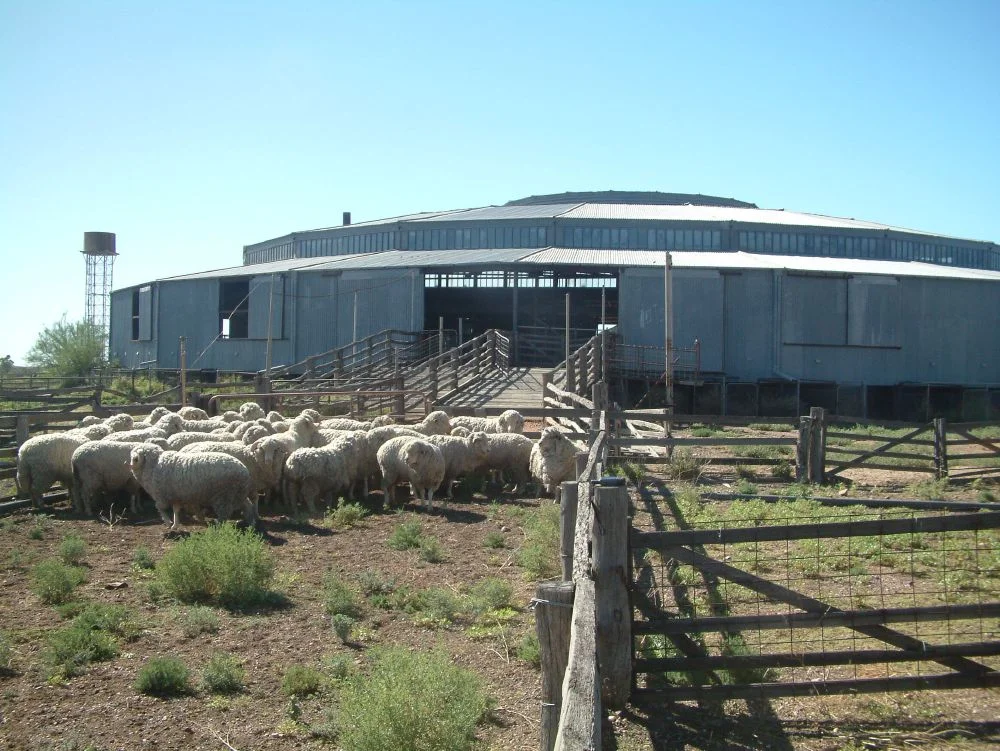

Isis Downs Woolshed
Picture a half-circle of corrugated iron rising from a dead-flat plain where the horizon runs unbroken in every direction. There are no hills behind it, no trees beside it - just this vast curved roof, tiered like a wedding cake, catching the western Queensland light. Inside, fifty-two shearing stands fan out around a single steel pillar driven thirty feet into the ground, holding up a clear span of seventy feet. The Isis Downs Woolshed is the only building of its kind in Australia: a semicircular, prefabricated-steel shearing shed, designed to solve one problem - how to shear enough sheep, fast enough, in a place where almost nothing else would work.
Born From Fire
The round shed exists because the old one burned. In September 1912, just as the shearing season closed, fire destroyed the station's earlier woolshed - a timber-and-iron barn with a hundred shearing stands - along with 1,200 bales of clip. The owners, Sir Rupert Clarke and Robert Whiting, moved fast. By December they had commissioned Melbourne engineers Kay, MacNicol and Company to design a replacement. Several schemes were weighed before they settled on the boldest: one enormous central pillar, the engineers argued, sunk five feet down and rising thirty feet up, would throw a clear span over the whole shearing floor. It was chosen as the "cheapest and simplest" answer to a fiendishly hard question, and it produced something nobody else in the country had ever built.
Steel That Crossed the World
The shed's bones came an extraordinary distance. Australia could not yet roll structural steel of this kind, so it was ordered in January 1913 from Dorman Long - the same Middlesbrough firm that would later raise the Sydney Harbour Bridge. The steel was shipped from England to Melbourne to be cut and prepared to the design, then shipped on to Rockhampton, railed inland to Malverton near Blackall, and finally carted across the plains to the property. Frank Luck, the station manager, oversaw the assembly. The steel arrived late, and the shed missed the 1913 shearing entirely, forcing improvised arrangements. By July 1914 it was finished - shed, yards, and powerhouse - a piece of English industry reassembled in the heart of the outback.
A Power Station for Wool
What made Isis Downs remarkable was not just its shape but its current. Beside the shed stood a purpose-built powerhouse, generating its own electricity and hydraulic power years before mains power reached the bush - a luxury possible only on the largest and most progressive stations. A wood-fired boiler drove a steam engine and an Austral Otis hydraulic pump; together they ran the shearing machines, the wool presses, the bale dump, and the hoist. Clerestory windows and ten sliding ventilation shutters spaced around the curved facade flooded the interior with light and air. The external pens were built to hold thirty thousand sheep, with crews aiming to put five thousand through the stands on a peak day.
The Last Clip
For most of a century the shed roared each season with the clatter of machines and the press of thousands of fleeces. Before World War II, around 150 permanent staff worked Isis Downs; mechanisation steadily thinned their ranks, hollowing out the local community along with them. Stock numbers swung with drought and price - 60,000 sheep in the late 1950s, 100,000 by the 1990s - before the property turned to cattle. The final clip came in May 2004, fewer than 30,000 sheep passing through stands built for ten times that. The shed did not fall silent entirely: it has hosted a symphony orchestra in 2003 and an "Outback Opera" in 2005, its great curved interior turning out to carry music as well as it once carried wool.
Drama on the Flat
Listed on the Queensland Heritage Register on 18 September 2008, the woolshed is prized as much for its presence as its engineering. Designed as a purely utilitarian building, it became, against all intention, one of the most dramatic structures in the Australian bush. The half-circle of corrugated iron set in a flat, unwooded landscape evokes a profound sense of isolation - a tin cathedral with no congregation but the saltbush. The complex survives almost intact: the shed with its mechanical gear and presses, the holding yards, the powerhouse crammed with its original machinery, and the steel bale hoist that once swung wool onto waiting transports. Few buildings express so completely the ambition, the ingenuity, and the loneliness of pastoral Australia.
From the Air
The Isis Downs Woolshed sits at about 24.22°S, 144.63°E, roughly 20 km east of Isisford on the Isisford-Blackall Road, within the Isis Downs homestead complex on the Barcoo plains. It is one of the most recognisable structures from the air in central-west Queensland: a large semicircular, three-tiered corrugated-iron roof standing alone on flat, treeless ground, its curved face oriented toward the property entrance. A recommended viewing altitude of 2,500–5,000 ft AGL frames the woolshed, powerhouse, and yards together against the surrounding plains. Nearest sealed airfields are Blackall (YBCK, about 88 km east) and Longreach (YLRE, to the north); the station has private strips. The dry, clear outback air gives excellent visibility, and low sun morning or evening dramatises the shed's tiered roof and clerestory ridges.
Nearby Stories
- Wellshot Station 23 km away
- Arrilalah 39 km away
- Blackall Woolscour 39 km away
- Barcaldine Masonic Temple 40 km away
- Yaraka 50 km away
- Idalia National Park 59 km away
- Lochern National Park 83 km away
- Augustus Charles Gregory 93 km away