.jpg)
Blackall Woolscour
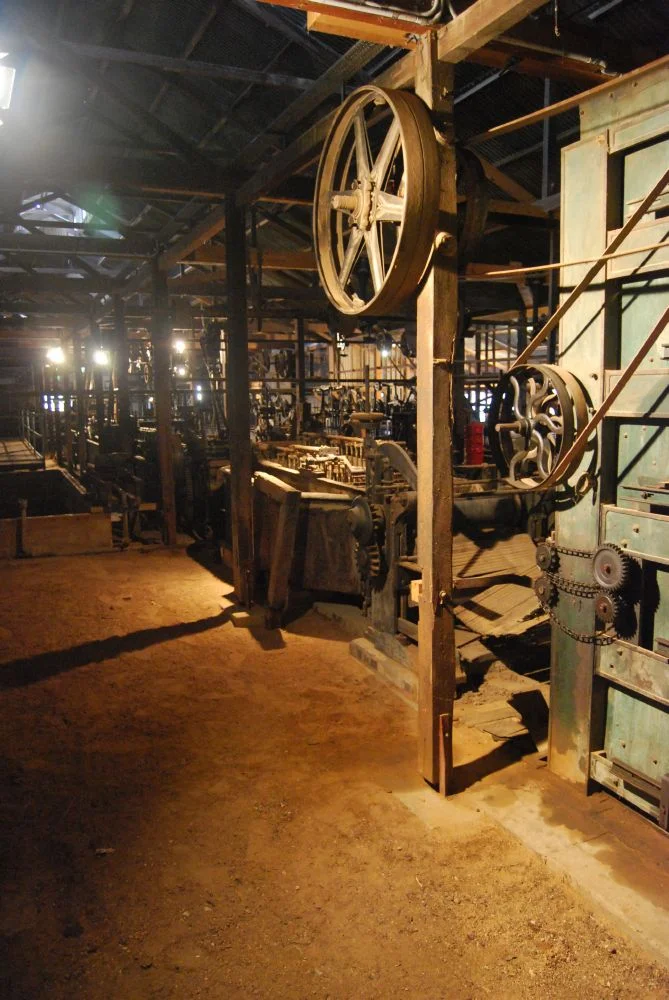
Strike a match to the firebox, build up the steam, and a piece of 1908 wakes up. The boiler ticks and groans, the great engine turns over, belts begin to slap against pulleys, and the Blackall Woolscour - a rambling huddle of corrugated-iron sheds four kilometres outside town - starts doing the only thing it was ever built to do. It is the last steam-operated wool-washing plant left in Australia, and it is not a museum mock-up. The original engine, more than a century old, still drives the works during the cooler months. To stand inside while it runs is to hear an entire vanished industry breathing again.
Water Was the Whole Point
Raw wool comes off a sheep's back heavy with grease, dirt, and lanolin, and before it could be sold at its best it had to be scoured - washed clean. That took enormous quantities of soft, warm water, which is exactly what central-west Queensland could not spare from the sky but could summon from below. The Great Artesian Basin, that vast reservoir trapped deep in the rock, rose here naturally warm and soft, ideal for the work. Before the scour could open, its founders sank a bore. The very first task, advertised in 1905, was to drill for water 'not more than three miles from the township of Blackall.' Everything else - the sheds, the engine, the bales - depended on that hot water coming up out of the ground.
Built in Four Months
The Blackall Proprietary Woolscouring Company was the work of five local grazing and business men, with John Henry Hart as chairman. In September 1906 they contracted Rockhampton builders Renshaw and Ricketts to throw up the shearing and scouring sheds in just four months, framing them in hoop pine carted from Maryborough on the far side of the colony. The plant opened in 1908 beside the newly laid branch railway, perfectly placed to receive fleece and dispatch clean, baled wool to the coast. In 1913 it changed hands, bought by the Melbourne-based Western Queensland Meat Export Company, which already ran a scour at nearby Barcaldine and set about wringing more output from the machinery.
The Peak Years
Under its new owners the scour boomed. The company tinkered and upgraded relentlessly, and by 1918 it had more than doubled its 1913 output to 7,640 bales - the largest in the works' history. The peak years, 1916 to 1920, coincided with wool's importance to a world at war and just emerging from it. Allan Martin Ferguson managed the complex from 1913 until his death in 1933, after which his family carried on running it until 1957. Then the long decline set in. Other scours across the region had already begun shutting their doors, and one by one the great washing sheds of western Queensland fell silent. Blackall held on longer than the rest.
The Last One Standing
The Blackall Woolscour finally closed in 1978, the last of its kind in western Queensland to stop work - and, as it turned out, the last steam-driven scour anywhere in the country. What saved it was simple neglect of the right sort: nobody stripped it for parts. The engine, the boiler, the scouring train, and much of the ancillary gear all survived intact, sitting in their sheds beside the settling ponds and sheepyards exactly as the last shift had left them. Added to the Queensland Heritage Register in 1992 and marked by Engineers Australia for its engineering significance, the complex is now run for visitors. From around May to August each year, the 1908 engine is fired up again, and the sheds fill with the smell of hot oil and the rhythm of belts - a working memory of the industry that built the outback.
From the Air
The Blackall Woolscour lies at about 24.39°S, 145.49°E, roughly 4 km north-northeast of Blackall on the eastern side of the Central Western railway line. From the air, look for the cluster of corrugated-iron sheds, the rectangular settling ponds, and the rail spur set against flat grazing country a short way out of town. The nearest field is Blackall Airport (ICAO YBCK) just southwest, served by QantasLink; Barcaldine (YBAR) lies to the north. Recommended viewing altitude 1,500-3,000 ft AGL for picking out the sheds and ponds. Visibility is generally excellent in this sunny inland region; midday summer heat brings shimmer that can soften ground detail.
Nearby Stories
- Isis Downs Woolshed 26 km away
- Augustus Charles Gregory 33 km away
- Yalleroi 39 km away
- Idalia National Park 42 km away
- Wellshot Station 46 km away
- Yaraka 134 km away
- Queensland National Bank, Charleville 202 km away
- Cullin-la-ringo Massacre 222 km away