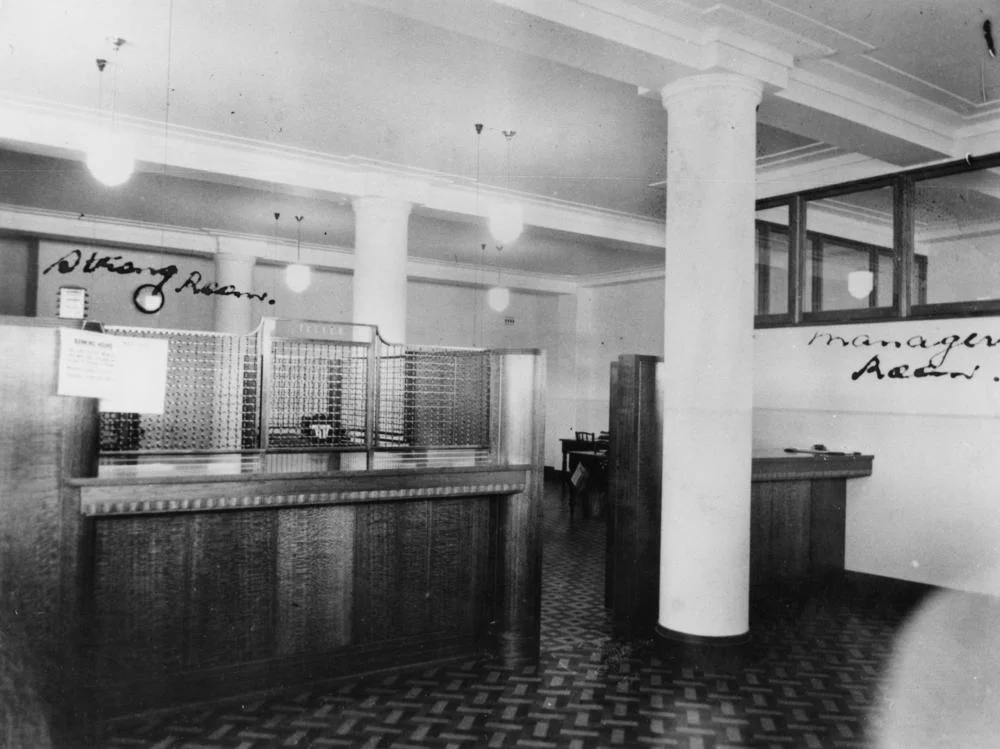

Queensland National Bank, Charleville
Behind a neat picket fence on Alfred Street stands a timber building that once held the money of an entire frontier. When it opened in 1888, the Queensland National Bank at Charleville was a statement of confidence: that wool and cattle would keep flowing, that the railway just arriving in town would make this dusty service centre rich, and that a colony on the far side of the world could run its own finances on its own terms. The squatters and graziers who walked up its timber steps believed in all of it. The building survived long after the certainty did, and today it keeps the town's memory as the Historic House Museum.
A Bank of Their Own
The Queensland National Bank was the colony's first and most successful homegrown bank, founded in Brisbane in March 1872 by a coalition of squatters, politicians, lawyers, and businessmen who were determined to control their own development capital rather than answer to financiers in London or the southern colonies. It worked spectacularly. By 1879 the bank had captured the entire Queensland Government account, and by 1880 it held forty per cent of every deposit in the colony, dominating the economy. It opened in Charleville on 30 July 1881, the first bank in town, just as the south-west's pastoral boom was gathering pace and the place was establishing itself as the regional hub where the inland did its trade.
The Colonial Architect's Hand
By 1888 the branch needed something grander, and the design came from one of nineteenth-century Queensland's finest architects. Francis Drummond Greville Stanley was born in Edinburgh in 1839, trained in Scotland, and emigrated to Brisbane in the early 1860s. He won the competition for Brisbane's General Post Office, served as the Queensland Colonial Architect through the 1870s, and went on to become the foundation president of the Queensland Institute of Architects. The Queensland National Bank was a regular client, and he designed timber branches for it across the colony, in St George, Normanton, Allora, and Blackall among them. The Charleville building, raised by the builder A. Anderson, was his work too, a country bank in timber that still carried the polish of a metropolitan hand.
Money and a Maid
The building did two jobs at once, as country branches usually did. The front was all business: a public banking chamber, a teller's counter, the safe, and the manager's office. The back was a home. Behind the counting of cheques and the weighing of the wool cheque lay a full residence for the manager and his family, including a room set aside for their maid. That detail, along with the high ceilings, the cedar joinery, and the four marble fireplaces, says a great deal about the standing of a bank manager in a remote pastoral town. He was a person of consequence, and his bank was built to look the part, a touch of imported refinement at the end of the railway line.
From Vault to Museum
Banks consolidate, and frontier prosperity does not last forever. In 1942, with the country at war and small branches being trimmed, the bank sold the building to Alex Smith, who made it his home. The Queensland National Bank itself merged into the National Bank of Australasia in 1948, an ancestor of today's National Australia Bank, and so the colony's proud independent institution dissolved into a larger national one. The Charleville building lived several more lives, becoming a boarding house under Smith's daughter before the Charleville and District Cultural and Historical Society bought it and turned it into a local museum. Listed on the Queensland Heritage Register in 1992, it now holds the artefacts of the district it once bankrolled, the vault traded for a display case.
From the Air
The former Queensland National Bank stands at 26.40°S, 146.24°E, on Alfred Street in Charleville, south-west Queensland, a short distance from the town's main street. It is a single-storey timber building on low stumps with a hipped corrugated-iron roof and verandahs, modest in footprint and best located from the air by reference to the surrounding street grid rather than as a standalone landmark. The town sits at roughly 297 metres elevation on the Warrego River. Charleville Airport (ICAO YBCV, IATA CTL) lies about 1 nautical mile to the south-west; Roma Airport (YROM) is the nearest larger field to the east. Skies are typically clear with excellent visibility, especially through the dry winter months. Recommended viewing altitude to take in the town centre is 3,000 to 5,000 feet AGL.
Nearby Stories
- Dillalah 16 km away
- Cooladdi 22 km away
- Koroit opal field 99 km away
- Yapunyah waterhole 146 km away
- Augustus Charles Gregory 179 km away
- Carnarvon Gorge 204 km away
- Hornet Bank Massacre 290 km away
- Jimbour Homestead 461 km away