
Barrow Lifeboat Station
Roa Island is not really an island. A causeway built in 1846 ties it to the mainland, and at the end of that causeway sits Barrow Lifeboat Station, looking out over Piel Channel toward Piel Castle on its own actual island a short distance away. The slipway here is three hundred and ninety-three feet six inches long. When the new boathouse and roller-slipway opened in September 1929 it was the longest at any RNLI station. The boats have changed since. The geography has not.
James Ramsden's Letter
On 7 April 1864, the RNLI committee of management considered a letter from Barrow industrialist James Ramsden and Captain L. Barstow, Royal Navy, the inspecting commander of coastguard. The letter proposed a lifeboat for Barrow. Ramsden offered local funding to match the institution's commitment. A station was agreed. Roa Island was chosen for its position: two and a half miles south of Barrow, overlooking Piel Channel, the entrance to the Port of Barrow, with easy access to the Irish Sea. The brick boathouse cost two hundred and thirty-nine pounds, fourteen shillings, and threepence. It was designed by RNLI consulting architect C. H. Cooke and built by William Gradwell. The opening ceremony was held on 28 July 1865. The first boat was named Commercial Traveller No.1. Ramsden, by then company secretary and soon to be managing director of the Furness Railway Company, became Honorary Secretary of the new station.
William Birkitt and the Long Slipway
In 1878 the boat was renamed William Birkitt after a legacy from Mr William Birkitt of Newton in Cartmel. A new boat assigned to the station in 1887, built by Forrestt of Limehouse in London, was given the same name. A new launchway built in 1884 (funded by the Furness Railway) and a new wooden boathouse in 1885 dropped the launch time to six minutes. The wooden boathouse eventually grew too small. A new pier was built at the end of Piel Street to carry a much longer roller-slipway and a substantial boathouse; opened in September 1929, it cost fourteen thousand pounds and gave the station the longest slipway in the RNLI's network. Ramsden himself was knighted in 1872, the recognition of a man who had built a town and then made sure the lifeboat for it would have somewhere to launch from.
Medals at Sea
The station's honours read like a record of who put out into what weather. In 1937 the Finnish government awarded its silver lifesaving medal to Coxswain Eb Charnley and bronze medals to the rest of the Barrow lifeboat crew, for service to a Finnish vessel. In 1943 the RNLI awarded bronze medals to Motor Mechanic James Orr Moore and Assistant Mechanic Frank Moore. Coxswain Roland Moore received the bronze in 1958, and the British Empire Medal in 1970. Coxswain Robert Charnley received the Thanks of the Institution on Vellum in 1974, alongside vellum service certificates for Second Coxswain Ernie Diamond, Motor Mechanic Frank Moore, Assistant Mechanic Albert Benson, and crewmen Peter Charnley, Thomas Keenan, Paul Cochrane, and Anthony Barber. Coxswain Alexander Moore received a framed letter of thanks from the chairman in 2003 and an MBE in 2006. Names recur down the years - Moore, Charnley - because lifeboat crewing in a place like this runs in families.
Grace Dixon
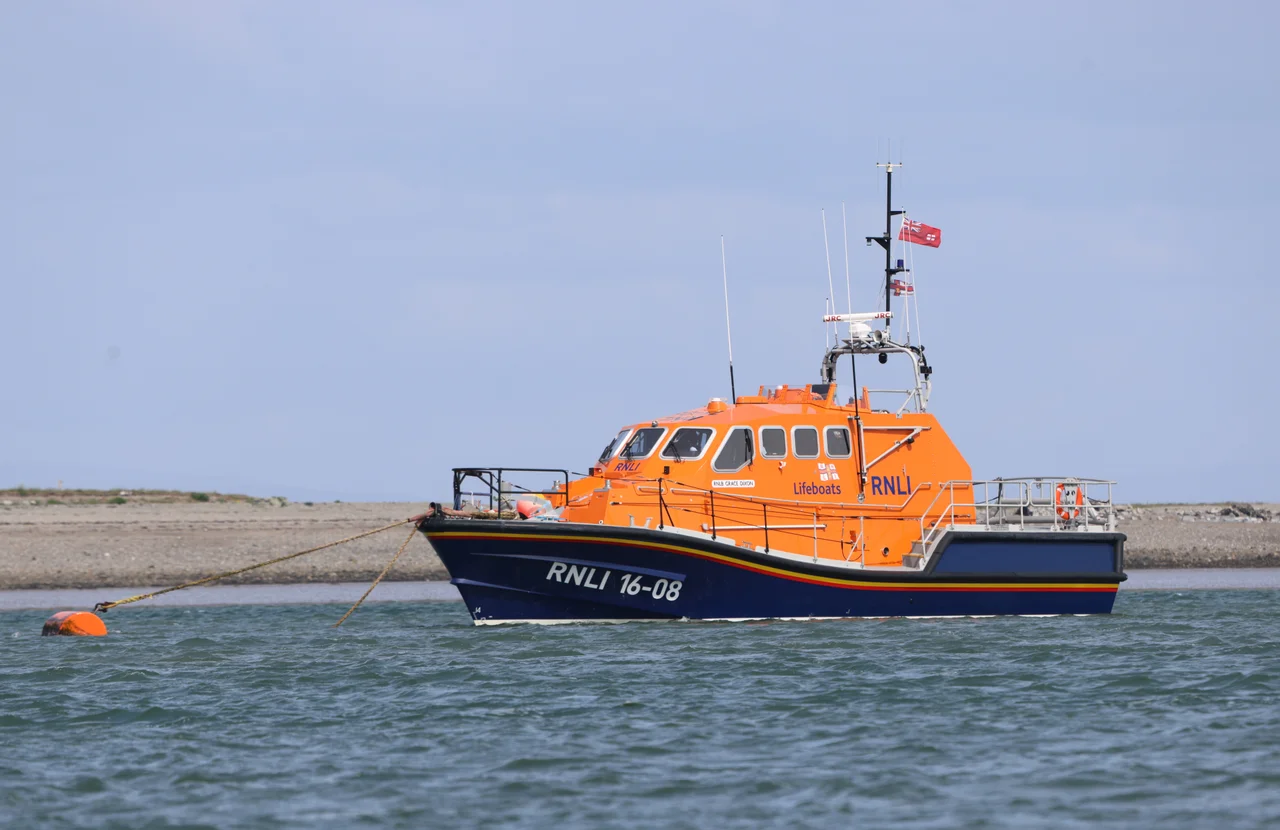
The current all-weather boat is Grace Dixon, a Tamar-class lifeboat, identification number 16-08, on station since 2008. She launches down the slipway under power and recovers via the same slipway by being winched stern-first up the rollers. The current inshore boat is Raymond and Dorothy Billingham, a D-class inflatable on station since 2022. The all-weather boat covers waters as far west as the Isle of Man, north toward the Cumbrian coast, south to Morecambe Bay, and around Walney Island. Most callouts are quieter than the headline rescues that earn medals. Most of them never make the local papers. Most of them are someone in trouble, and the boat going out, and someone coming home who otherwise would not have. That, in this place since 1864, has been the pattern.
From the Air
Barrow Lifeboat Station sits on Roa Island at 54.073 N, 3.173 W, two and a half miles south of central Barrow at the seaward end of a causeway built in 1846. Barrow/Walney Island Airport (EGNL, BWF) is about 5 nm to the north-northwest. Liverpool John Lennon (EGGP, LPL) is about 55 nm to the south. From altitude the station appears at the southern tip of the narrow Roa Island spit. Piel Channel runs west between Roa and Piel Island, on which Piel Castle stands. Walney Island stretches north along the coast; the southern end of Walney has a nature reserve. Morecambe Bay opens east. Black Combe is visible to the north; on clear days the Isle of Man may be visible to the west across the Irish Sea.
Nearby Stories
- Lancaster Priory 0.5 km away
- Kendal 4.5 km away
- Muncaster Castle 5 km away
- Ribble Steam Railway 5 km away
- St Annes Lifeboat Station 21 km away
- Ramsey Bay 28 km away
- Celtic Array 36 km away
- Laxey Bay 38 km away