.jpg)
Kendal
Cloth is my bread, says the town motto - Pannus mihi panis, written in Latin around the Kendal coat of arms. For most of seven centuries that was literal truth. The wool trade made Kendal, and the particular hard-wearing weave known as Kendal Green was famous enough to clothe the English archers credited with breaking the French line at Agincourt. Shakespeare gave it to Falstaff's foresters in Henry IV, Part 1. The town's grey limestone buildings have earned it another nickname - the Auld Grey Town - and the contrast captures the place: a hard-working market town built of stone the colour of a winter sky, sitting just outside the Lake District National Park and serving as its commercial gateway. Catherine Parr's family rooted here. Postman Pat was created here. Kendal Mint Cake was carried to the summit of Everest from here. The town is small. Its reach is not.
From Cherchebi to County Town
The Domesday Book of 1086 lists the area under the name Cherchebi, from Old Norse kirkju-by - church-village. For many centuries afterwards it was called Kirkby Kendal: village with a church in the valley of the River Kent. The Kent gave the place its modern name, attached to the Old Norse dalr (valley). The town became the seat of the Barony of Kendal after 1226, when the barony merged with Westmorland. The traditional county town of Westmorland was Appleby; Kendal only formally became county town in 1889. The 1974 reforms made it the centre of South Lakeland district, and in April 2023 - through the largest local-government reorganisation in fifty years - Kendal became the seat of the new Westmorland and Furness council. The town's status has climbed steadily upward across a thousand years.
Cloth, Snuff, Mint Cake
A Roman fort once stood about two miles south of the modern town centre, at a site called Watercrook. Built around AD 90 in timber, rebuilt in stone in Hadrian's reign around 130, abandoned and reoccupied through the second and third centuries until the legions finally pulled back. The stone is now buried under a field. Medieval Kendal grew around the cloth trade. Then in 1792 a Kendal man named Thomas Harrison returned from Glasgow carrying fifty tons of second-hand snuff-making equipment - all of it transported on horseback - and started a tobacco industry that survives today. Samuel Gawith and Company in Kendal employs the oldest piece of industrial equipment still in use anywhere in the world: a device manufactured in the 1750s. Then, sometime in the late nineteenth century, Joseph Wiper accidentally created Kendal Mint Cake while trying to make a clear glacier mint. His great-nephew marketed it as an energy food and supplied it to Shackleton's Imperial Trans-Antarctic Expedition of 1914-17. Mint cake has since been carried to the summit of Everest, to the top of K2, and to both poles.
Catherine Parr's Town
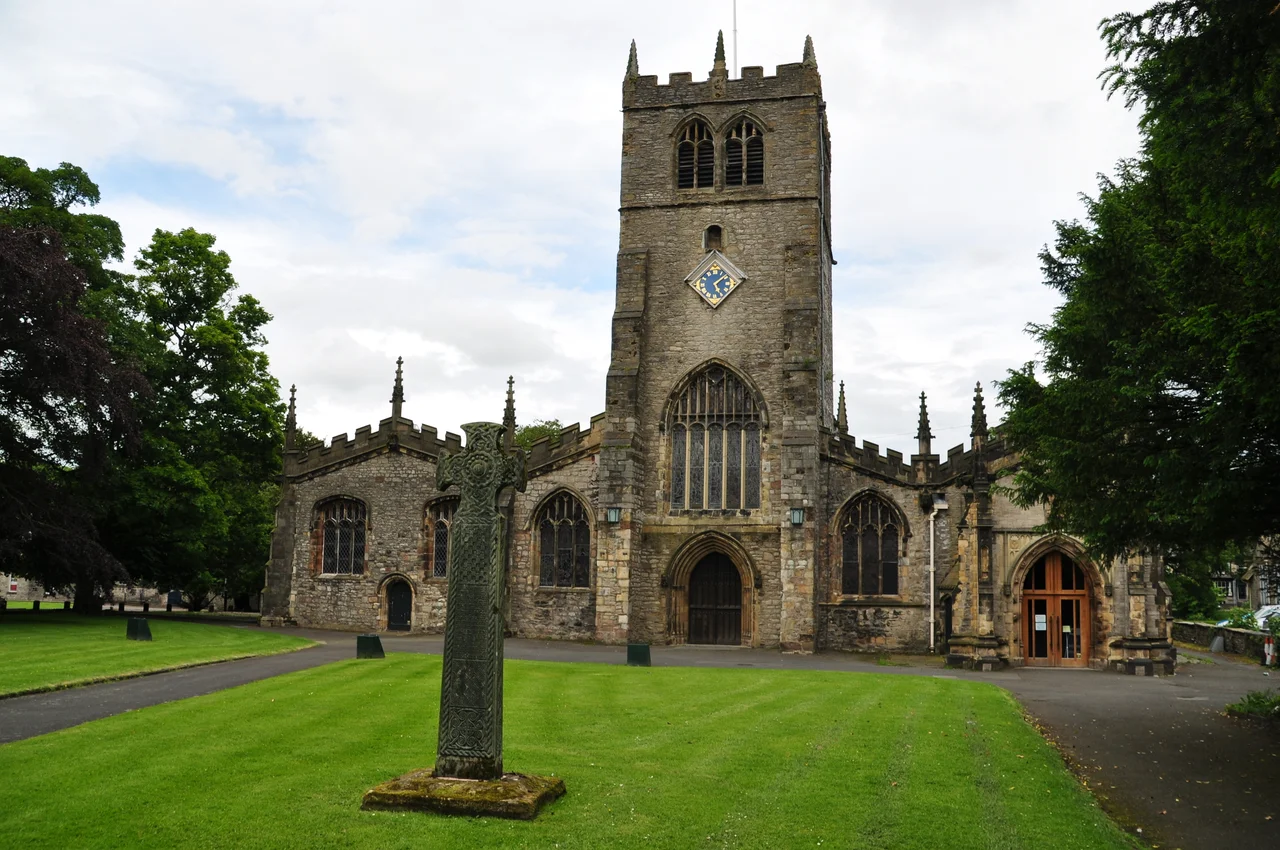
Kendal Castle, the medieval fortification on the drumlin east of town, was for generations the seat of the Parr family. Catherine Parr - sixth and last wife of Henry VIII, the one who outlived him - was long thought to have been born here. Modern research has shown that by her birth in 1512, the castle was in great disrepair and her father preferred London. She was almost certainly born in Blackfriars. But the family that produced her was rooted in Kendal across centuries, and the connection has shaped local civic identity ever since: the secondary school is named the Queen Katherine School, the town's main church preserves the Parr Chapel, and prayers in Catherine's own hand survive there. The cloth manufacture that funded the Parr rise to court influence was the same trade that gave the town its Latin motto. Cloth bought the family's tickets to London.
Auld Grey Town, New Geography
Kendal stands at the southern end of the Lake District, ringed by low hills: Scout Scar to the west, Potter Fell to the north, Benson Knott and Helm Hill to the east. The River Kent runs through the town and winds south through dairy and sheep country to Morecambe Bay near Arnside. Although Kendal is the natural commercial centre for the Lakes, it does not lie within the National Park's boundaries - a deliberate choice by the 1951 boundary commission, which kept the working town outside the protected zone. The K Shoes factory was a major employer until it closed in 2003. Today the local economy mixes Gilkes and Gordon pumps and turbines, James Cropper paper (who make the paper for British Legion Remembrance poppies at no profit), Lakeland the kitchenware retailer, and Kendal Nutricare. The town also produced an unusual concentration of British creative talent: chemist John Dalton, astrophysicist Arthur Eddington, painter George Romney, John Cunliffe who invented Postman Pat, and Alfred Wainwright whose hand-drawn guides defined how the modern English walker reads the Lakes. Paul McCartney once joked about the Kendal freeway in his Wings song Helen Wheels; anyone who has driven through Kendal during a Lake District bank holiday will recognise the irony.
From the Air
Kendal is centred at 54.33 degrees north, 2.75 degrees west, on the River Kent in southern Cumbria. From altitude, look for the limestone-grey town nestled in the river valley with Kendal Castle prominent on the drumlin to the east. Best viewed from 2,500-4,000 feet AGL. Carlisle (EGNC) lies approximately 50 nautical miles north; Blackpool (EGNH) is about 40 nautical miles south; Leeds Bradford (EGNM) is approximately 55 nautical miles southeast. The Lake District fells rise immediately to the west and northwest. The Howgill Fells lift to the east. Morecambe Bay opens to the southwest. The M6 motorway runs north-south about 8 nautical miles east of the town.
Nearby Stories
- Hardknott Pass 2.1 km away
- Furness Abbey 2.3 km away
- Ireby 8 km away
- Cross Fell 10 km away
- Weardale Railway 11 km away
- Morecambe Bay Cockling Disaster 13 km away
- Bolton Castle 14 km away
- 1975 Dibbles Bridge Coach Crash 15 km away