
St Annes Lifeboat Station
The Laura Janet had been on station for five years and had saved six lives. That was her one successful service. Five days after she brought the crew of the Yan Yean of Montrose to shore, distress signals went up at nine in the evening from the barque Mexico, driven aground off Ainsdale in a south-southwesterly gale. The Laura Janet launched into the dark with thirteen men aboard. None of them came back.
A New Town, A New Station
St Annes did not exist as a town before 1874. The development of the Victorian seaside resort, which began the following year, ran fast: pier, station, hotels rising from the dunes, streets laid out by the architects who would later build Blackpool Tower. A lifeboat was an obvious need. In 1879 James Chadwick of Prestwich, Manchester, gave one thousand pounds to start a station. Admiral John Ward, Chief Inspector of Lifeboats, came to inspect that May. By 1881 the new station had its first boat. Lifeboatmen were drawn from local fishermen and from men who already worked the dangerous water of the Ribble approaches. They were neighbours and brothers and fathers before they were a crew.
9 December 1886
The German barque Mexico was driven ashore off Ainsdale around twenty-one hundred hours on the evening of 9 December 1886. Three lifeboats launched into the storm: the Southport Eliza Fernley, the St Annes Laura Janet, and the Lytham Charles Biggs. The Charles Biggs reached the Mexico and saved her twelve men. The Eliza Fernley capsized on her approach. The Laura Janet was never seen alive again. Her upturned hull was found on Birkdale beach the next morning. All thirteen of her crew had drowned in the water under her. Together with the fourteen Southport men who died that night, the toll came to twenty-seven lifeboatmen lost in a single rescue, leaving sixteen widows and fifty children. It remains the worst single-incident loss in the history of the Royal National Lifeboat Institution. The Laura Janet was hauled in and officially returned to service in January 1887, but she was never used again. She went back to London and was broken up.
What the Town Did Next
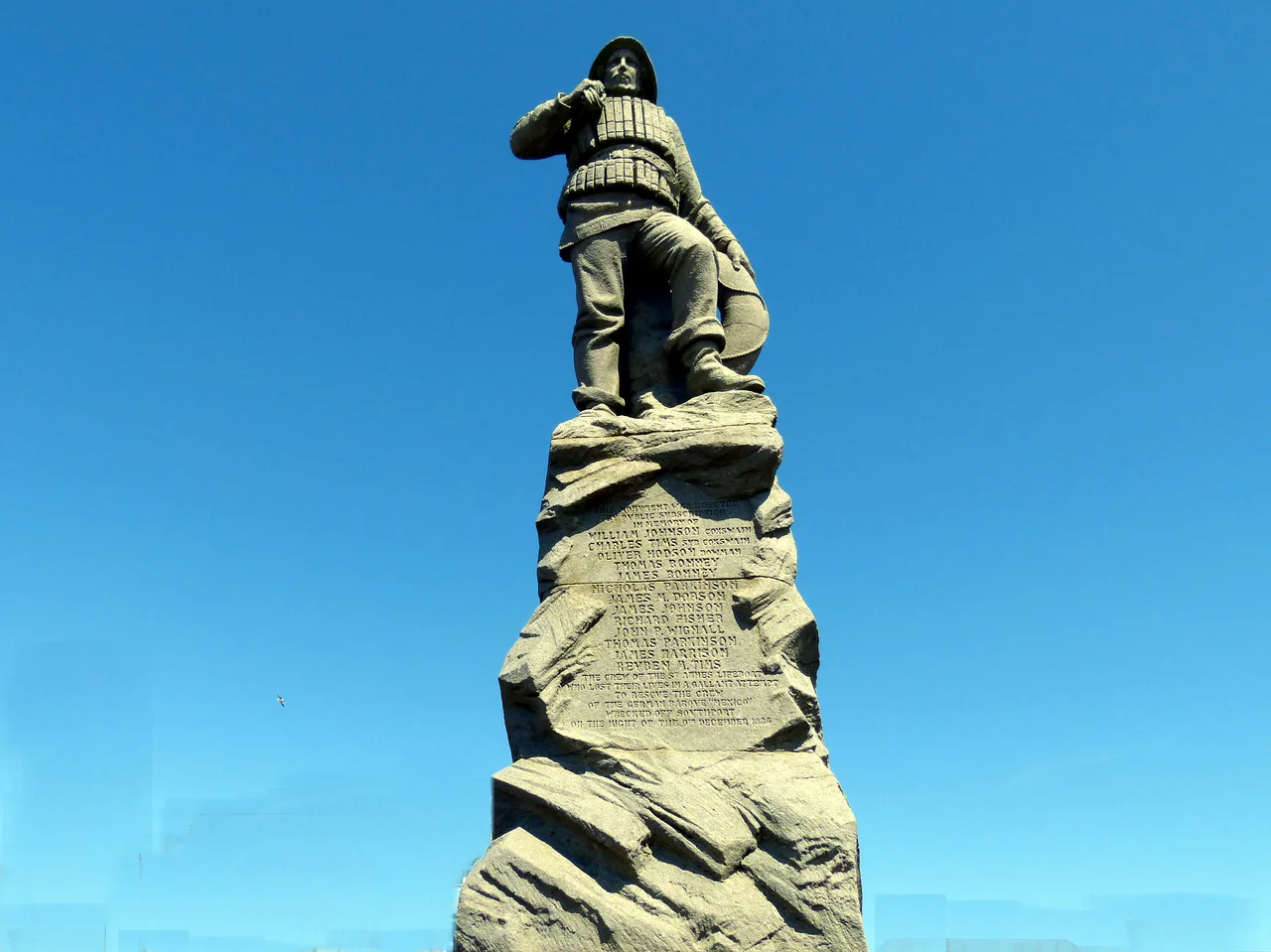
On 23 May 1888, a monument designed by William Birnie Rhind and topped by a figure of a lifeboatman was unveiled on St Annes Promenade by John Talbot Clifton. It is still there. At the same ceremony, the new boat, The Brothers, was named, and Coxswain Thomas Rimmer was presented with his silver medal. A relief fund had opened immediately after the disaster and had drawn over thirty thousand pounds within weeks for the bereaved families. Charles Wright Macara, a Manchester businessman, joined the St Annes RNLI branch committee in 1887 and became chairman in January 1889. Macara noticed something specific about the fund's success: most of the money had come from a small number of wealthy donors. He thought the entire country might give if it were asked. He invented Lifeboat Saturday, the first national charity street collection in Britain, in 1891. It went on to fund a generation of new boats.
The Slow Closing
Through the 1920s the same silt that closed the steamer service at Southport Pier choked the Ribble approaches at St Annes. The local fishing industry, which had given the lifeboat its crew, collapsed. The station became a half-time station, able to launch only at high water. It was closed in May 1925. The St Annes RNLI branch kept fundraising, and in March 1931 was formally merged with the Lytham station to create Lytham St Annes Lifeboat Station, which still operates today from a base south of St Annes Pier. The lifeboatman on the promenade still looks out to sea. He has been looking for one hundred and forty years and counting. The boats have changed. The reason for them has not.
From the Air
St Annes Lifeboat Station sits at 53.748 N, 3.030 W on the Fylde coast in Lancashire, on Eastbank Road just south of the current Lytham St Annes RNLI base. Blackpool International (EGNH, BLK) is the closest airport, about 5 nm to the north. Liverpool John Lennon (EGGP, LPL) is about 22 nm to the south. From altitude, the promenade lifeboatman memorial on St Annes seafront and the long sand beach extending toward Lytham and the Ribble estuary mouth are the main visual references. Ainsdale Beach, where the Mexico was wrecked in 1886, stretches several miles south. The estuary opens west into Liverpool Bay; Blackpool Tower is visible up the coast in clear weather.
Nearby Stories
- Kingsway Tunnel 3.1 km away
- Helmshore Mills Textile Museum 8.3 km away
- Heysham Port 9 km away
- Tatton Park 13 km away
- Abergele Rail Disaster 18 km away
- Malham Cove 23 km away
- Llandudno 47 km away
- Egremont Castle 57 km away