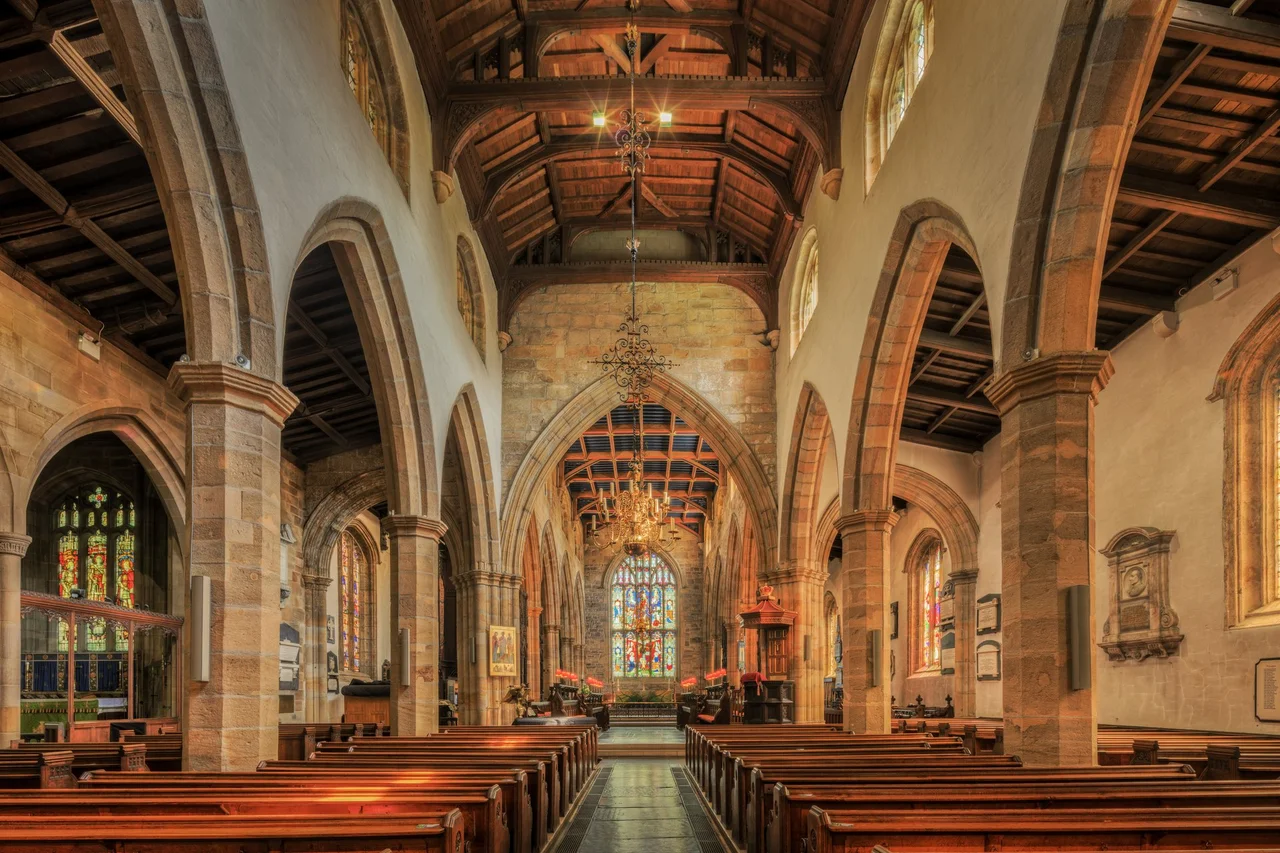

Lancaster Priory
Layer upon layer. A Roman fort stood on this hilltop above the River Lune from the first century AD. A Saxon church may have been here from the sixth century. A monastery, traditions suggest, was founded before the Normans arrived. Then in 1094 - twenty-eight years after Hastings, two years before the First Crusade - Roger de Poitou established a Benedictine priory dedicated to St Mary, as a daughter house of the great Abbey of Saint Martin at Sees in Normandy. Almost a thousand years later, the same hill still has a church on it, and the walls of Lancaster Priory rest on foundations older than England.
Sharing the Hill
The priory and Lancaster Castle stand a stone's throw apart on the same outcrop. They have always been neighbours, sometimes uneasy ones. The castle held political prisoners and condemned felons; the priory held services that were sometimes attended by people on their way to be hanged. The medieval church was a Benedictine cell, dependent on Sees, until 1414 when the Crown dissolved alien priories during the wars with France and the cells were given to English monasteries. After the Dissolution of the Monasteries in the 1530s, Lancaster Priory became a parish church. It has been parish church to the city of Lancaster ever since, and since 1953 has held Grade I listed status.
Carved Wood and Cast Iron
The carved oak choir stalls inside the priory date from around 1340 and are reckoned among the finest medieval woodwork in any northern English parish church. Tradition holds they came from Cockersand Abbey on the Lune estuary, salvaged after the abbey's dissolution - though Pevsner notes the provenance is uncertain, with Furness Abbey also proposed. The pulpit dates from 1619 - originally a three-decker, its canopy restored in 1999 using the original crown that surmounted it. The font has a stone base from 1848 and a carved wooden cover dated 1631. Three brass chandeliers are dated 1717. Edward Paley designed the stained glass in the east window and William Wailes made it. An Anglo-Saxon cross found at the priory was moved to the British Museum in 1868 after a meeting of the British Archaeological Association in Lancaster; a replica now stands near the south west door.
Towers and Bells
In 1743 the parish decided to raise the steeple ten yards higher so the bells could be heard further across the city. The bells were recast for the new tower. By 1753, only a decade later, the rebuilt tower was found to be in danger of collapse, the bells were removed, and Henry Sephton was commissioned to demolish and rebuild the whole structure. Between 1809 and 1811 George Pike England installed an organ at a cost of £672. The Lancaster firm of Paley and Austin - the same architects who would later design Lancaster Cathedral down the hill - restored the chancel between 1868 and 1871, added a new organ chamber and vestry, and replaced the organ in 1872. A south porch and a polygonal-apsed outer north aisle followed in 1903.
The Churchyard and the View
The ground under and around the church is a scheduled monument; this is the heart of Roman Lancaster, and the soil holds layers of fort, settlement, Saxon graveyard, and medieval cemetery. Among the listed monuments in the churchyard are a late 18th-century sandstone sundial, restored in 1894; the Rawlinson memorial; and a mid-19th-century tomb chest with a damaged marble effigy. From the priory's west end, the ground falls away to the curving Lune. The castle's gatehouse rises immediately to the south. Lancaster Priory is open to visitors Monday to Saturday from 10 am to 4 pm, and on Sundays for services, and is a member of the Greater Churches Group - the network of England's largest non-cathedral parish churches. Stand in the nave on a quiet weekday morning, look up at choir stalls carved before Chaucer wrote the Canterbury Tales, and the layering of this hill becomes physical.
From the Air
Lancaster Priory sits at 54.051°N, 2.806°W, immediately north of Lancaster Castle on Castle Hill above the River Lune. The priory's tower reaches roughly 100 ft above ground. Best viewed VFR at 1,500-2,500 ft AGL. The two pale stone buildings - castle keep and priory church - share a single hilltop above the curving river, an unmistakeable cluster from the air. Nearest airports: Blackpool (EGNH) 17 nm southwest, Manchester (EGCC) about 50 nm south. The Ashton Memorial dome stands a mile east in Williamson Park. The M6 motorway and West Coast Main Line run close past the city centre.
Nearby Stories
- Piel Castle 1.3 km away
- Samlesbury Hall 4.7 km away
- Kendal Castle 6.5 km away
- Murder of Lindsay Rimer 7.8 km away
- Hardknott Pass 9.8 km away
- Bolton Castle 10 km away
- Embsay and Bolton Abbey Steam Railway 12 km away
- Hoylake Lifeboat Station 43 km away