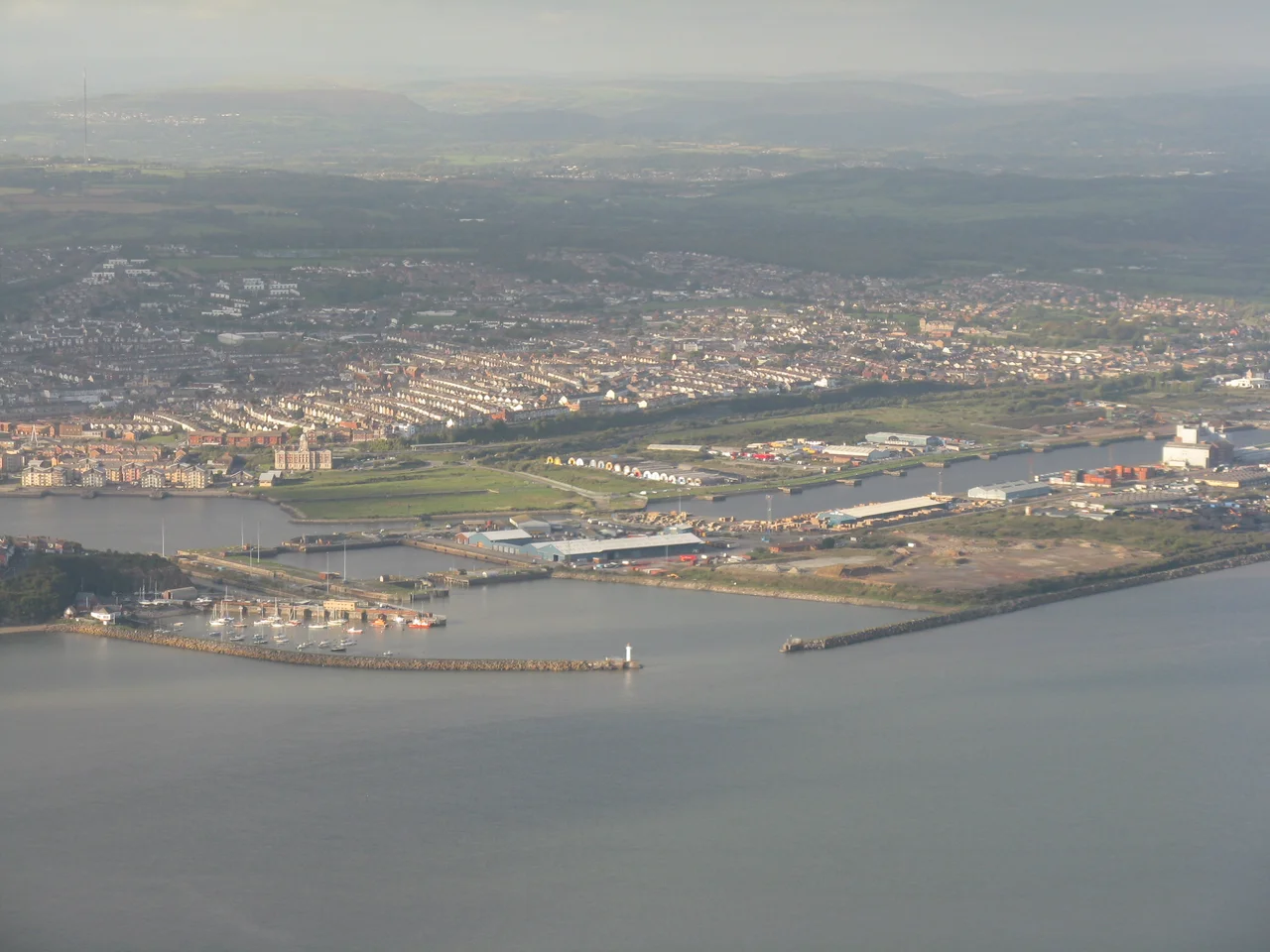

Barry Docks
In 1913, the small Welsh town of Barry shipped 11.05 million long tons of coal - more than any port in the world. Cardiff, its older and grander rival, came in second. The reason Barry existed at all was that a Welsh coal magnate named David Davies had got tired of paying the Marquis of Bute's extortionate fees at Cardiff Docks. So in 1884, with John Cory and a consortium of mine owners, he began digging out the channel between Barry Island and the mainland to make his own port. Six years later they had the world's biggest coal docks. Twenty-three years later they had the world's busiest port. Sixty-five years after that the last coal tip came down, and the place that fed empires became a place to scrap obsolete steam engines.
Davies's Revenge
John Crichton-Stuart, 2nd Marquess of Bute, owned Cardiff Docks - and through them, effectively, the entire South Wales coal export trade. Every Rhondda mine owner shipped through Cardiff and paid whatever Bute charged. David Davies, founder of the Ocean Coal Company and son of a Montgomeryshire smallholder, decided he would not. After multiple failed attempts to get parliamentary permission, his group of mine owners finally won approval in August 1884. On 14 November of that year, Davies and his partners 'trudged out to Castleland Point to dig a small hole in the ground with the aid of a ceremonial spade, a wheelbarrow and a plentiful supply of planking to keep the autumn mud off their shoes.' The engineer was John Wolfe Barry - son of the architect of the Houses of Parliament, builder of Tower Bridge - assisted by Thomas Forster Brown and Henry Marc Brunel, son of the famous Isambard.
Holding Back the Sea
Barry Sound was a tidal inlet between Barry Island and the mainland - the perfect site for a dock because the bedrock was high and the excavation modest. But first they had to get the sea out. The contractors built three dams: a centre dam splitting the dock area in half, plus eastern and western dams completely sealing the site from the Channel. The centre dam went up easily enough. The eastern dam was managed with masonry piers. The western dam was the nightmare - it rested on mud forty feet deep, and twice the contractors tried to close the final gap at low tide only to watch a torrent of water break through at five miles an hour. The solution, in July 1885, was to drop heavy timber shutters between piles when the tide receded, then back them with stone faster than the next high tide could undermine them. It worked. A Cornish beam engine from the Severn Tunnel works pumped out 150,000 gallons an hour. Gunpowder loosened the marl below. Steam shovels did the rest. Five million cubic yards came out of the ground.
Coal Hoists and Trimmers
Water flooded into the docks on 29 June 1889 and the SS Arno sailed in on opening day, 18 July. The first dock alone covered 70 acres. By 1898 a second dock opened to the east, and the Lady Windsor Lock - 647 feet long, said to be the largest and deepest lock in the world - let ships in and out at almost any tide. The system had eleven high-level coal tips on the north side, four cranes, more tips on the mole and at the dock heads. A loaded wagon held ten tons. Hydraulic power tipped it onto a cradle, which raised or lowered to match the ship's hold. An anti-breakage box caught the first cone of coal until the chute could reach. Two men could empty a wagon in a minute. In one hour from a single tip, 400 long tons of coal could be shipped. Three engine houses (Barry, Battery Hill, Bendricks) supplied hydraulic power at 750 pounds per square inch. By 1909 between 8,000 and 10,000 men worked the docks. The whole town - 33,000 people - existed because of them.
Peak and Decline
In 1913 the docks shipped 11.05 million long tons of coal and overtook Cardiff. Most went overseas - to France, the Mediterranean, the Black Sea, West Africa, South America - to power steamships. Smokeless Welsh coal was particularly prized by the Royal Navy, whose worldwide bunkering depots ran on it. Then the war came, then the General Strike of 1926, then the Great Depression. Coal output in Wales fell from 57.4 million tons in 1923 to 37.7 million in 1928. The Railways Act 1921 merged the Barry Railway Company into Great Western. Customers switched their ships from coal to oil. The docks survived another war, served as embarkation point for 4,000 troops bound for Normandy in 1944, then drifted into a long decline. The Geest company imported West Indian bananas through Barry from 1959 until the 1980s. Shipments of coal from the port ceased in 1976. The last coal tip came down in November 1981.
The Steam Locomotive Graveyard
Then came the unlikely afterlife. In 1957 British Railways began modernising, scrapping 650,000 wagons and 16,000 steam locomotives. A Barry scrap dealer named Woodham & Sons - founded in 1892 by Albert Woodham - won contracts to break them up. Albert's son Dai Woodham concentrated on the wagons, planning to get to the locomotives later. The locomotives, meanwhile, were parked in long lines on the reclaimed sidings beside the dock, rusting in the Welsh weather. Then a strange thing happened. From 1968, preservationists - heritage railway societies, individuals, charities - started buying the locomotives at their scrap-metal value. Dai Woodham sold them off, one by one. By the time the last engines left in 1989, more than 200 steam locomotives had been bought from Woodham's yard at Barry and rebuilt. Most of the British steam locomotives running on heritage lines today owe their survival to the slow pace at which a Barry scrap dealer cut up wagons.
Waterfront Barry
The first dock is now The Waterfront. In 1993 the Barry Joint Venture launched the redevelopment, and over the next two decades the derelict quays became housing, retail, medical centres, a Morrisons, a Premier Inn, an Asda, a hydraulic-engine-house-turned-espresso-bar still labelled in Welsh and English on its black-lettered chimney. The second dock is still active, handling chemicals (mainly for Dow Corning), timber from Scandinavia and the Baltics, and intermodal rail freight. The Barry Dock Offices, built in 1897-1900 by Arthur E. Bell, survive as Vale of Glamorgan Council offices, the David Davies statue out front - unveiled in 1893, three years after his death, overlooking the docks he had forced into existence. The Porthkerry Viaduct, sixteen stone arches 110 feet high, still carries the Vale of Glamorgan Line. From the air, the basin and locks still trace the shape that John Wolfe Barry's engineers cut from the mud - a square pond of dark water where, for thirty years, the world came to load coal.
From the Air
Located at 51.40°N, 3.27°W, on the north shore of the Bristol Channel, a few miles southwest of Cardiff. The dock complex covers around 530 acres between Barry Island and the mainland, with the two main basins (No.1, now The Waterfront, and the still-active No.2) clearly visible from above. Cardiff (EGFF) is approximately 7 miles northeast. Best viewed at 2,000-3,000 feet AGL with Barry Island to the south, the Bristol Channel opening west, and the dramatic 110-foot Porthkerry Viaduct sweeping in from the west on the railway line.
Nearby Stories
- Aberfan Disaster 1.3 km away
- Glastonbury 6.5 km away
- Quantock Hills 7.4 km away
- Tyntesfield 7.5 km away
- Tintern 9.2 km away
- The Mumbles Lifeboat Station 19 km away
- Carreg Cennen Castle 20 km away
- Appledore Lifeboat Station 26 km away