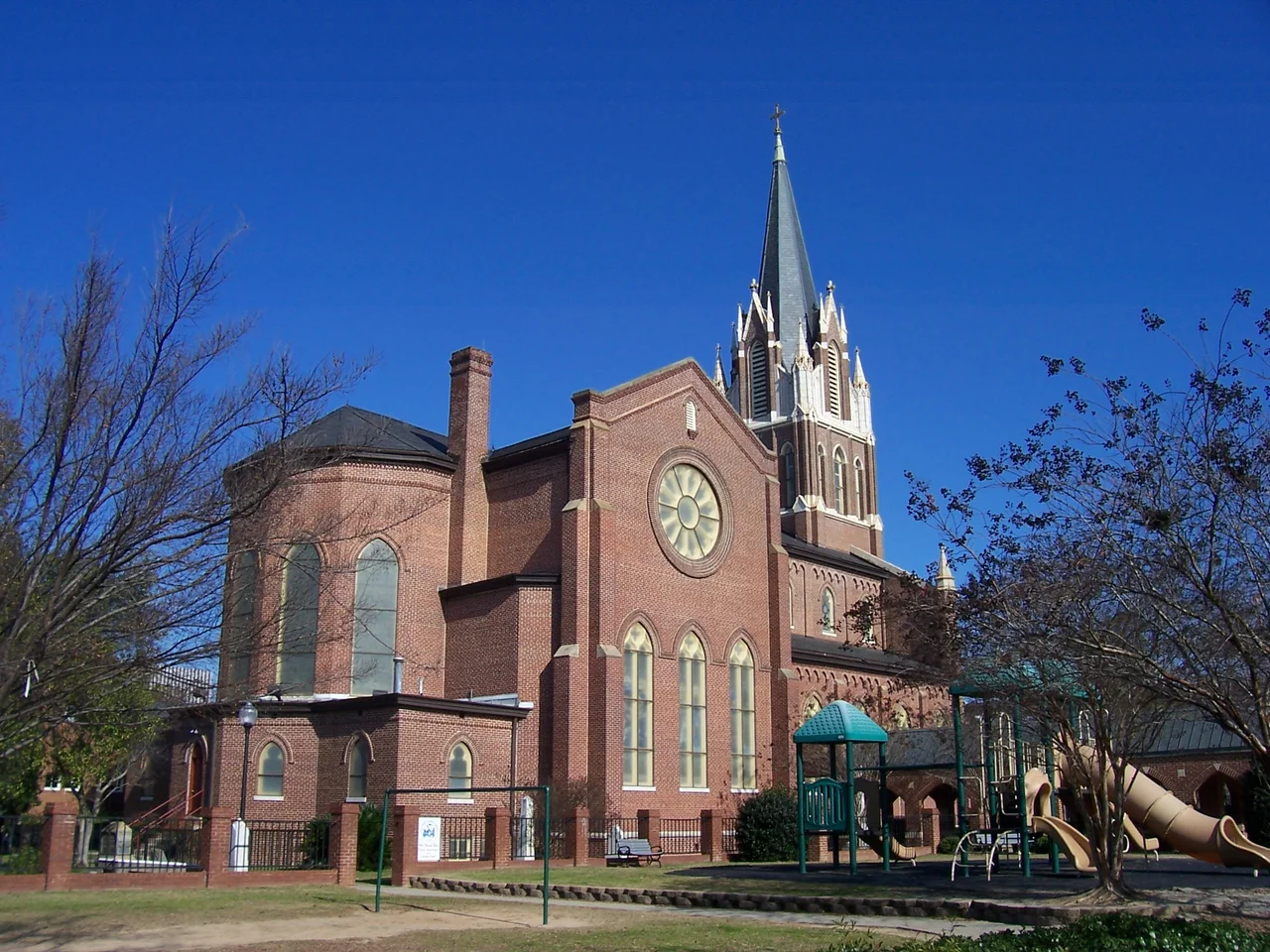

Basilica of St. Peter (Columbia, South Carolina)
On June 24, 2018, a decree from the Vatican's Congregation for Divine Worship arrived in Columbia and quietly changed the standing of a single building. St. Peter's Roman Catholic Church at 1529 Assembly Street, founded by the first Catholic priest to set up shop in the South Carolina capital nearly two centuries earlier, became the Basilica of St. Peter - the eighty-fifth minor basilica in the United States and the first in South Carolina. The designation does not change what the building looks like. It does not change the brick or the spire. What it does is recognize, in the formal language of Rome, that the people who have worshiped in this nave since 1908 belong to something old, and that their building belongs in the company of the basilicas of Christendom.
A Catholic Parish in a Protestant Capital
Columbia was barely a generation old when its first resident Catholic priest arrived in 1820. South Carolina was overwhelmingly Protestant - Baptist, Methodist, Presbyterian, Lutheran - and Catholics in the capital were few enough to count individually. Yet within four years they had built a church. The first St. Peter's, completed in 1824, was designed by Robert Mills, the South Carolina-born architect later famous for the Washington Monument and the U.S. Treasury Building. Mills was a Protestant who had trained under Jefferson; he designed Catholic churches anyway, because the city needed buildings and Mills built whatever the city needed. That first St. Peter's survived the Civil War, including Sherman's burning of Columbia in February 1865 that consumed much of the surrounding city. It stood until the early 1900s, when the growing parish demolished it to make way for something larger.
The 1908 Building
The current church was designed by Frank Pierce Milburn, a prolific Southern architect responsible for courthouses, train stations, and university buildings across the post-Reconstruction South. Father Thomas J. Hegarty led the fundraising. Construction began in 1906, finished in 1908, and the building was dedicated in January 1909. Milburn worked in the Gothic Revival vocabulary that high-church Catholics and Episcopalians both favored in the period: dark red brick, Bedford limestone trim, dull-glazed terracotta details, Buckingham slate roof. The spire rises 163 feet above grade and is topped with a cross. Inside, the cruciform plan stretches 131 feet long and 79 feet wide; the high nave is 51 feet from floor to ceiling, with windows tall enough to fill the space with colored light on a clear afternoon. In 1989 the structure was listed on the National Register of Historic Places.
The Bell and the Irish
The bell was cast in 1911 in Baltimore by the McShane Bell Foundry, weighs 3,500 pounds, and measures 55 inches across. McShane had been making church bells since 1856; their bronze rings out from Catholic parishes across the Eastern Seaboard, and St. Peter's is one of dozens of Southern churches whose Sunday morning carries a McShane voice. The church graveyard behind the building holds Irish names disproportionate to their share of nineteenth-century Columbia, including some of the indentured laborers who dug the nearby Columbia Canal in the 1820s and were buried at the parish after deaths from cholera, exhaustion, and accident. The Ancient Order of Hibernians dedicated a granite memorial to those workers in 2008. They lie within sight of the basilica's spire.
From the Air
The Basilica of St. Peter is at 34.006°N, 81.038°W, on Assembly Street in downtown Columbia, roughly three blocks south-southwest of the South Carolina State House. The 163-foot Gothic Revival spire is the most identifiable visual feature from low altitude - a single dark vertical accent rising above the central business district. Columbia Owens Downtown Airport (KCUB) is about three miles east-southeast; Columbia Metropolitan (KCAE) is about seven miles southwest. The Congaree River runs about half a mile to the west. Best low-pass viewing altitudes are 1,500-2,500 feet AGL in clear midday light.
Nearby Stories
- Shaw Air Force Base 5.5 km away
- Fairfield County, South Carolina 16 km away
- Newberry Opera House 30 km away
- Graniteville Train Crash: The Night Invisible Death Came to a Mill Town 31 km away
- Orangeburg Massacre 33 km away
- Battle of Hammond's Store 33 km away
- Hartsville, South Carolina 41 km away
- Middleton Place 101 km away