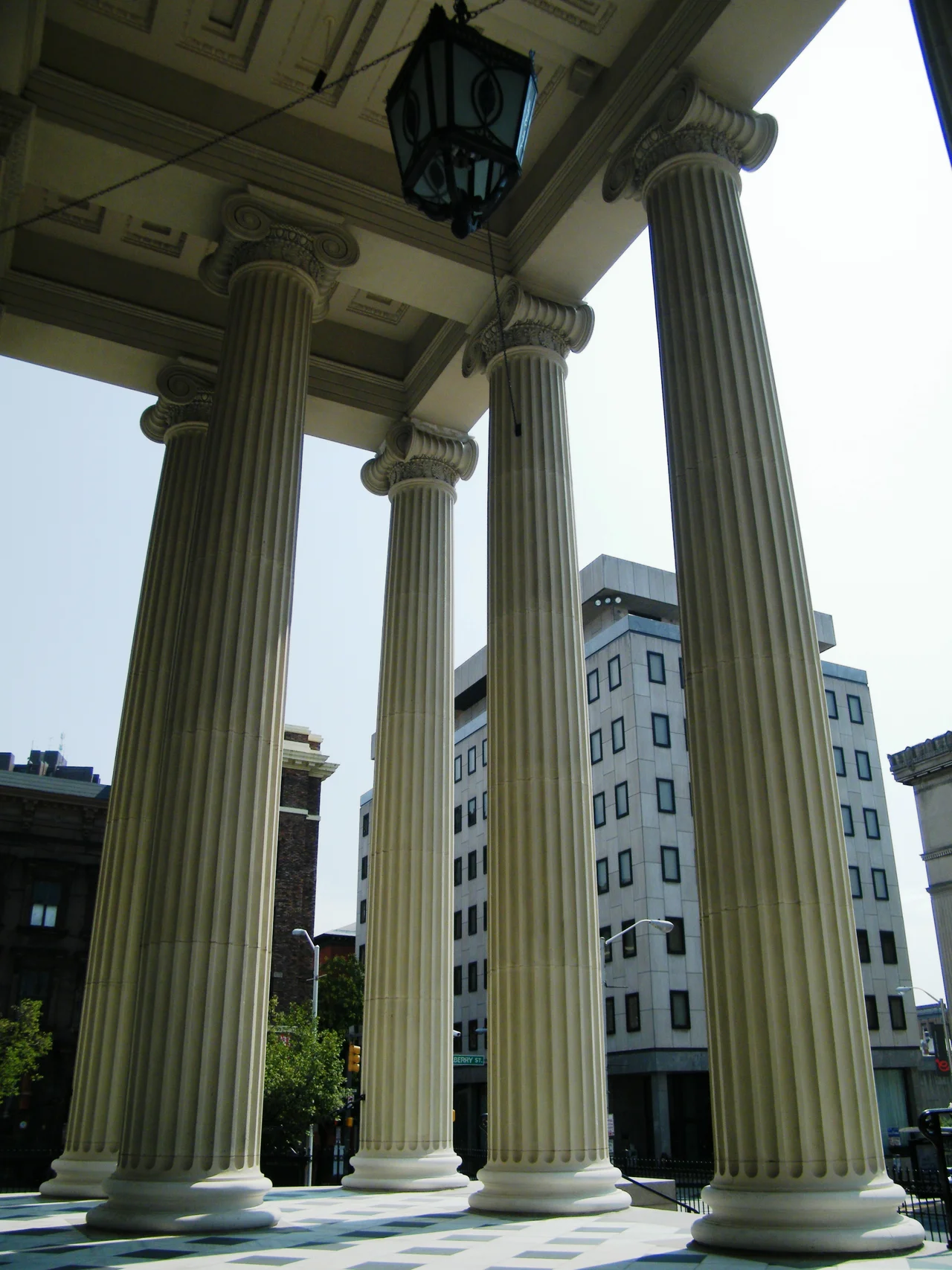

Baltimore Basilica
The two men who designed the Baltimore Basilica had also designed the United States Capitol. Benjamin Henry Latrobe was the country's first professionally trained architect - born in England, educated in Saxony, trained as a draftsman before he ever sailed for America. Thomas Jefferson, who supervised much of the Capitol's work and considered architecture a calling as much as a hobby, was Latrobe's friend, patron, and occasional design collaborator. When Latrobe began designs in 1804 for a Catholic cathedral in Baltimore - the first major Catholic cathedral built in the United States after the founding - Jefferson suggested replacing the planned masonry dome with a wooden double-shell dome inspired by the work of French master builder Philibert Delorme. The change saved structural weight, allowed for twenty-four half-visible skylights to flood the interior with daylight, and gave the building its singular quality: a Catholic church that feels, inside, almost Quaker in its bright simplicity.
John Carroll's Cathedral
The Catholic Church in the newly independent United States was in a complicated position. Until the Revolution, English colonial law had severely restricted Catholic worship in most American colonies. Maryland, founded as a Catholic-friendly colony by the Calverts in 1634, had been an exception, but even there, Catholic political rights were limited for decades. John Carroll became the first Catholic bishop in the United States in 1789, named to the new Diocese of Baltimore - then a diocese that covered the entire country. Carroll, a Maryland-born Jesuit who had been educated in Europe and had served as an emissary to French Canada during the Revolution, was a cousin of Charles Carroll of Carrollton, the only Catholic signer of the Declaration of Independence. Carroll commissioned Latrobe to design what would become the new American Catholic Church's most visible monument. Ground was broken in 1806. Construction continued in fits and starts until 1863. The cathedral was finally consecrated on May 25, 1876, by Archbishop James Roosevelt Bayley.
Latrobe's Light-Filled Interior
Latrobe drew the cathedral as a Latin cross with a massive dome at the crossing, surrounded by a sophisticated system of barrel vaults and shallow, saucer-like secondary domes. The plan creates an unusual centralizing effect inside - what looks from the street like a long oblong building feels, when you stand under the dome, like a circular space. The masonry inner dome has a coffered ceiling with grids of plaster rosettes. The outer wooden dome, the Jefferson suggestion, allowed for the twenty-four skylights that fill the interior with daylight, in deliberate contrast to the dark, cavernous interiors of European Gothic cathedrals. Latrobe and Carroll wanted the Catholic Church in America to feel different - clearer, more rational, less weighed down by centuries of accumulated stone and shadow. Two paintings hang in the church, both gifts from King Louis XVIII of France shortly after the basilica's 1821 opening. One depicts Louis IX of France burying his plague-stricken troops at the start of the Eighth Crusade in 1270.
The First American Catholic Center
Through the 19th century, the basilica was the center of American Catholic ecclesiastical life. Seven Provincial Councils and three Plenary Councils met there - the gatherings of American bishops that shaped how the Catholic Church would organize itself across the expanding country. Most of the first generation of American bishops were consecrated in the basilica to fill the dioceses that multiplied as the country grew. Mother Mary Lange, the Cuban-born woman of African and French descent who founded the Oblate Sisters of Providence in Baltimore in 1829 - the first Catholic religious order for women of African descent in the world - was associated with the basilica. Lange has been declared Venerable by the Catholic Church, an early step toward sainthood. The basilica hosted the funeral Mass of Charles Carroll of Carrollton, the last surviving signer of the Declaration of Independence, in 1832. For decades, more priests were ordained at the Baltimore basilica than at any other Catholic church in the United States.
Restoration
By the late 20th century the basilica had accumulated, in the words of the eventual restoration architects, many misguided accretions. The original wall colors - pale yellow, blue, and rose - had been painted over. The light-colored marble flooring had been replaced with dark green. The twenty-four dome skylights had been blocked and covered. Stained glass windows installed in the 1940s replaced the clear glass Latrobe had designed. A 32-month, $34 million restoration completed in November 2006 under Cardinal William Keeler, the Archbishop of Baltimore, returned the building to Latrobe's design. The skylights were re-opened. The original wall colors were restored. The 1940s stained glass was given to St. Louis parish in Clarksville, whose new church was designed around them. The crypt beneath the main altar was opened to the public. The undercroft, which had been filled with construction sand from the 1806 building campaign, was finally cleared and the Our Lady Seat of Wisdom Chapel that Carroll and Latrobe had originally envisioned was at last realized, more than two centuries after the design.
Earthquakes and Permanence
On August 23, 2011, the magnitude 5.8 earthquake centered in Virginia that closed the Washington Monument also sent nearly 1,000 linear feet of cracks through the basilica's ceilings and walls. A seven-month, $3 million restoration was completed on Easter Sunday 2012. The basilica still serves as one of the two co-cathedrals of the Archdiocese of Baltimore - the other is the modern Cathedral of Mary Our Queen north of downtown - and remains a parish church and minor basilica. Nine of the fourteen deceased archbishops of Baltimore are interred in the crypt beneath the main altar, including John Carroll himself, who died in 1815 while construction was still underway. The historic pipe organ, originally built by Thomas Hall in 1821 and rebuilt several times since, was played in recital at the Organ Historical Society Convention in July 2024. The basilica was added to the National Register of Historic Places on October 1, 1969 - a designation that recognizes what Latrobe and Jefferson built more than two centuries earlier as a uniquely American Catholic place, made when neither the country nor its Catholic church quite knew what they would become.
From the Air
The Baltimore Basilica is located at approximately 39.297 N, 76.617 W on Cathedral Street in midtown Baltimore, across the street from the Enoch Pratt Free Library. The site sits well outside both the Washington Flight Restricted Zone and the Special Flight Rules Area. BWI Marshall (KBWI) is 10 miles southwest. Martin State Airport (KMTN) is 6 miles east. From altitude, the basilica is identifiable as a low neoclassical building with a distinctive shallow copper-clad dome flanked by two square bell towers, immediately north of the Mount Vernon Place historic district and Washington Monument.
Nearby Stories
- Takoma Park, Maryland 5.2 km away
- Annapolis 5.5 km away
- Adkins Arboretum 7.8 km away
- Murders of Katherine and Sheila Lyon 28 km away
- Fort Delaware: The Island Prison Where 33,000 Confederates Waited Out the War 32 km away
- Battle of Gettysburg 35 km away
- Memorial Hall (Delaware State) 36 km away
- Three Mile Island: The Accident That Stopped Nuclear America 71 km away