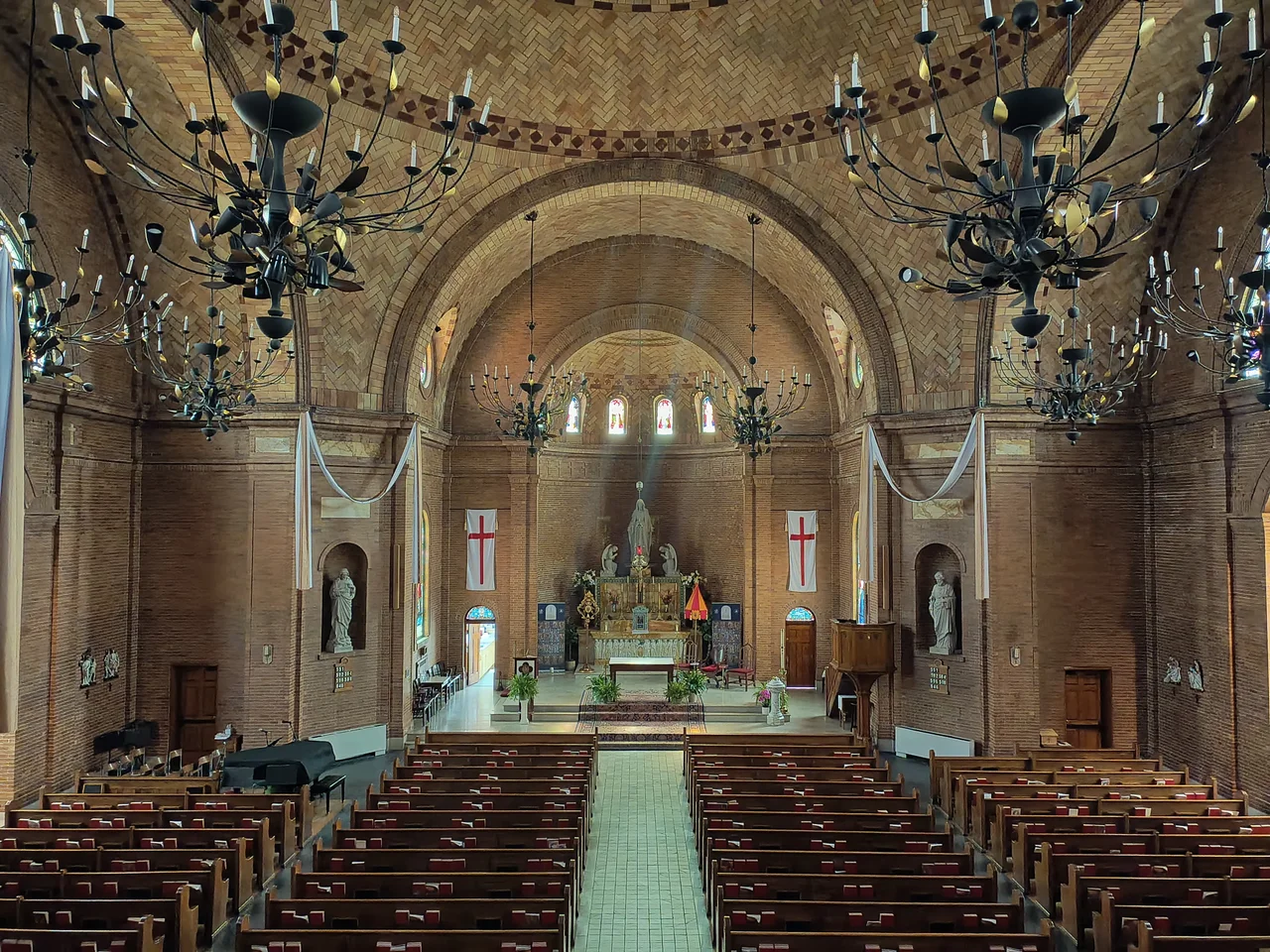

Basilica Shrine of St. Mary
There are no nails in this church. No wooden beams, no steel girders. The whole structure, dome and arches and vaulted ceilings, is built of interlocking terra cotta tile, set in a way that the building actually gets stronger under its own weight. The architect was Rafael Guastavino, a Spanish-born tile genius whose vaulting holds up Grand Central Terminal, Ellis Island's Registry Room, and the Boston Public Library reading room. The Basilica Shrine of St. Mary, completed in 1912, is one of his late masterworks. Step inside, look up, and you are looking at engineering nobody else has ever quite figured out how to repeat.
Guastavino, the Tile Man
Rafael Guastavino y Moreno emigrated from Valencia, Spain, to New York in 1881, carrying with him a Catalan vaulting technique that had been used in Mediterranean churches for centuries. His version, patented as the Guastavino Tile Arch System, used thin terra cotta tiles laid in overlapping layers with a quick-setting Portland cement. The geometry of the curves did the structural work. The tiles themselves were lightweight and fireproof. By the time Guastavino died in 1908, his firm had built or contributed to more than a thousand projects across the United States. His son, also Rafael, ran the company through its golden age and oversaw the construction in Wilmington. The Basilica Shrine of St. Mary, dedicated in 1912, is one of the firm's full church commissions rather than a vaulted ceiling within someone else's building. The Spanish Baroque facade, the dome, the deep arches around the sanctuary, all of it is the Guastavino system.
Inside
Walk in on a weekday and the church is usually empty enough that you can hear your own footsteps on the marble. The acoustics are extraordinary, dry but full, designed by accident as a byproduct of the curved tile surfaces. Sunlight catches the gilt detail on the high altar. The dome above the crossing is what you keep looking back at, the way the tile pattern radiates from a center point and arches downward to the supporting walls without any visible structure holding it up. There is something almost mathematical about the calm of the room. The Catholic Diocese of Raleigh elevated the church to the status of minor basilica in 2013, recognition reserved for churches of special historical or architectural significance. The Wilmington Historic District, which includes the basilica, was added to the National Register of Historic Places in 1974.
The School and Its Sisters
Long before the basilica itself was built, the parish was already teaching children. The Sisters of Our Lady of Mercy founded a school here in 1869 at the request of Bishop James Gibbons, who would later become a cardinal and one of the most influential American Catholic leaders of his era. They called it the Academy of the Incarnation. A separate school for poor girls, St. Peter's Parochial School for Girls, opened around the same time. The Sisters of Mercy taught in Wilmington through the Reconstruction era and into the 20th century, a period when access to education in the South was uneven, segregated by both race and class, and often dependent on which religious order would commit teachers and money to the work. The original schools have closed, but the parish still runs St. Mary Catholic School, serving children from kindergarten through eighth grade in the buildings beside the basilica.
A Working Parish
For all its architectural fame, the basilica is foremost a working parish church. Masses run multiple times daily. Confessions are heard on schedule. Couples get married under the dome and bury their parents from it. Wilmington's Catholic community has roots here that go back to the 1840s, when the city's first permanent Catholic congregation organized in a small wooden church on this same site. The 1912 building replaced earlier structures, and the rhythm of a downtown parish has continued, more or less without break, ever since. The basilica sits two blocks from the river, in the middle of a neighborhood whose streetscape has barely changed since the 1920s. Walk Fifth Avenue at dusk and the dome glows pale against the sky, a small Mediterranean shape dropped into the Carolina coastal plain.
From the Air
The Basilica Shrine of St. Mary sits at 34.232 N, 77.943 W in downtown Wilmington, two blocks east of the Cape Fear River. From 1,500-3,000 feet AGL the dome reads as a small pale hemisphere amid the older grid of downtown Wilmington streets, between Fourth and Fifth Avenue. Wilmington International (KILM) lies about 5 miles north.
Nearby Stories
- Ocean Isle Beach house fire 4.7 km away
- Pender County, North Carolina 6.6 km away
- Bald Head Island 13 km away
- Marine Corps Base Camp Lejeune 16 km away
- Lake Waccamaw, North Carolina 17 km away
- The Robesonian Takeover 59 km away
- Swansboro 59 km away
- Mercury-Redstone 4 726 km away