
Battle of Alnwick (1093)
Malcolm III of Scotland had besieged English towns before and walked away unharmed. He had marched on Durham in 1091 with William Rufus chasing him north into Scotland, and a truce had been negotiated, and he had gone home. In November 1093, leading another invasion of Northumbria, he settled his army in front of the small castle at Alnwick and began the siege his successors expected him to complete. He had reason to think the campaign would go his way. Robert de Mowbray, the new Earl of Northumbria, did not have nearly enough men to fight him in open battle. What Mowbray had instead was speed, surprise, and the autumn fog of north Northumberland on the morning of St Brice's Day. Malcolm and his eldest son both died that day in front of the ramparts. The Scottish army went home leaderless.
The Border in 1093
Control of Northumbria, in the late eleventh century, was still genuinely an open question. The Norman kings of England held London comfortably enough, but the long border country between the Tweed and the Tyne was contested ground. William Rufus, the son of the Conqueror, tried to settle the matter by installing strong barons along the frontier. Malcolm Canmore, king of Scots, had ambitions of his own that ran south from the Forth into both Cumbria and Northumbria. The two kings had spent the past two years circling each other. A truce had been negotiated in 1091. William had spent 1092 strengthening his hold on Cumbria. Malcolm, for reasons no chronicler quite explains, decided in November 1093 to invade again. He led his army across the Tweed, marched south, and arrived at Alnwick to besiege a castle that the Vesci family had built from timber only a few decades earlier.
Mowbray's Decision
Robert de Mowbray, Earl of Northumbria, was governor of Bamburgh Castle on the coast and had been pardoned for his role in the 1088 rebellion against William Rufus. He was the man on the spot. He could see, plainly, that he had nowhere near the men he needed to meet Malcolm's army in pitched battle. The orthodox response was to wait, send for reinforcements, and hope the besieged garrison at Alnwick could hold. Mowbray made a different calculation. He gathered every knight he could find and rode north. He arrived in front of the ramparts on 13 November, the feast day of St Brice. The Scottish army, expecting a siege rather than a relief column, was not arrayed for battle. Mowbray's knights charged into them.
Malcolm's Spring
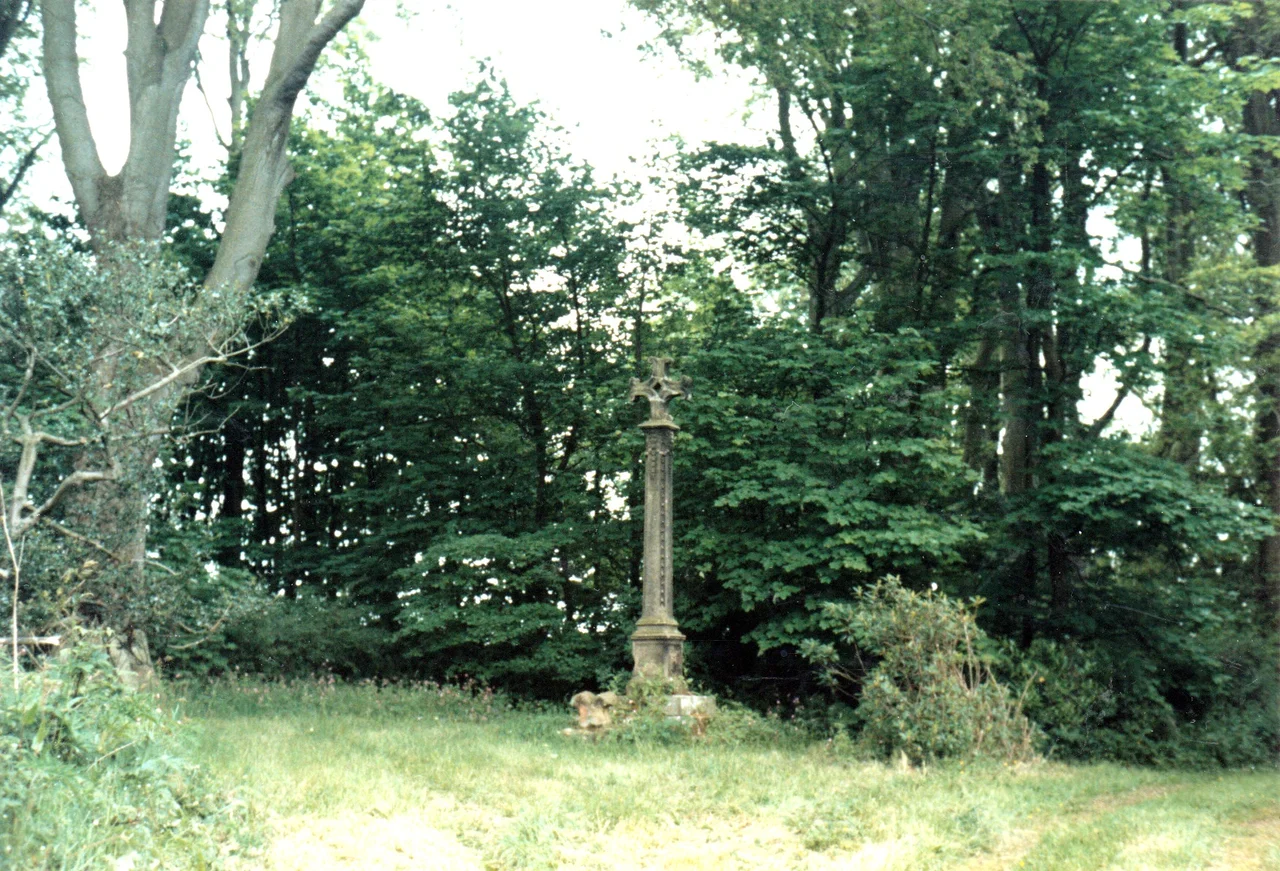
The fighting was brief and very bad for Scotland. Malcolm Canmore was killed somewhere near a spring on the north side of the town. His eldest son Edward was killed in the same action. The spring became known as Malcolm's Spring or Malcolm's Well, the kind of folk memory that outlasts paperwork. The Scottish army discovered itself to be leaderless and made the long march home without orders. Mowbray's men interred Malcolm and Edward at Tynemouth Priory on the coast, although later chroniclers disagree on whether Malcolm's body was eventually moved to Dunfermline Abbey to lie among other kings of Scots. A rough stone marked the place of the battle for centuries. In 1774 the Duchess of Northumberland replaced it with a more elaborate monument called Malcolm's Cross, which still stands on Broomhouse Hill across the river from Alnwick Castle.
Aftermath
Malcolm's queen, Margaret of Scotland, died within days of hearing the news. The Scottish throne, suddenly without its dominant figure and his heir, fell into a succession crisis that benefited William Rufus enormously. Malcolm's surviving sons and his younger brother Donald Bane fought a civil war over the next several years. Donald took the throne; Malcolm's sons tried to displace him. The instability suited the English crown perfectly. Robert de Mowbray, who had won the battle, did not enjoy his rewards for long. In 1095 he joined a baronial conspiracy against William Rufus, was defeated, dispossessed of his earldom, and imprisoned for the rest of his life. The battle that he won by riding hard and reading his enemy correctly turned out to have been the high point of his career.
From the Air
The 1093 battlefield lies at 55.43 degrees north, 1.70 degrees west, on the north side of Alnwick, just across the River Aln from the castle. Malcolm's Cross still marks the traditional site on Broomhouse Hill. From the air the broad shoulder of land north of the river and the castle's grey curtain walls below give a clear visual context. Newcastle International (EGNT) is roughly 35 miles south. The A1 runs just west of the battlefield. Best viewing at medium altitudes in clear conditions; the meandering Aln and the bowl of farmland north of town make the geography easy to read.
Nearby Stories
- Ashington 1.8 km away
- Cheviot Hills 3.4 km away
- Battle of Nesbit Moor (1402) 12 km away
- Hadrian's Wall Path 18 km away
- Berwick-upon-Tweed Lifeboat Station 27 km away
- Saltburn Pier 68 km away
- German submarine U-2367 84 km away
- Alexander L. Kielland (Platform) 271 km away