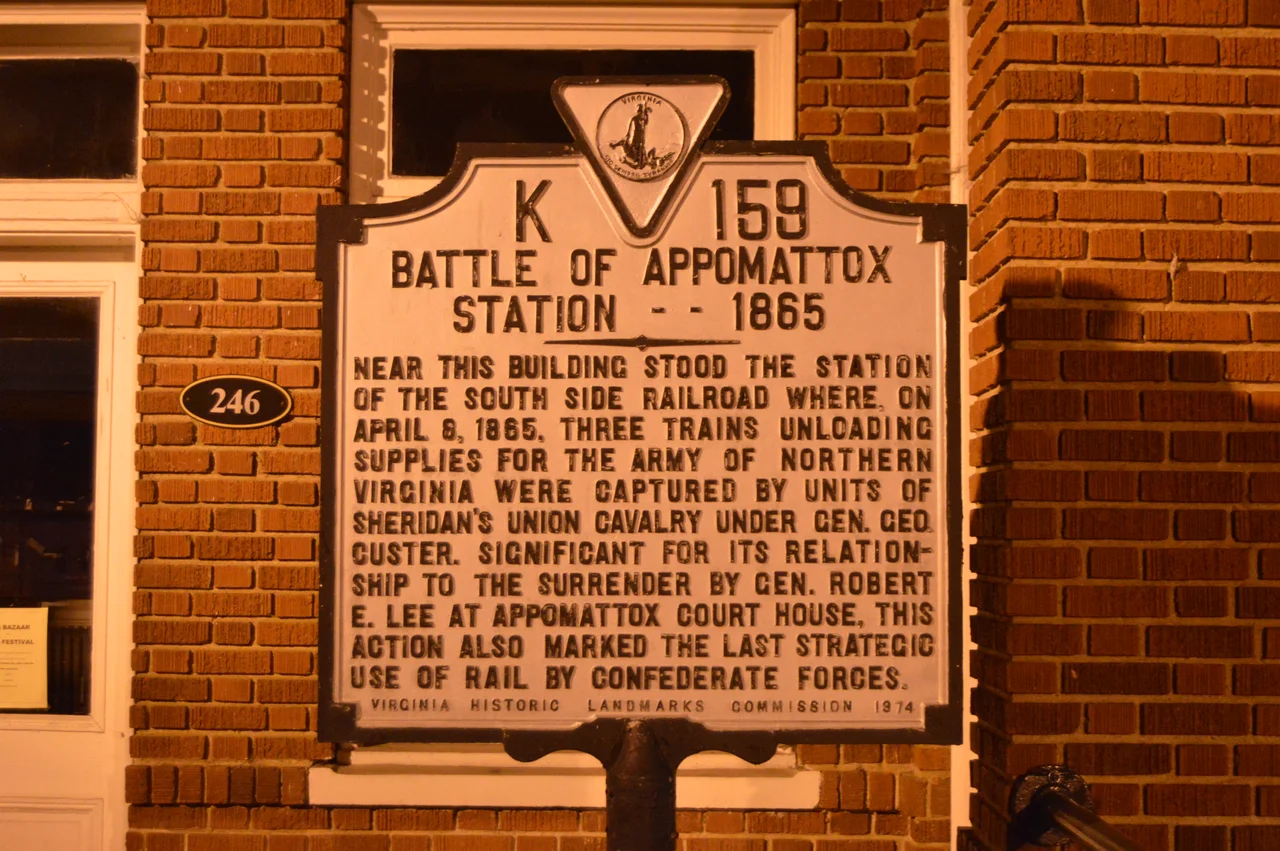

Battle of Appomattox Station
By the afternoon of April 8, 1865, the soldiers of the Army of Northern Virginia had not eaten in nearly two days. Lee's surviving rations - cornmeal, salt pork, ammunition for guns that had no place to fire - were sitting on four trains at a small railroad stop called Appomattox Station, sent up from Lynchburg in answer to Lee's desperate order. Between those trains and the rest of Lee's army stood twenty-eight miles, the Union cavalry of Philip Sheridan, and the impatience of a brigadier general named George Armstrong Custer who could smell the end of the war. The Battle of Appomattox Station is one of the least famous engagements of the American Civil War. It was also, in the most literal sense, the last fight that decided the war's outcome.
A Long Ride West
After the disaster at Sailor's Creek on April 6 and the smaller fight at Cumberland Church on April 7, Lee's army was bleeding men with every mile. Roads were mud. Horses were dying in the traces. The Confederate supply system had been reduced to a single hope: trains from Lynchburg meeting the army at Appomattox Station. Sheridan's Federal cavalry, riding parallel and south, learned of those trains from scouts in Confederate uniform who intercepted the supply order. On April 8, Sheridan ordered his cavalry to ride about thirty miles in a single day to seize the station before Lee's exhausted infantry could arrive. Custer's division led the column.
The Trains Surrender Themselves
Between two and three in the afternoon, the lead troopers of Company K, 2nd New York Cavalry trotted into Appomattox Station and found four trains sitting unguarded - locomotives still hissing, cars half-unloaded with rations, ordnance, shoes, blankets, and medical supplies. The astonished crews surrendered without a shot. Union troopers with railroad experience climbed into the cabs and ran three of the trains east into Federal lines. A fourth locomotive escaped toward Lynchburg before the tracks could be cut. The car or two that did not get away were burned. In thirty minutes, the Army of Northern Virginia's last meal had been driven into Union camps.
Walker's Artillery Park
Two miles north along the Lynchburg stage road, Confederate Brigadier General Lindsay Walker had parked the Third Corps reserve artillery - about a hundred guns in total, with twenty-five arranged in a defensive semicircle and the rest still in their wagon traces. Walker's guard was thin: five hundred dismounted cavalrymen under Martin Gary, gunners hastily armed with muskets, engineers, and stragglers picked up on the march. When Walker heard Custer's troopers at the station, he opened fire with his arrayed guns. Custer turned his division and rode toward the sound. The intervening woods were thick. The afternoon was sliding into evening. Custer's first three charges were beaten back by canister and rifle fire.
Moonlight at Nine O'Clock
Custer was not a patient general. As darkness fell, he reorganized all three of his brigades for a single mass assault. At about 9 p.m., under the light of a full moon, the entire division charged together. The Confederate semicircle finally broke. Walker's gunners, with no infantry support left and the artillery horses panicking, began to limber up and pull guns away into the night. Custer's troopers took roughly 1,000 prisoners, including the ill Confederate Brigadier General Young Marshall Moody, captured in a hospital wagon. They seized about thirty guns. Union losses were strikingly small in numbers - five killed, forty wounded, three missing - but the wounded suffered severely from artillery fire at close range. Cavalry surgeons remarked afterward that they had rarely treated so many mangled cases in so brief a fight.
The Last Door Closes
After the breakthrough, Custer's troopers pushed east toward Appomattox Court House and ran into Confederate infantry pickets in the dark. They stopped, dug in, and formed a blocking line across the road to Lynchburg. Sheridan sent word back to Grant: he was certain the army could be surrounded and forced to surrender in the morning if infantry could come up fast enough. Behind Custer's tired troopers, two corps of Union infantry under Edward Ord and Charles Griffin were marching all night - some of Ord's men, including two brigades of African-American troops of the XXV Corps, would march farther that day than any other Union unit. By dawn on April 9, Lee's army was effectively surrounded. The road to Lynchburg, the road to Danville, every road west - all closed. A few hours later Lee rode to Wilmer McLean's parlor to ask Grant for terms. The shots fired at Appomattox Station the night before were the last gunfire the Army of Northern Virginia would meaningfully exchange.
From the Air
Located near 37.36 degrees N, 78.83 degrees W, at the town of Appomattox in central Virginia. The battle ranged from the railroad station northeast about two miles to the Confederate artillery park along the Lynchburg stage road, and then east toward Appomattox Court House National Historical Park (37.38 N, 78.80 W). The site is now within or adjacent to the town of Appomattox and surrounding farmland. Nearest airport is Lynchburg Regional (KLYH) about 18 miles west. Best viewed at 2,500 to 4,000 feet AGL, ideally on a clear spring evening when the same light conditions of the actual battle can be glimpsed.
Nearby Stories
- Battle of Cumberland Church 1.3 km away
- Red Hill Patrick Henry National Memorial 6.9 km away
- National D-Day Memorial 7.8 km away
- Smith Mountain Lake 9.1 km away
- Fork Union Military Academy 20 km away
- 2023 Virginia Cessna Citation Crash 38 km away
- Alleghany County, Virginia 52 km away
- Long Grass Plantation 60 km away