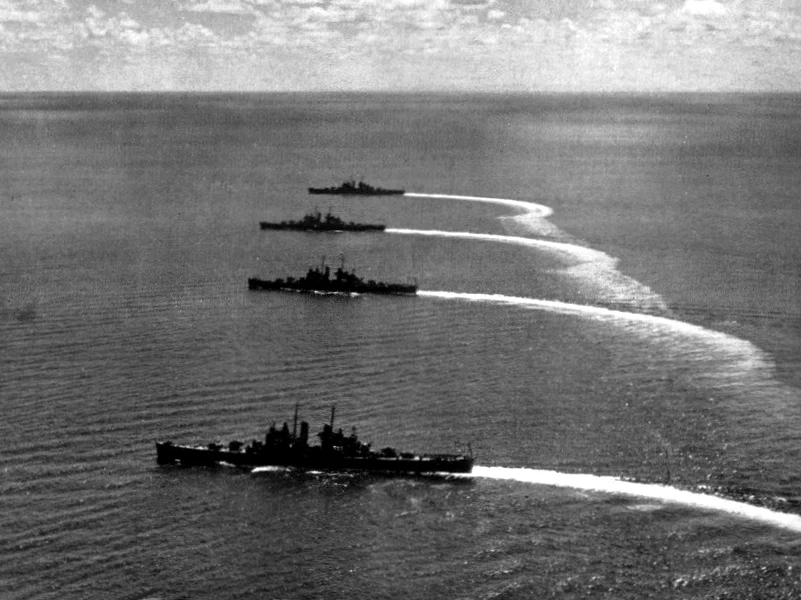

Battle of Blackett Strait
At 01:15 on the morning of 6 March 1943, the Japanese destroyer Murasame exploded so violently that American sailors twenty-five miles away, off Munda, heard the detonation roll across the black water. She had been running a routine supply mission through the Blackett Strait - the kind of night job Imperial Japanese destroyers had performed dozens of times in the Solomons - when the radar screens of an American cruiser force painted her onto the cathode glass without warning. Two ships went in. Neither came out. The battle lasted minutes, but the waters between Kolombangara and Arundel Island would remain infamous for the rest of the Pacific War.
Where the Slot Narrows
Blackett Strait is not a strait so much as a squeeze - the narrow passage where the central Solomon Islands pinch together, with Kolombangara's volcanic cone rising steeply to the north and flat Arundel Island hugging the south. In early 1943, this geography mattered more than almost anywhere else in the Pacific. The Japanese had built a seaplane base at Vila on Kolombangara's southern coast, and an airstrip at Munda on New Georgia, and they kept both supplied by sending destroyers down at night from their main fortress at Rabaul. American planners called the larger corridor the Slot. They called the nightly runs of Japanese resupply ships the Tokyo Express. Blackett Strait was one of its shortcuts home.
Radar Over Moonlight
On the night of 5 March 1943, the destroyers Murasame and Minegumo had finished unloading at Vila and chosen the shorter return route through the Kula Gulf. They did not know that Rear Admiral Aaron Merrill's Task Group 68.5 - three light cruisers and three destroyers - was steaming into the same waters, tasked with shelling Vila's shore facilities. The Americans had SG surface-search radar; the Japanese did not. When the cruiser Montpelier's radar returns resolved into two fast-moving pips, Merrill's force already had a firing solution. The opening salvo straddled Murasame. Six salvos in, she was burning. The destroyer Waller fired five torpedoes and one found its mark. Murasame broke apart and went down before Minegumo's captain could finish giving orders. The Americans then shifted fire to Minegumo and sank her too, all before the Japanese could release a single torpedo in reply.
The Night After
The bombardment of Vila proceeded as planned. American ships steamed away toward their base having lost not a man. For the Imperial Japanese Navy, which had dominated night battles in these same waters the previous year through superior optics and the lethal Long Lance torpedo, the engagement was a shock. Radar had changed everything. Over the next months, Allied aircraft began sowing mines throughout the northern Solomons - torpedo bombers planting steel fruit in the same passages the Tokyo Express needed to use. The strategic picture shifted. The Japanese could still reinforce Rabaul, but every run grew harder, slower, and costlier.
PT-109 in the Same Water
Five months later, in the same Blackett Strait, an American patrol torpedo boat idled with engines barely turning over, trying to keep her wake invisible to Japanese floatplanes hunting above. The destroyer Amagiri - returning from yet another supply run - came out of the darkness and ran her down. The PT boat was cut in half. The lieutenant commanding her, John F. Kennedy, gathered his surviving crew onto the shattered bow, then led them swimming to a tiny island. Two Solomon Islander scouts named Biuku Gasa and Eroni Kumana found them. Gasa and Kumana ferried a coconut carved with a rescue message through Japanese-patrolled waters, and the crew came home. Decades later, Kennedy would keep that coconut on his Oval Office desk. The man who found him lived in the Solomons until 2014.
Quiet Water
Today Blackett Strait runs blue and calm between Kolombangara's forested slopes and Arundel's low green shore. Dive charters pass over the wrecks of Murasame and Minegumo; local fishermen know the spots. The villages along the shoreline remember, in the way small island places remember - through stories passed down, through the occasional rusted Japanese helmet pulled from a garden, through the fact that some of the elders were there. It is not a place you pass through without feeling the water has a longer memory than the land.
From the Air
The Battle of Blackett Strait site lies between Kolombangara and Arundel Island in the Western Province of Solomon Islands (approximately 8.0 degrees S, 157.1 degrees E - note the source article's stored coordinates place the article in the Rabaul area; the actual strait is in the central Solomons). The nearest operational airport is Munda Airport (ICAO: AGGM) on New Georgia, the same airstrip the 1943 bombardment targeted in its Japanese form. Best viewing altitude is 3,000 to 5,000 feet to see the compression of the passage between Kolombangara's 1,770-meter volcanic cone and Arundel's low profile. Typical weather is warm, humid, with afternoon cumulus over the Kolombangara volcano. Visibility generally good in the morning.
Nearby Stories
- Battle of Bita Paka 39 km away
- Landing at Jacquinot Bay 53 km away
- Ulawun 60 km away
- Operation RY 97 km away
- New Ireland 139 km away
- Battle of the Green Islands 140 km away
- Japanese cruiser Sendai 184 km away
- Kimbe 251 km away