
Battle of Carnifex Ferry
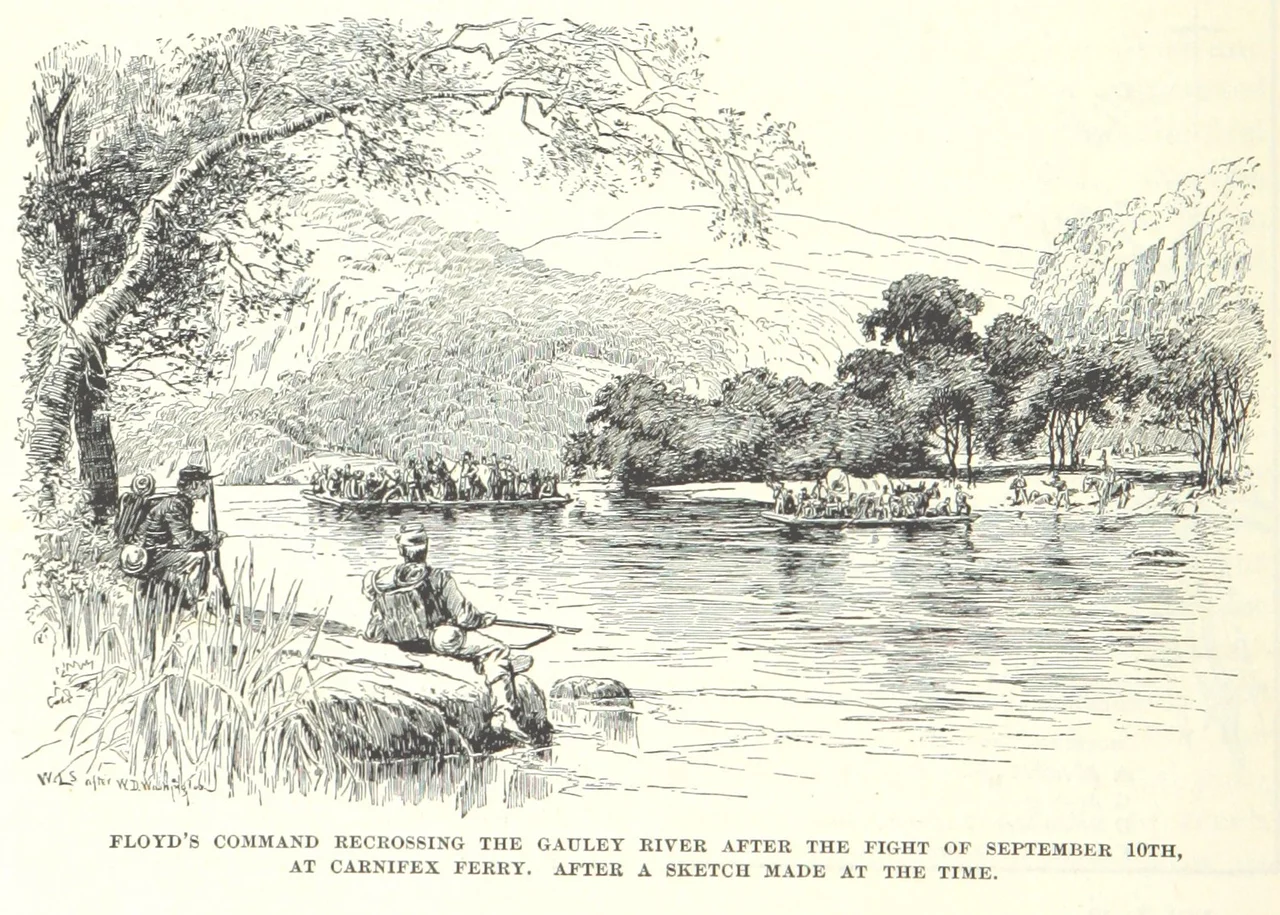
On the afternoon of September 10, 1861, three Union brigades under Brigadier General William S. Rosecrans crested a ridge on the Patteson farm above the Gauley River and saw what they had marched all night from Clarksburg to find: Confederate breastworks, freshly thrown up, manned by John B. Floyd's troops. Rosecrans attacked. The Federals lost more men than the Confederates that afternoon, but when night fell, Floyd made a decision that determined more than just the day's outcome. He ordered his soldiers to slip down the ferry road to the Gauley River and cross to the south bank. By dawn the Confederate position on the rim was empty. Carnifex Ferry became a strategic Union victory that helped clear western Virginia of Confederate forces and set the stage for the creation of West Virginia two years later.
The Setup
The summer of 1861 was the Confederacy's first attempt to hold the western counties of Virginia, where Unionist sentiment ran strong. In late August, Brigadier General John B. Floyd - a former Secretary of War whose departure from Buchanan's cabinet had embittered Northerners - led his command across the Gauley River and surprised the inexperienced 7th Ohio Infantry under Colonel Erastus Tyler at Kessler's Cross Lanes. The Ohioans were routed. Floyd camped near Carnifex Ferry, the river crossing named for the local Carnefix family that had operated it. His men began entrenching on the Henry Patteson farm, perched on the rim of the Gauley River Canyon a few miles south of Summersville. The Patteson farm sat on a piece of ground that was easy to defend in one direction but had a long, exposed escape route behind it - down the ferry road to the river.
Rosecrans Comes South
William S. Rosecrans, a 42-year-old West Pointer who would later become one of the most prominent Union commanders in the western theater, was concerned that Floyd's drive aimed at the Kanawha Valley itself. He gathered three brigades of infantry at Clarksburg and marched them hard down the rough mountain roads of central western Virginia. By the morning of September 10, his column had reached Tyler's regrouped Ohio regiment near Cross Lanes. By early afternoon they were closing on Floyd's entrenched position. Rosecrans deployed his brigades. He chose to attack rather than to wait, partly because he did not know Floyd's exact strength and partly because the late-summer light was already fading. The first Federal assaults went forward in mid-afternoon. Confederate fire from the breastworks broke them up. Three more attempts followed. None broke through.
The Night Crossing
On the field itself, the day belonged to Floyd. Union casualties exceeded Confederate. But Rosecrans had brought a significantly larger army, and crucially he had brought artillery that the Confederates could not match. As darkness settled in, Floyd realized that the next morning's fight would not favor him. The Federal guns could be repositioned to enfilade his works, and his only line of retreat ran across a single ferry crossing of a deep gorge. Sometime after midnight, Floyd ordered his men to abandon the entrenchments, march down to the Gauley, and cross to the south bank by ferry. The operation was accomplished without serious Federal interference. By dawn, Rosecrans's troops occupied the empty breastworks. Floyd retreated eastward to Meadow Bluff near Lewisburg, where he promptly began trying to blame the defeat on his co-commander Henry A. Wise. The dissension in the Confederate western Virginia command, already real, deepened.
What It Set in Motion
Carnifex Ferry did not end the war in western Virginia, but it broke the Confederate offensive of 1861. By the end of October, Federal forces had pushed Confederate units back across the mountains toward the Shenandoah Valley. With the western counties firmly in Union hands, the political process of separating them from Virginia could proceed. On June 20, 1863, West Virginia was admitted to the Union as the 35th state. The Patteson farm itself, where Floyd's breastworks ran along the canyon rim, was preserved in October 1935 as Carnifex Ferry Battlefield State Park. Visitors today can walk the same ridge that Rosecrans's men attacked, look down at the Gauley River where Floyd's men descended in darkness, and read interpretive markers describing one of the small but pivotal early battles of the Civil War.
From the Air
The Carnifex Ferry battlefield centers on the Patteson farm at 38.21 N, 80.94 W, on the north rim of the Gauley River Canyon in Nicholas County, West Virginia, a few miles south of Summersville. Recommended viewing altitude is 2,500 to 4,500 feet AGL. The Gauley River canyon and the open meadows of the state park are visible from the air. WV Route 129 runs to the park entrance. Nearest airports are Summersville Lake Airport (KSXL) about 8 miles north and Yeager (KCRW) in Charleston about 45 miles west.
Nearby Stories
- New River Gorge National Park and Preserve 4.2 km away
- Greenbrier County, West Virginia 5.5 km away
- End of the World Turn 7.9 km away
- Kanawha State Forest 8.8 km away
- Webster Sycamore 13 km away
- Cranberry Wilderness 16 km away
- Buffalo Creek Flood 21 km away
- Battle of Winfield 29 km away