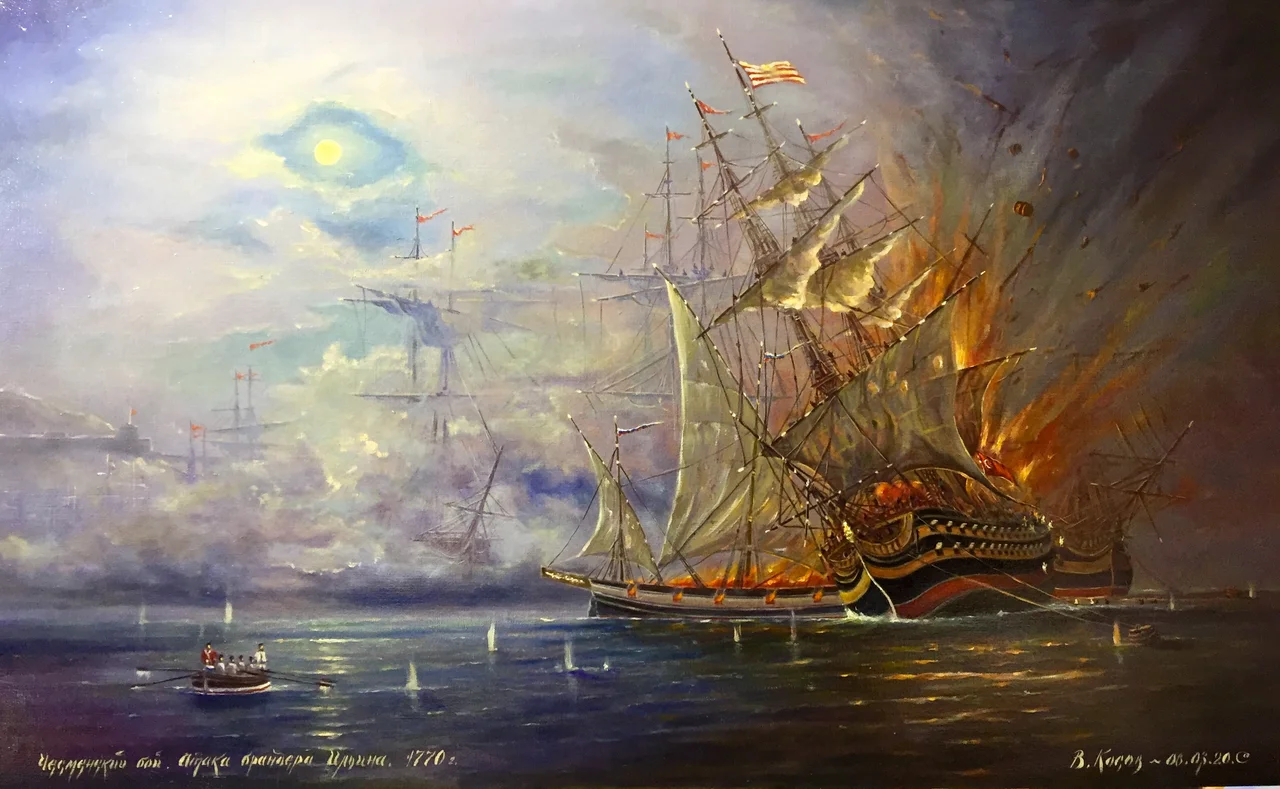

Battle of Chesma
There is a stretch of water barely seven kilometers wide between the eastern shore of Chios and the Anatolian mainland, and on the night of 6–7 July 1770, that water turned to fire. The Ottoman fleet had crowded into the small bay at Çeşme, ships packed hull to hull for safety. By dawn almost nothing was left of it. Around ten thousand Ottoman sailors died there in a few dark hours, most of them trapped aboard wooden ships that the flames reached faster than any man could swim. It was the worst defeat the Ottoman navy had suffered in two centuries, and it began with a single spark carried by a single small boat.
Two Fleets Find Each Other
The war had started in 1768, and Catherine the Great's strategy was audacious: sail Russian squadrons all the way from the Baltic, around Europe, into the Mediterranean, to threaten the Ottomans from a sea they thought was theirs. Two squadrons under Admiral Grigory Spiridov and the British-born Rear Admiral John Elphinstone joined under Count Alexei Orlov and went hunting. On 5 July 1770 they found their quarry anchored north of Çeşme Bay: roughly fourteen ships of the line, frigates, galleys, and small craft, some 1,300 guns in all, commanded by Kapudan Pasha Mandalzade Hüsameddin. The first day's clash was brutal and confused. Spiridov's flagship Sviatoi Evstafii grappled with the Ottoman Real Mustafa; when the burning Ottoman ship's mast crashed onto the Russian deck, both vessels blew apart. Of the Russians, 636 men died on Sviatoi Evstafii alone.
The Night the Bay Burned
The Ottomans retreated into the bay itself, anchoring in tight defensive lines. It was meant to be protection. It became a trap. Through the day of 6 July the Russians bombarded the crowded ships. Then, after midnight, they pressed in close. Gunfire from the ships Grom and Ne Tron Menya set an Ottoman vessel's topsail alight, and the fire leapt from rigging to rigging across the packed fleet. Into this Samuel Greig sent fireships — vessels deliberately set ablaze and steered into the enemy. One reached its target and the flames spread further still. There was nowhere for the Ottoman sailors to go. The ships were wedged together; the bay was narrow; the night was lit orange from shore to shore. By morning almost the entire Ottoman fleet was ash on the water.
Ten Thousand Names Unrecorded
The numbers are stark and they belong to real people. Russian losses were counted in the hundreds. Ottoman losses ran to roughly ten thousand sailors dead — ordinary men, conscripts and crew, most of whom never had a chance to fight back. They were not statistics to the families who waited for them in ports across the empire. Only one large Ottoman ship of the line, Semend-i Bahri, and a handful of galleys survived to be captured. The commanders — Hüsameddin, Hasan Pasha, Cafer Bey — lived; the men who served them mostly did not. It is worth pausing over that gap. The painters who later celebrated the night, the columns Catherine raised in St. Petersburg, none of them recorded the names of the dead.
What the Fire Set in Motion
Chesma was the greatest naval disaster the Ottomans had known since Lepanto in 1571, and its consequences spread far beyond the bay. Russia controlled the Aegean for the next five years and returned to bombard Çeşme twice more. The defeat emboldened Orthodox Christian populations across the Balkans toward rebellion. But the violence also rebounded cruelly on innocents: in the aftermath, mobs in nearby Smyrna massacred around 1,500 local Greeks. Catherine the Great built monuments to her triumph — a palace, a church, an obelisk, a column at Tsarskoe Selo. Today Russia still marks Chesma as a Day of Military Honour. The narrow strait off Chios, so often a place of beauty, keeps the memory of one of the deadliest nights in the history of naval war.
From the Air
The battle site lies in Çeşme Bay at roughly 38.33°N, 26.29°E, in the strait between the eastern coast of Chios and the Anatolian mainland of Türkiye. The bay is a shallow inlet on the Turkish side, with the resort town of Çeşme visible at its head. Chios International Airport (LGHI) sits about 20 km west on the Greek island; İzmir Adnan Menderes (LTBJ) lies roughly 70 km to the east. A viewing altitude of 3,000–5,000 ft over the strait reveals how narrow the water is — the geography that turned a defensive anchorage into a trap. Summer skies here are typically clear with strong afternoon meltemi winds from the north.
Nearby Stories
- Psara 18 km away
- Battle of the Oinousses Islands 28 km away
- St. Helena Church 35 km away
- Battle of Corycus 35 km away
- Greek Islands 60 km away
- Temple of Artemis at Ephesus 61 km away
- Adramyttium 94 km away
- Skyros 101 km away