
Battle of Good's Farm
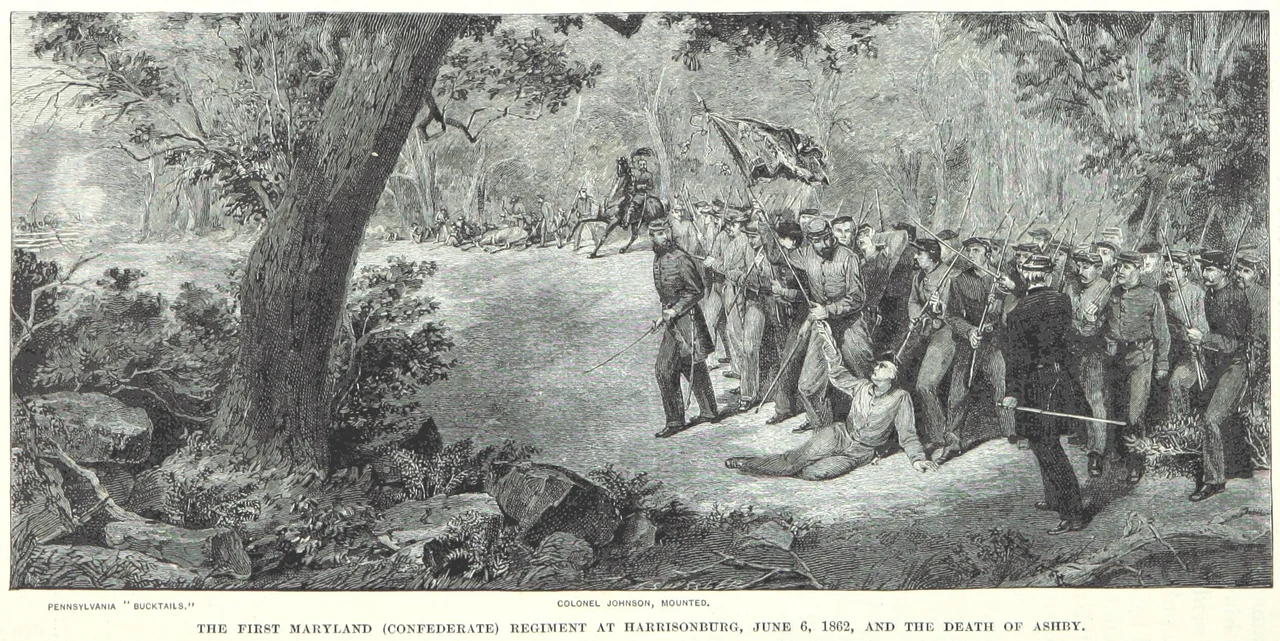
Turner Ashby had been appointed brigadier general just two weeks earlier. He was 33, the most celebrated Confederate cavalry officer in the Shenandoah Valley, the man Stonewall Jackson relied on to screen his army's movements and confuse Union pursuers. On June 6, 1862, on a farm just outside Harrisonburg called Good's Farm, his horse was shot out from under him. Ashby got up, drew his sword, and moved forward on foot to rally the men of his line. "Forward my brave men!" he shouted - and then a bullet went directly through his heart. Whose bullet it was has never been settled. The skirmish itself was minor. The death of Turner Ashby was not.
A Trap on the Road
On the morning of June 6, 1862, a company of the 1st New Jersey Cavalry pursued Confederate scouts from Harrisonburg out toward Good's Farm. The scouts were bait. Infantry of the 58th Virginia waited behind stone walls on either side of the road. When the Union horsemen reached the ambush point, the rifles came up. The Jersey cavalry pulled back and notified Colonel Percy Wyndham, who brought up reinforcements and charged a wooded hill where Ashby's 7th Virginia Cavalry had blocked the road. Wyndham dismounted to lead his men into the trees, but the concealed Confederate infantry caught them in another fusillade, and Ashby's cavalry began flanking them. The Jersey troopers broke in a disorganized retreat. They left behind Wyndham, three captains, and a portion of their men - along with their regimental colors.
The Bucktails
Colonel Thomas L. Kane of the 13th Pennsylvania Reserves - the Bucktails, named for the deer tails they wore in their hats - received permission from Brigadier General George D. Bayard to advance and rescue the wounded. Bayard brought up cavalry and infantry together. From a vantage point, he watched Confederate reinforcements from the 1st Maryland Infantry arrive and ordered the cavalry to fall back. He sent a messenger to Kane, who had already entered the woods. The Bucktails took position behind trees at the wood's edge and began firing into the advancing Confederates with the marksmanship that gave the regiment its reputation. Their fire stopped the Confederate advance and began inflicting casualties. Ashby's horse went down. He continued forward on foot.
The Death of Turner Ashby
Ashby was rallying his line when he was shot through the heart. He died instantly. Soldiers of the 13th Pennsylvania Reserves later claimed credit for the killing shot. Other accounts pointed to friendly fire from his own men in the confusion. The truth is now unrecoverable. What followed was a Confederate counterattack. The 58th Virginia and the 1st Maryland Infantry pressed the position. The Bucktails were flanked and outnumbered, and they fell back. Colonel Kane was shot in the leg and captured, along with Captain Charles Frederick Taylor. Ashby's body was carried off the field by his men. He was 33 years old. The promotion to brigadier general, which he had not yet had time to celebrate, was made moot.
A Death That Outlasted the Skirmish
Tactically, Good's Farm was inconclusive - both sides claimed something, neither side won decisively. But Ashby's death rippled outward. Stonewall Jackson wrote of him as an irreplaceable loss; the Valley Campaign continued, but without the cavalry screen Ashby had provided. Confederate memorial culture, after the war, made Ashby into a romantic icon - the Black Knight of the Confederacy, in some accounts - and a monument now stands at the spot where he fell on the edge of Harrisonburg. The men he was leading died alongside him in numbers historians have not always bothered to count. The Bucktails who fired the volley that may have killed him went on to other battles - many to die at Gettysburg the following summer. The skirmish at Good's Farm is a small example of how Civil War history can hinge on whose names happen to get written down.
From the Air
Located at 38.4233N, 78.8645W on the eastern outskirts of Harrisonburg, Virginia, in the Shenandoah Valley. The battle site is now residential and commercial frontage. Recommended viewing altitude is 3,500 to 5,500 feet for an overhead of Harrisonburg and the surrounding agricultural Valley. The Blue Ridge rises to the east, Massanutten Mountain to the north. Nearest airport is Shenandoah Valley Regional (KSHD) about 10 nm south. Watch for valley haze in summer.
Nearby Stories
- United States National Radio Quiet Zone 5.5 km away
- Waynesboro 9.3 km away
- Shenandoah: The Skyline Drive Through America's Oldest Mountains 14 km away
- Orkney Springs Hotel 17 km away
- Sinks of Gandy 17 km away
- The Inn at Little Washington 21 km away
- Bath County, Virginia 27 km away