
Battle of Leeds
Snow was already falling when Sir Thomas Fairfax assembled his army on Woodhouse Moor, a mile west of Leeds, on 23 January 1643. He had around three thousand men: musketeers and dragoons, some experienced cavalry, and two thousand clubmen, ordinary Bradford and Halifax weavers recruited days earlier and armed with clubs and forks. The Royalist garrison inside the town numbered about two thousand under Sir William Savile, sheltered behind a six-foot trench and demi-culverin cannon covering Briggate. Fairfax sent a trumpeter into town demanding surrender. Savile refused, complaining that the summons had been delivered too close to the walls. The fight that followed lasted two hours and changed who controlled the wool trade of the West Riding.
Why the Wool Towns Mattered
Five months earlier King Charles I had raised his royal standard at Nottingham and declared Parliament traitors. Yorkshire became contested ground at once. The Earl of Newcastle had marched south from the Tyne with eight thousand Royalist troops in December 1642, swinging the balance in the king's favour. He sent Sir William Savile, a deputy lieutenant of the West Riding, to secure Leeds, Wakefield and Bradford. Savile took Leeds and Wakefield without a fight but was repelled at Bradford on 18 December. The towns mattered because the West Riding cloth trade ran through them: dyeing, fulling, finishing. Without that trade the area's economy collapsed, and with it the popular support Ferdinando, Lord Fairfax, needed to keep raising troops. He sent his son Thomas to defend Bradford and, eventually, to retake what Savile had won.
The Plan
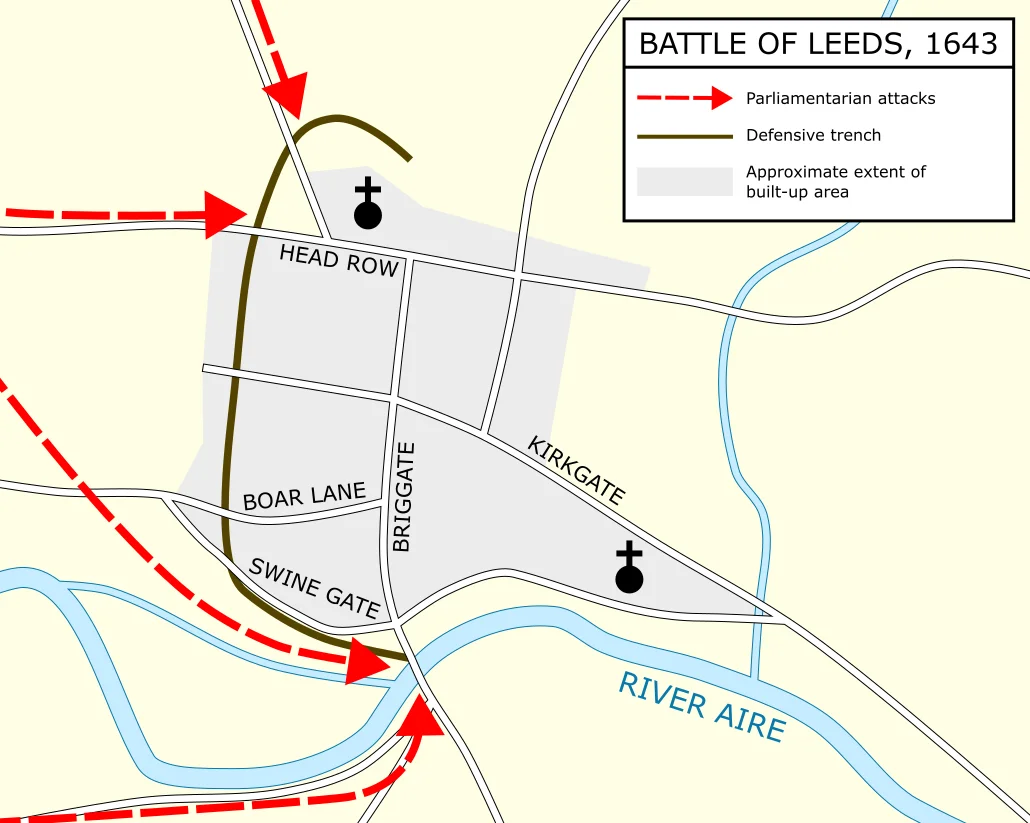
Leeds in 1643 was a wool town of about six thousand people, built mostly along a single street, Briggate, running south to the bridge over the River Aire. The town had no walls. Savile had a trench dug from St John's Church on the Headrow down to the river, breastworks raised at the bridge, and cannon positioned to sweep the main street. Sir Thomas Fairfax split his force into three. A smaller party under Captain Mildmay would loop south across the Aire to attack the bridge from below; the bulk of the army would cross at Apperley Bridge, four miles upstream, because the Royalists had destroyed the bridge at Kirkstall Abbey. Sergeant-Major Forbes would lead five companies south along the trench, William Fairfax would attack from the north near the church, and Sir Thomas himself would press the western end of the Headrow.
Two Hours in the Snow
The assault began around two in the afternoon. Forbes' dragoons concentrated their fire on one of the defensive sconces until the Royalists abandoned it; the second fell soon after. Mildmay's men drove the defenders off the southern end of the bridge. Savile ordered one of his cannons to be wheeled down Briggate to bombard them. A minister called Schofield, serving with the Parliamentarian force, led twelve musketeers up the street, killed the gun crew and captured the piece. Thomas and William Fairfax broke through the barricades. By around four o'clock all three columns met at the Market Place at the head of Briggate. Savile himself, with one of his captains and the town's vicar, fled by swimming the Aire on their horses. Savile and the vicar made it. Captain Beaumont drowned. Around forty-five Royalist soldiers were killed and roughly twenty Parliamentarians; four hundred and sixty Royalists were taken prisoner.
The Beginning of a Career
Word reached Wakefield by six that evening. The Royalist garrison there withdrew overnight. Newcastle pulled his army back to York. Parliament's printers seized on the victory, celebrating the 'Bradford men, with their Clubs and Forks.' Fortunes shifted again in February when Queen Henrietta Maria returned from continental Europe with weapons and money for the king, and Thomas Fairfax was beaten at Seacroft Moor in March. Leeds fell back into Royalist hands after the disaster at Adwalton Moor in June, and most of Yorkshire with it. But Fairfax himself was now noticed. The next year he won a decisive victory at Marston Moor. The year after that he was appointed commander-in-chief of Parliament's forces and built the New Model Army. The roads up Briggate and down to the Aire are paved over now, but the street pattern that Forbes and Mildmay fought along is still visible. The Headrow remains the spine of central Leeds.
From the Air
Central Leeds sits at 53.80 N, 1.54 W on the north bank of the River Aire in West Yorkshire. The closest airport is Leeds Bradford (EGNM), seven miles to the north. Manchester (EGCC) is thirty-eight miles south-southwest. From altitude, the seventeenth-century battlefield is the modern Briggate area of central Leeds, between The Headrow and Leeds Bridge. Look for the curve of the River Aire and the dense grey grid of the city centre; Woodhouse Moor, where Fairfax assembled his army, remains a large green park to the northwest. Best viewed from 3,500 to 5,500 feet on a clear day.
Nearby Stories
- Hovingham Hall 6 km away
- RAF Elvington 7.6 km away
- Battle of Hatfield Chase 9.1 km away
- Wentworth Castle 11 km away
- Murder of Suzanne Capper 12 km away
- Pendle Hill 13 km away
- RAF Topcliffe 15 km away
- Hawes Junction Rail Crash 26 km away