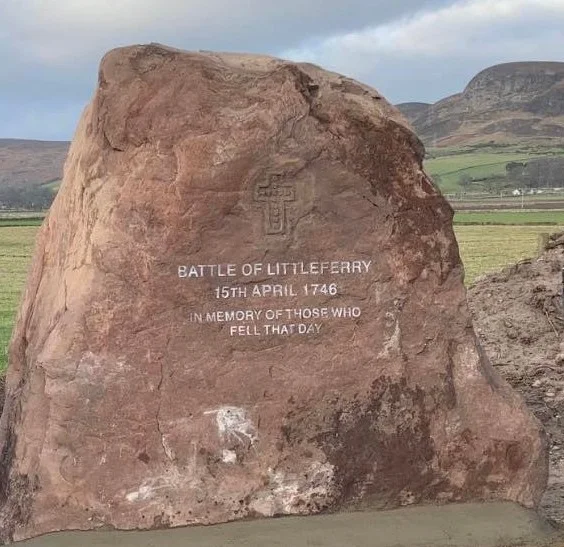

Battle of Littleferry
It was 15 April 1746, and a chest containing roughly £900 in silver was about to change hands. The Jacobite Earl of Cromartie was retreating along the Sutherland coast with 300 to 500 men, having marched north weeks earlier to recover supplies for Bonnie Prince Charlie's army. He was too late, he was outmanoeuvred, and he was unaware that the next morning - just twenty-five miles to the south - the Jacobite cause itself would be destroyed at Culloden. About 100 of his men would not live to learn the news. They died on the sands of Strathfleet at the Battle of Littleferry, the last skirmish of the 1745 rising, fought the day before the war ended.
The Wrong Direction
George Mackenzie, 3rd Earl of Cromartie, had been sent north earlier in 1746 after the Skirmish of Tongue, where Government forces under Captain Hugh Mackay had captured a substantial Jacobite shipment of money and supplies. Cromartie's job was to recover what had been lost. He arrived too late: the supplies were gone, the Jacobite party at Tongue was already captured. He turned south to rejoin Charles Edward Stuart's main army, which was concentrating near Inverness. Along the way he passed through Sutherland - friendly territory only on paper. The Earl of Sutherland's tenants were Government men. The Mackays were Government men. The Munros were Government men. Cromartie was walking through a hostile country, and he did not know how organised it was.
Three Sutherland Companies
Historian Patrick Marriott, writing in 2022, untangled what previous accounts had blurred. The Government victory at Littleferry was won not chiefly by the semi-professional Independent Highland Companies but by three Sutherland local militia companies - around 230 to 250 men in total. Captain Robert Macallister, a factor to the Earl of Sutherland, led roughly 80 men with Hector Munro of Novar as his lieutenant and Ensign John Mackay of Golspie - a man whose identity, Marriott argues, was later confused with another John Mackay and obscured from history. Lieutenant William Sutherland of Sciberscross commanded another 70. Captain Robert Gray, another Sutherland factor, led 80 to 100, with a contingent of Independent Company veterans embedded among them. They were neighbours, tenants, and clansmen of the Earl of Sutherland - and they knew the ground.
On the Sands
Ensign John Mackay of Golspie made the initial attack. The Jacobite force, strung out along the coast and trying to cross at Littleferry where Loch Fleet meets the sea, was caught between the militia and the tidal sands. The Battle of Littleferry was not a set-piece engagement so much as a running fight across the marshes and shoreline, with the Government men flushing Cromartie's troops out of cover and cutting them down on the open beach. Around 100 Jacobites died, according to Ruairidh MacLeod's 1984 account in the Transactions of the Gaelic Society of Inverness. Cromartie himself was captured. He handed over the chest of £900 to the victors, along with two silver pistols presented to Lieutenant Hector Munro. Twenty-five miles south, the rest of his army was preparing to march onto Culloden Moor.
The Tribunal
What happened to the £900 says something about the Highland economy of 1746. The Earl of Sutherland convened a tribunal to divide it as prize money. The officers received fixed sums - Macallister and Gray £70 each, Sutherland £45 (including funds for the parish of Clyne), Munro £35, Ensign John Mackay £50 "for having made the initial attack and for securing the money." The volunteers from the Independent Companies, Lieutenant John Mackay of Torrdaroch and Sergeant William Mackay, took £35 each. The largest single share - £264 - went to the men who had done the fighting in the Culmaily part of the battle. Captured banners and the silver pistols stayed with the officers. The Sutherland militia had won decisively, but London never quite stopped associating them with their rebellious neighbours.
Remembered, Eventually
For 276 years the dead of Littleferry had no monument. In April 2022, a memorial stone was unveiled at the battle site, dedicated to those who fell on both sides. The unveiling was attended by Ronald Munro Fergusson, a descendant of Lieutenant Hector Munro, and by Margaret Openshaw, a descendant of an Ensign George Mackenzie who fought in Cromartie's force - their ancestors had stood on opposite sides of the line. The Sutherland Schools Pipe Band composed a new tune to mark the occasion and played it at the unveiling. The view from Rhives above Golspie still looks south across the same long ribbon of sand where Cromartie's men were caught between the militia and the tide.
From the Air
The Littleferry battle site lies at 57.96°N, 4.00°W on the south side of Loch Fleet, near Golspie on the Sutherland coast. The most distinctive feature from the air is Loch Fleet itself - a tidal sea loch sealed behind The Mound causeway, which Telford built across its head in 1815. The battlefield extends along the sandy spit between the loch mouth and the sea. From cruise altitude north of Inverness (EGPE), follow the A9 corridor past Tain, across the Dornoch Bridge, through Dornoch and Embo. Golspie sits 6 miles north of Loch Fleet; Dunrobin Castle is just north of the village. Best viewed 2,000-3,500 ft AGL at low tide when the sands are fully exposed.
Nearby Stories
- North Coast 500 5.8 km away
- Pluscarden Abbey 7.7 km away
- Fort George, Highland 8.2 km away
- Conon Hydro Scheme 12 km away
- Caithness and Sutherland Peatlands 19 km away
- Moray Firth 19 km away
- Hill o' Many Stanes 24 km away
- Kylesku Bridge 28 km away