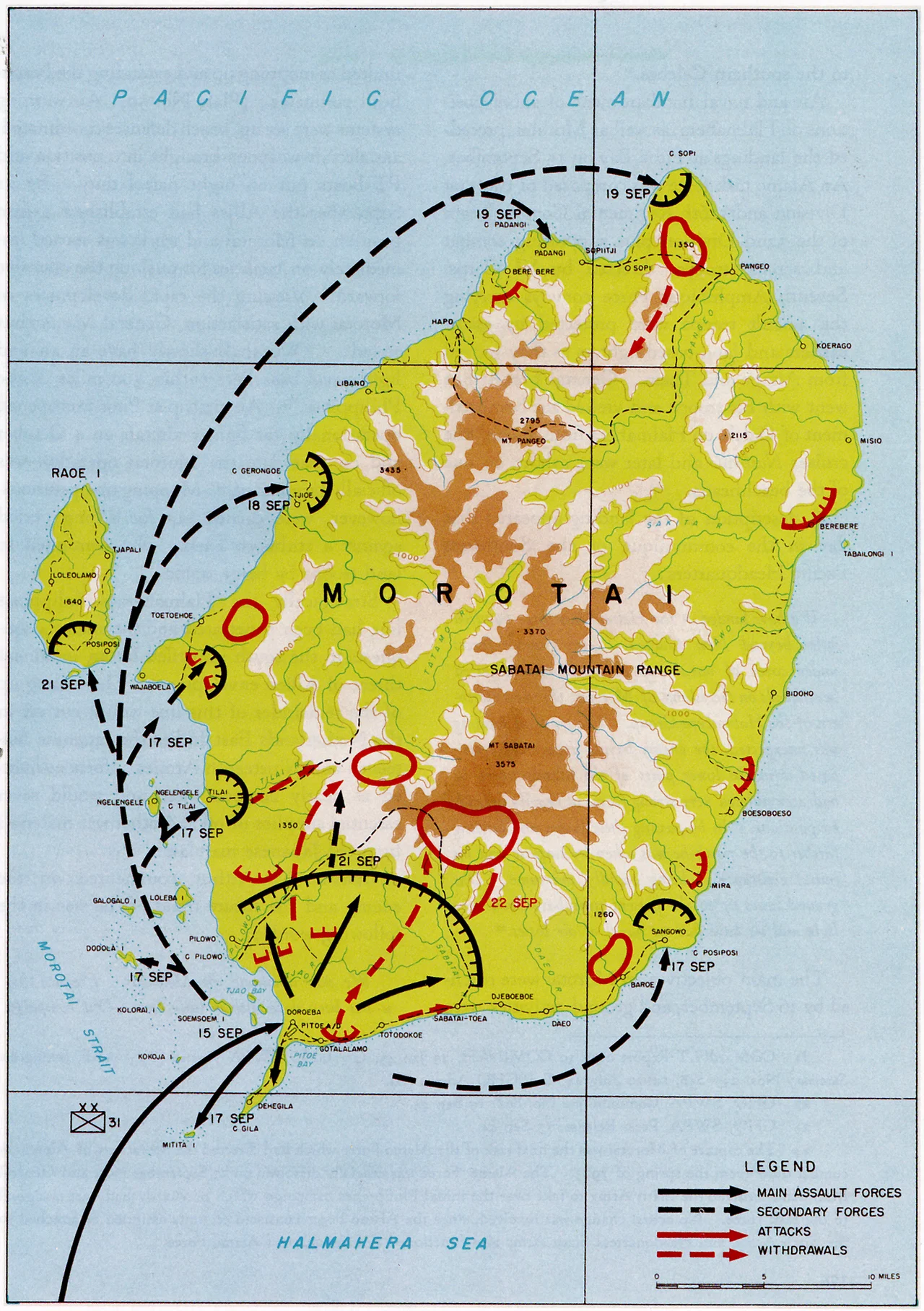

Battle of Morotai
The invasion planners expected it to be easy, and in a narrow military sense, it was. When American troops waded ashore on the southwest corner of Morotai at 8:30 on the morning of 15 September 1944, they encountered no opposition. The island's Japanese defenders were few and scattered. Within two weeks, the Allies had secured their objectives and begun converting the Doroeba Plain into what would become one of the most important air bases in the Pacific. What the planners did not expect was that the battle would never really end. Japanese reinforcements landed between September and November, but without adequate supplies they could not mount an effective attack. Instead, they starved. The fighting on Morotai dragged on until August 1945, a slow attrition marked less by combat than by disease and hunger.
A Stepping Stone to Manila
Morotai mattered because of what it could become, not what it was. The small island in the Halmahera group had a prewar population of about 9,000, no commercial development, and one significant feature: the Doroeba Plain, a flat lowland area in the southwest corner large enough for major airfields. The Allies needed those airfields to provide air cover for General Douglas MacArthur's planned return to the Philippines. Morotai had been part of the Netherlands East Indies, ruled by the Dutch through the Sultanate of Ternate. The Japanese occupied it in early 1942 during their sweep through the East Indies but never bothered to garrison or develop it. That neglect would cost them. Allied code breakers determined the island's defenses were minimal, and the decision was made to seize it.
The Landing
The battle opened with a two-hour naval bombardment at 6:30 AM on 15 September that set several villages ablaze but inflicted few Japanese casualties -- there simply were not many Japanese troops in the landing area. The 155th and 167th Regimental Combat Teams came ashore at Red Beach, the 124th RCT at White Beach. The assault troops assembled quickly and pushed inland against negligible resistance. The real work began immediately: construction of three major airstrips, with the first required to be operational right away. The pre-invasion plan called for accommodation and supply facilities for 60,000 personnel, a 1,900-bed hospital, bulk fuel storage, and ship docking facilities. Seven thousand engineer troops, 84 percent of them African American, began building the base that would help end the war in the Pacific.
Reinforcements Without Supplies
The Japanese recognized the threat. If the Allies completed their airfields on Morotai, the Philippines would be within range. Between late September and November, Japanese commanders on Halmahera sent the main body of the 211th Infantry Regiment, a battalion of the 210th Infantry Regiment, and three raiding detachments to Morotai by barge. Colonel Kisou Ouchi assumed command of Japanese forces on the island in October. But the reinforcements arrived without adequate food, ammunition, or medical supplies. They could not breach the Allied defensive perimeter. What followed was not a battle in any traditional sense but a prolonged ordeal. Japanese soldiers died of disease and starvation in the island's jungle interior, occasionally launching attacks that achieved little beyond adding to the toll.
An Island That Kept Fighting
Morotai's airfields were operational by October 1944 and played a critical role in the liberation of the Philippines. Torpedo boats and aircraft based there harassed Japanese positions across the Netherlands East Indies. In 1945, the base expanded to support the Australian-led Borneo Campaign, with Australian I Corps using Morotai as its staging ground. The island became so crowded that some Australian camps were placed outside the American defensive perimeter, exposing them to sporadic Japanese attacks. Aircraft from the Thirteenth Air Force and the Australian First Tactical Air Force struck targets across the southern Philippines and East Indies from Morotai's runways until the war's end. The island remained a logistics hub until the Dutch reestablished colonial control. For the Japanese soldiers who had been sent to Morotai without supplies, the end of the war brought surrender -- for those who survived. Many did not.
From the Air
Located at approximately 2.03°N, 128.29°E. Morotai Island is visible from altitude in the northern Halmahera group, with the Doroeba Plain (site of the WWII airfields) in the southwest corner. The island's interior is rugged and jungle-covered. Leo Wattimena Airport (ICAO: WAMG), built on the wartime airfield site, serves the island. Halmahera's northern arm lies to the south across a narrow strait. The waters between Morotai and Halmahera were used by Japanese barge reinforcement runs during the battle.
Nearby Stories
- North Halmahera Regency 16 km away
- Japanese Minelayer Tsugaru 22 km away
- USS Shark (SS-174) 41 km away
- Japanese Submarine Ro-41 67 km away
- USS Shelton (DE-407) 91 km away
- Fort Tolukko 137 km away
- The Ocean's Hidden Crossroads 233 km away
- Sangihe Islands 248 km away