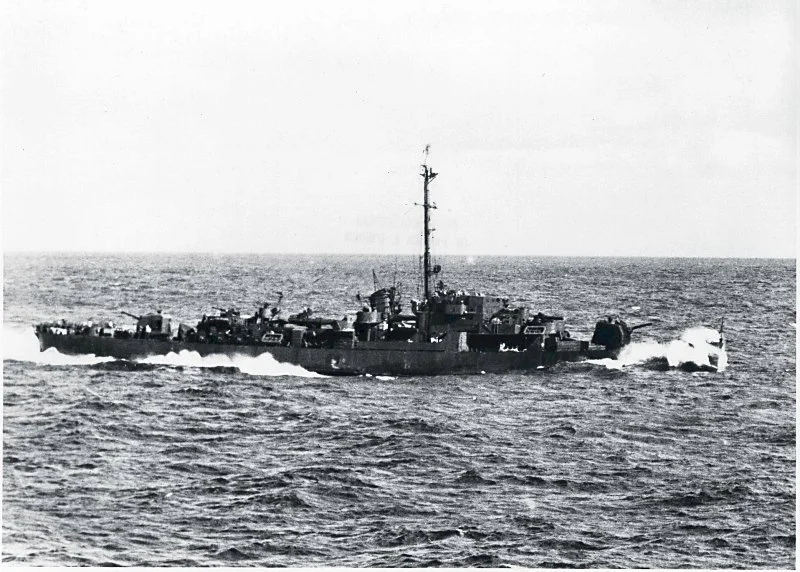
_underway_at_sea,_circa_in_1944.jpg)
USS Shelton (DE-407)
Ensign James A. Shelton never came back from the Battle of Midway. A naval aviator reported missing during that pivotal 1942 engagement, his name lived on in a destroyer escort launched eighteen months later from the shipyards of Houston, Texas. USS Shelton (DE-407) would serve the Navy for exactly six months from commissioning to sinking -- a brief, violent career that ended in the warm waters off Morotai Island on October 3, 1944, when a Japanese torpedo found her starboard propeller and the sea poured in.
From Houston to the Pacific
Brown Shipbuilding Company laid Shelton's keel on November 1, 1943, in Houston. She launched on December 18, sponsored by Mrs. John Shelton, and commissioned on April 4, 1944. After fitting out, she steamed to Bermuda for her shakedown cruise, then underwent repairs at the Boston Navy Yard before heading west -- through New York, Hampton Roads, and the Panama Canal Zone to San Diego. She arrived on July 6 and sailed for Pearl Harbor three days later. By late July she was part of a convoy bound for Eniwetok, and by mid-August she had reached Seeadler Harbor in the Admiralty Islands, assigned to screen Task Force 57's five aircraft carriers. The Pacific War was accelerating, and Shelton was heading straight into its teeth.
The Morotai Attack Force
In September 1944, Shelton was reassigned to Task Force 77, the Morotai Attack Force. Allied forces had just seized the southern plain of Morotai Island as a staging base for the coming invasion of the Philippines, and escort carriers provided air cover for the operation. Shelton's job was to screen those carriers -- to stand between them and whatever the Japanese Navy might send. It was dangerous work. Japanese submarines prowled these waters, hunting for targets among the Allied fleet. For weeks Shelton steamed back and forth in the tropical heat, her sonar operators listening for the telltale ping of a submarine contact, her crew at battle stations more often than not.
Torpedo in the Water
October 3, 1944, began like any other day on station. Shelton was screening the escort carriers off Morotai when Japanese submarine Ro-41 found the task force. The first sign of danger was a torpedo wake spotted at 1,500 yards, streaking toward one of the escorts. Shelton turned hard to evade. She avoided that torpedo, but a second one struck her starboard screw -- the propeller shaft that drove her through the water. The explosion tore open her hull. Seawater flooded in faster than damage control parties could fight it. The ship began to list, then to settle. A fellow destroyer escort came alongside and took off the crew, but Shelton was beyond saving. Taken under tow in a desperate attempt to reach shallow water, she capsized and sank. Thirteen of her sailors died with her -- men whose names are recorded on the Naval Vessel Register alongside the notation that they remain on duty. Shelton was struck from the register on November 27, 1944, and awarded one battle star for her brief service.
What Remains
Shelton lies somewhere on the seafloor near Morotai, in waters that were once among the most contested in the Pacific. The submarine that killed her, Ro-41, would itself be sunk five months later east of Okinawa, rammed by the destroyer USS Haggard in a nighttime engagement that left no survivors. The symmetry is striking: both ships were small vessels crewed by young men, both were lost in the vast Pacific far from home, and both now rest in darkness on the ocean floor. Shelton's story is inseparable from the larger campaign that swept through these waters in 1944 -- the Allied drive to retake the Philippines that cost thousands of lives on both sides. Her namesake, Ensign Shelton, was lost at Midway when the tide of war began to turn. The ship that bore his name was lost at Morotai as that tide surged toward Japan. A second USS Shelton would later carry the name forward, but the first lies here still, keeping watch over waters that have long since returned to peace.
From the Air
USS Shelton sank at approximately 2.55N, 129.30E in waters off Morotai Island. The nearest airport is Leo Wattimena Airport (WAMR) on Morotai's south coast. The sinking location is open ocean with no visible surface markers. From altitude, look for Morotai Island to the west-southwest and the smaller islands of the Halmahera group to the south. Recommended viewing altitude: 15,000+ ft. Clear tropical conditions typical, though heavy rain is common outside August-October.
Nearby Stories
- Morotai Island 41 km away
- Battle of Morotai 51 km away
- North Halmahera Regency 146 km away
- Hatohobei 157 km away
- The Diver's Mecca at the Edge of the Map 293 km away
- The Four Kings 322 km away
- Sangihe Islands 353 km away
- Japanese Destroyer Hokaze 420 km away