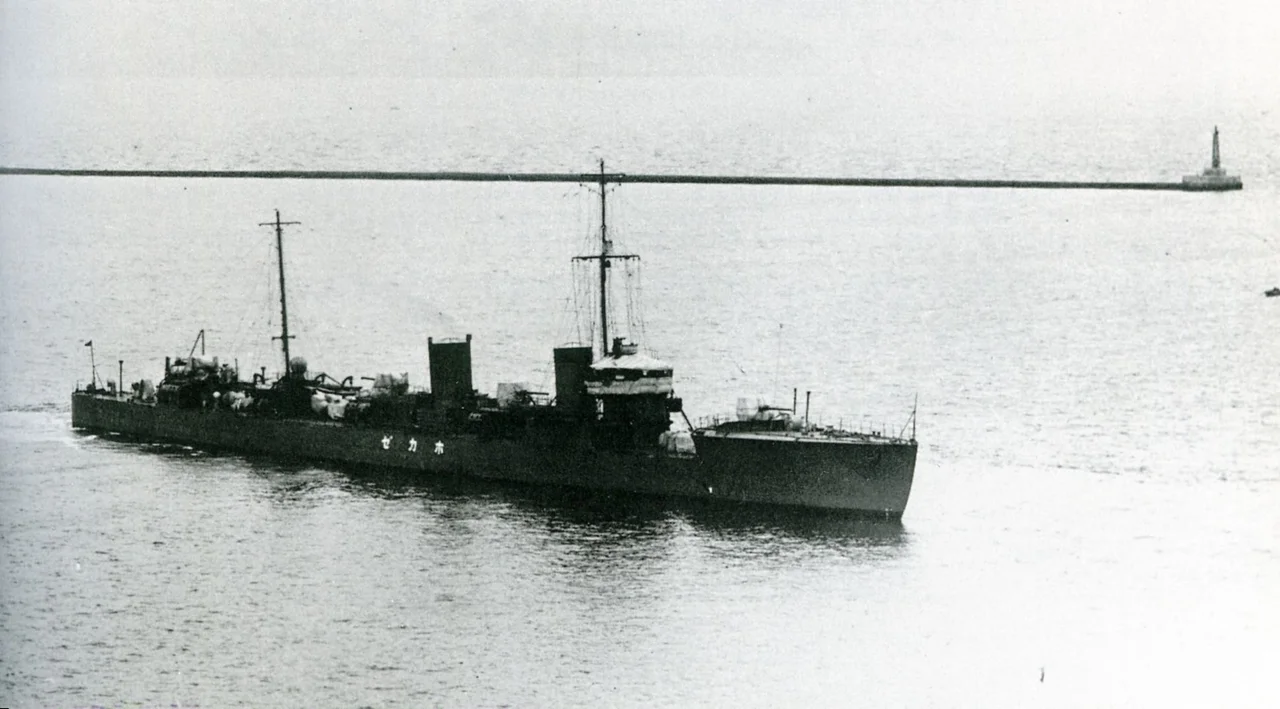

Japanese Destroyer Hokaze
By July 1944, Hokaze was running on borrowed time. Commissioned in 1921 as a cutting-edge fleet destroyer, she had been obsolete for years by the time World War II began, relegated to convoy escort duty in increasingly dangerous waters. On July 2, she departed Ambon on a 'Tokyo Express' run -- a high-speed supply dash to deliver critically needed provisions to beleaguered Japanese forces in New Guinea. Four days later, an American submarine found her in the Celebes Sea off Sangir Island. Her captain, Lieutenant Commander Eiichi Someya, went down with his ship.
A Destroyer of the Old Guard
Hokaze was the twelfth vessel of the Minekaze class, authorized under the Imperial Japanese Navy's 8-4 Fleet Program in the years following World War I. Built at the Maizuru Naval Arsenal, she was laid down on November 30, 1920, launched on July 12, 1921, and commissioned on December 21 of that year. The Minekaze-class ships were fast and well-armed for their era, designed to escort a class of battlecruisers that were ultimately never built. For two decades Hokaze served capably, forming part of Destroyer Division 4 under Torpedo Squadron 1 at the Yokosuka Naval District. By the late 1930s, she was patrolling the coastlines of northern and central China during the Second Sino-Japanese War. But warship technology had advanced rapidly, and by December 1941 the Minekaze class was firmly second-line.
Escort Duty Across the Pacific
When Japan attacked Pearl Harbor, Hokaze was assigned to Carrier Division 4. She escorted aircraft carriers between Sasebo, Takao (modern Kaohsiung), Palau, and the Kure Naval District. In early 1942, she accompanied a carrier to Truk. By late May, she was operating from the Ominato Guard District in northern Japan, escorting transports for the Kiska invasion in the Aleutian Islands -- about as far from the tropical Pacific as a Japanese ship could get. Through 1942 and into 1943, she was shuffled between assignments: convoy escort between Moji and Taiwan, then patrol and escort duties out of Balikpapan, Borneo, in the Netherlands East Indies. The work was unglamorous but essential, and it grew more deadly as American submarines tightened their grip on Japan's shipping lanes.
Torpedoed Twice
On July 1, 1943, Hokaze was the sole escort for a three-ship convoy in the Makassar Strait when an American submarine attacked. A torpedo struck Hokaze, inflicting moderate damage. Two of the convoy's merchant ships -- a tanker and a freighter -- were also hit. Hokaze remained functional, managed emergency repairs, and escorted a convoy from Surabaya back to Yokosuka, where she spent months in dry dock. By mid-November 1943 she was back in service, assigned to the 1st Surface Escort Division of the General Escort Command. She escorted convoys to Qingdao, then in April 1944 was dispatched to western New Guinea to join the Fourth Southern Expeditionary Fleet. The assignments were growing more dangerous with each passing month, as American air and submarine power made every convoy run a gamble.
The Last Run to New Guinea
On July 2, 1944, Hokaze departed Ambon loaded with emergency supplies, tasked with a Tokyo Express run to New Guinea -- the kind of high-speed armed transport mission that had become synonymous with desperate logistics. Four days later, on July 6, an American submarine caught her in the Celebes Sea at a position 105 miles north-northeast of Menado, off Sangir Island. The torpedo struck, and Hokaze went down. Some of her crew survived, but her captain, Lieutenant Commander Eiichi Someya, perished with his ship. On September 10, 1944, Hokaze was formally removed from the navy list. She had served the Imperial Japanese Navy for twenty-two years and eight months -- from the hopeful naval expansion of the interwar period through the grinding attrition of a war Japan was losing. Her wreck lies somewhere on the floor of the Celebes Sea, one of thousands of ships claimed by the Pacific theater.
From the Air
Hokaze sank at approximately 3.40N, 125.47E in the Celebes Sea off Sangir Island, about 105 miles north-northeast of Manado (Sam Ratulangi Airport, WAMM). The Sangihe Islands chain is visible to the north. From cruising altitude, look for Sangir Besar with its distinctive Mount Awu volcanic peak. The wreck site is in open water with no surface markers. Recommended viewing altitude: 20,000+ ft to see the relationship between the Sangihe chain and the Sulawesi mainland.
Nearby Stories
- Sangihe Islands 26 km away
- Bunaken National Park 167 km away
- Balut Island 190 km away
- Bunaken 201 km away
- 1913 Sulawesi-Mindanao Earthquake 206 km away
- USS Shark (SS-174) 220 km away
- Sinkyo Maru 244 km away
- Basilan 443 km away