.jpg)
Sinkyo Maru
At 23:48 on March 24, 1944, the USS Bowfin made radar contact with a Japanese convoy off the coast of Mindanao. The American submarine fired her first torpedo salvo, sinking the cargo liner Bengal Maru. Minutes later, she fired again. This time the target was Sinkyo Maru, a twelve-year-old cargo steamer that had been converted into every kind of warship the Imperial Japanese Navy needed: gunboat, minelayer, submarine chaser, troopship. The torpedoes struck, and Sinkyo Maru sank in three minutes. Sixty-one people -- twelve crewmen and forty-nine passengers -- died in the dark waters of the Philippine archipelago. It was an anonymous end for a ship that had sailed an extraordinary wartime odyssey.
A Merchant Ship's Modest Origins
Sinkyo Maru began life as a civilian cargo steamer, built by the Uraga Dock Company in Uraga, Kanagawa. Her keel was laid on February 25, 1932; she launched on November 24 and was completed on April 11, 1933. She was a modest vessel, powered by a three-cylinder triple-expansion steam engine augmented by an exhaust turbine that drove the same propeller shaft through double reduction gearing. Her owners, Chosen Yusen KK, registered her at Jinsen in Japanese-controlled Korea -- modern-day Incheon, South Korea. Through the 1930s she worked the unglamorous trade routes between Korea and the ports of Honshu, with occasional voyages to Vladivostok. In 1938, the romanization of her name changed from Shinkyo Maru to Sinkyo Maru, a bureaucratic footnote that would outlast the ship herself.
Pressed into the Imperial Navy
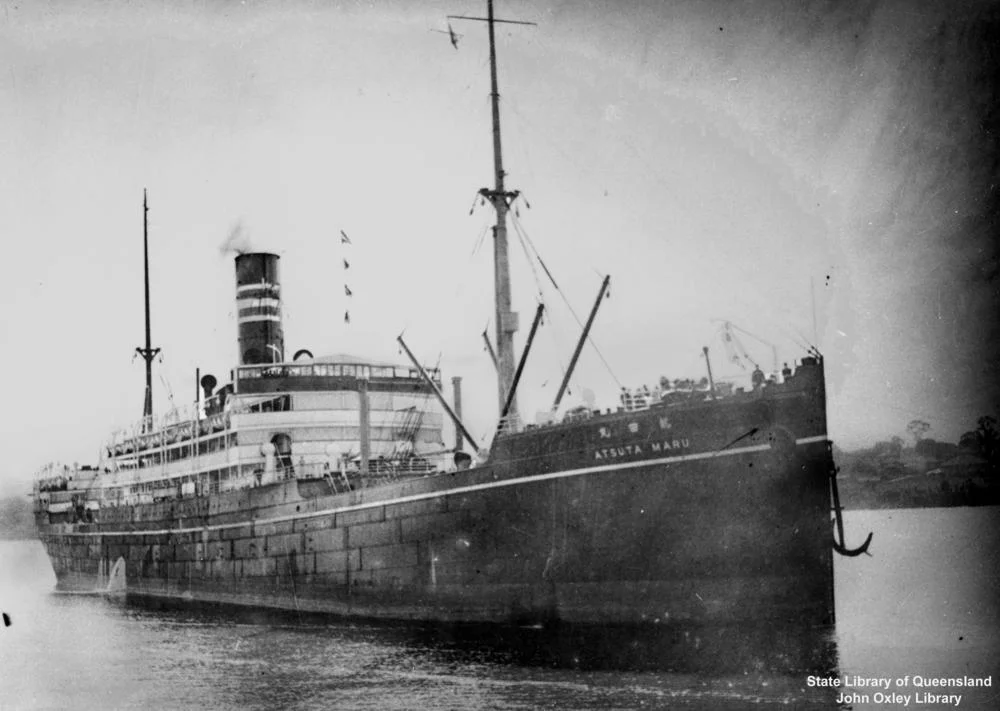
On September 15, 1940, the Japanese Navy requisitioned Sinkyo Maru. Within weeks she was attached to the Sasebo Naval District as an auxiliary gunboat, armed with three 12cm naval guns, machine guns, depth charge racks, and 32 depth charges. By January 1941, she was laying mines -- 115 Type 93 mines deployed in two minefields off the Japanese coast. She patrolled Chinese waters, formed part of the Sasebo Local Defence Squadron, and in January 1942 survived a collision with the auxiliary oiler Akatsuki Maru that badly damaged her bridge. Repaired and reassigned, she spent months operating from Kakeromajima in the Amami Islands, south of Kyushu. When the troopship Atsuta Maru was crippled by an American submarine in May 1942, Sinkyo Maru was part of the flotilla that responded -- making anti-submarine sweeps and rescuing survivors while Atsuta Maru burned and eventually sank.
Wewak and the Kuril Islands
In late 1942, Sinkyo Maru was assigned to reinforce the Japanese campaign in New Guinea. She joined convoys carrying the 20th and 41st Divisions to Wewak -- dangerous runs through waters increasingly dominated by American submarines and aircraft. In January 1943, she embarked 399 troops and 300 bundles of supplies in Busan, sailed to Palau, and from there joined a three-ship echelon escorted by a destroyer for the dash to Wewak. The echelon arrived at 2:00 in the morning, disembarked its cargo in nine hours, and fled before daylight could bring American air attacks. A second run in February followed the same pattern: load in Tsingtao, stage through Palau, sprint to Wewak, and run. By spring 1943, she was reassigned to coastal defense of eastern Japan, patrolling from Yokosuka north to Kushiro on Hokkaido and out to Paramushiro in the Kuril Islands -- the cold, fog-shrouded volcanic chain at the northern limit of Japanese territory.
Three Minutes Off Mindanao
After a late-1943 refit at Mitsubishi Heavy Industries' shipyard in Yokohama, Sinkyo Maru was redesignated as an auxiliary transport and sent south again. She joined convoys through Okinawa, Taiwan, and on to Manila, arriving in mid-March 1944. On March 20, she departed Manila in Convoy H-22, bound for Halmahera in the Maluku Islands with seven other ships and two escorts. On March 23, in the Basilan Strait, an auxiliary submarine chaser joined the convoy. The next day, off Mindanao, USS Bowfin found them. The submarine's radar picked up the convoy, and at 23:48 Bowfin fired her first salvo. Bengal Maru went down. Minutes later, another salvo struck Sinkyo Maru. She sank in three minutes -- too fast for any organized evacuation. Twelve crew and forty-nine passengers died in those waters, their ship joining the thousands of vessels that the Pacific War scattered across the ocean floor. Sinkyo Maru had been many things in her twelve years: freighter, gunboat, minelayer, troop transport, submarine chaser. In the end, she was just another target in a submarine's crosshairs.
From the Air
Sinkyo Maru sank at approximately 5.62N, 125.97E off the coast of Mindanao near the Basilan Strait. The nearest major airport is General Santos Airport (RPMR/GES) to the west or Zamboanga Airport (RPMZ) to the northwest. From altitude, the sinking location is in the waters between Mindanao and the Sangihe/Talaud island chain. The Celebes Sea stretches to the south. Recommended viewing altitude: 20,000+ ft. No surface features mark the wreck site.
Nearby Stories
- Island of Palmas Case 4 km away
- Balut Island 20 km away
- Japanese Destroyer Hokaze 208 km away
- Sangihe Islands 260 km away
- 1955 Lanao Earthquake 332 km away
- Japanese Minelayer Tsugaru 363 km away
- Jose Rizal's Farm 426 km away
- Munakata Taisha 3143 km away