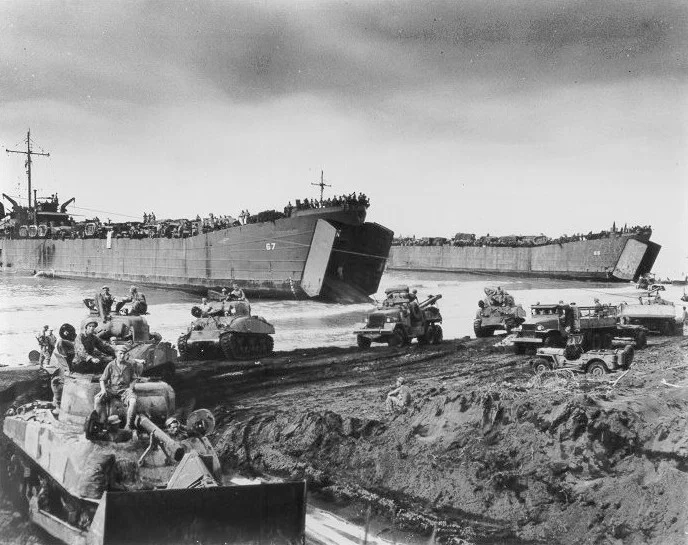

The Battle of Noemfoor: Three Airfields and a Forgotten Cost
The math was simple and the logic was cold. Noemfoor had three airfields crammed onto an island barely eleven miles across. Japanese air defenses in western New Guinea were nearly nonexistent. Allied planners estimated they would face fewer than a battalion of defenders. The operation, codenamed Cyclone, would require modest forces and minimal amphibious shipping -- a resource the Allies were desperately short of in mid-1944. What the planners did not fully account for was what they would find after the fighting stopped: the remains of a forced labor system that had consumed thousands of Indonesian civilians to build the very runways the Allies now wanted.
The Runways Built by Hand
The Japanese occupied Noemfoor in December 1943 and immediately began constructing airfields. Three strips took shape: Kameri on the northwest edge, Kornasoren (also called Yebrurro) toward the north, and Namber on the west coast. The labor came from more than 3,000 Indonesian men, women, and children shipped from Surabaya and other cities on Java. These Javanese civilians built roads and runways mostly by hand, with little food, clothing, shelter, or medical care provided. Many who attempted to steal Japanese supplies to survive were executed. Others died of starvation and preventable disease. Survivors later alleged that sick laborers were buried alive. By the time Allied troops landed, only about 1,100 laborers remained on the island -- 600 Formosan auxiliary workers and 500 Indonesian forced laborers. When the battle ended on August 31, 1944, the U.S. Army official history recorded that just 403 of the original 3,000 Javanese civilians were still alive.
Dawn Bombardment
At 4:30 on the morning of July 2, 1944, warships from U.S.-Australian Task Forces 74 and 75 opened fire on Noemfoor's defenses. Task Force 74 was commanded by Commodore John Collins, who became the first graduate of the Royal Australian Naval College to command a naval squadron in action. Between June 20 and July 1, Allied bombers had already dropped 800 tons of bombs on the island. The bombardment was devastating. When the 158th Regimental Combat Team came ashore near Kamiri Airfield, they found Japanese soldiers so stunned, in the words of the U.S. Navy official history, that "all the fight was taken out of them." Despite an almost solid ring of coral surrounding the island, newspapers reported almost no troop losses reaching the shore. Kamiri fell within hours. About 45 Japanese soldiers died in the initial fighting, and 30 damaged aircraft were captured on the ground.
Paratroopers and Broken Legs
The day after the beach landing, 2,000 paratroopers from the 503rd Parachute Infantry Regiment dropped onto Noemfoor as a precaution against stronger resistance elsewhere on the island. The precaution came at a painful cost. The 1st Battalion jumped first, and several sticks were dropped from too low an altitude, resulting in 72 non-battle casualties -- most of them broken legs from the hard landings on coral-studded ground. The 3rd Battalion followed the next day and suffered another 56 jump injuries. The toll was so severe that commanders canceled the third drop entirely. The 2nd Battalion came ashore by landing craft instead. It was a bitter irony: the paratroopers suffered more casualties from the jump itself than from Japanese resistance, which by that point had largely melted into the island's forested interior.
A Colonel's Retreat into the Hills
Colonel Suesada Shimizu had arrived on Noemfoor only weeks before the invasion, on June 8, and organized his roughly 2,000 defenders into fourteen strongpoints scattered across the island. The dispersal proved fatal to any coherent defense. When the Allied bombardment shattered his forward positions, Shimizu's plan was to withdraw east toward Broe Bay and await evacuation by sea. The evacuation never came. His force broke contact and gathered at Hill 670, several miles northeast of Kamiri, but abandoned it before the 503rd's 1st Battalion reached the crest on July 16. For a week beginning July 23, fighting flared near a lagoon northwest of Inasi, where Sergeant Ray E. Eubanks earned a posthumous Medal of Honor. Shimizu slipped through a U.S. cordon after a week-long action around Hill 380 in August, withdrawing toward Pakriki on the coast with a dwindling force. By August 31, all fighting had ceased. The Allies counted 66 killed or missing and 343 wounded.
Stepping Stones to Balikpapan
The real prize was never the island itself but what could be launched from it. Namber Airfield proved too rough for Allied use, but engineers expanded Kornasoren into a serious installation. By September 2, two parallel 7,000-foot runways were operational. B-24 Liberator heavy bombers soon began flying from Kornasoren against Japanese petroleum facilities at Balikpapan, Borneo, which supplied up to 35 percent of Japan's refined petroleum products. The first raid, on September 30, 1944, was led by Colonel Thomas Cebern Musgrave Jr. Without fighter cover, the early raids suffered severe losses, but by October, P-38 Lightnings and P-47 Thunderbolts flying from new bases at Morotai and Sansapor provided escort. Noemfoor had served its purpose in the island-hopping calculus: a small place, briefly fought over, that became a platform for striking at the arteries of Japan's war machine. The Javanese laborers who died building those runways are not named in the operational histories.
From the Air
Noemfoor (Numfor) island sits at approximately -0.98 lat, 134.89 lng in Cenderawasih Bay (formerly Geelvink Bay), between Biak island and the Bird's Head Peninsula of New Guinea. The island is roughly circular, about 11 miles in diameter, and ringed by coral reefs. From altitude, the oval shape and flat terrain are clearly visible against the deep blue of the bay. The three WWII airfield sites -- Kameri (northwest), Kornasoren/Yebrurro (north), and Namber (west coast) -- may still be partially visible as cleared areas. No major commercial airport currently operates; the nearest significant airfield is Frans Kaisiepo Airport (ICAO: WABB) on Biak island to the east. Expect tropical weather with frequent cloud cover and rain. Recommended viewing altitude: 8,000-12,000 ft for the full island perspective, lower for individual airfield sites.
Nearby Stories
- Manokwari: Where Empires Came and Went 26 km away
- Biak Archipelago 63 km away
- Owi Airfield 96 km away
- Cenderawasih Bay 152 km away
- Where the Mangroves Stand Thirty Meters Tall 157 km away
- Mapia Atoll 185 km away
- Spring Rain on Dark Water 185 km away
- Yoshino-Kumano National Park: Cherry Blossoms, Sacred Water, and Ancient Stone 3837 km away