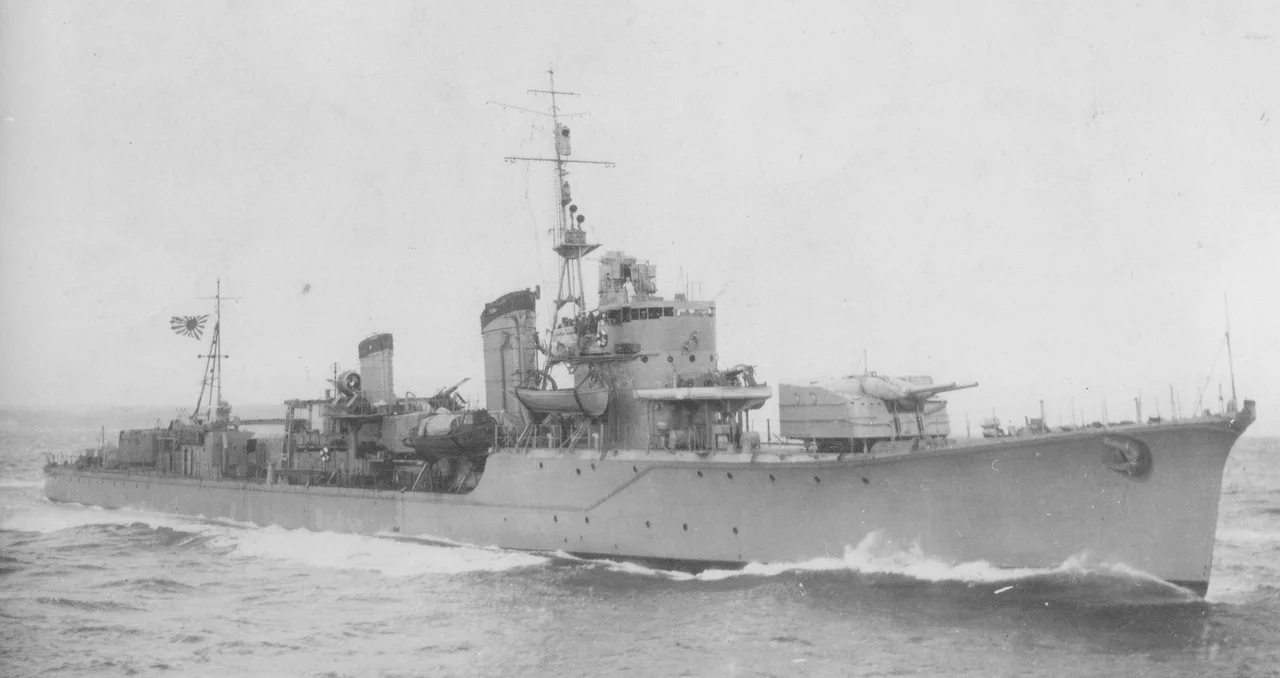

Spring Rain on Dark Water
Her name meant "spring rain" -- a gentle word for a ship designed to kill. Harusame slid down the ways at Maizuru Naval Arsenal on September 21, 1935, the sixth of ten Shiratsuyu-class destroyers built to give the Imperial Japanese Navy an edge it would desperately need. These were among the most formidable destroyers afloat, armed with eight 610mm torpedo tubes carrying the fearsome Type 93 "Long Lance" oxygen torpedoes, weapons that could strike targets at distances other navies considered impossible. None of the ten sisters would survive the war they were built to fight.
A Weapon Forged in Treaty Shadows
The Shiratsuyu class emerged from a peculiar strategic calculus. Japan's naval planners, constrained by the Washington and London Naval Treaties that limited capital ship construction, invested heavily in destroyers that could punch far above their weight. The plan was straightforward in concept, terrifying in ambition: as the American fleet advanced westward across the Pacific, waves of destroyers would launch night torpedo attacks to whittle it down before the decisive battleship engagement. The Type 93 torpedo made this plausible. Fueled by compressed oxygen rather than compressed air, it left almost no visible wake, carried a warhead nearly twice the size of its American counterpart, and could travel 40 kilometers. Harusame was commissioned on August 26, 1937, and assigned to Destroyer Division 2. By the time the war began, she and her crew had drilled relentlessly in the night torpedo tactics that Japanese strategists believed would decide the conflict.
From Pearl Harbor to the Java Sea
When the attack on Pearl Harbor launched the Pacific War, Harusame was already at sea. She had sortied from Mako Guard District in the Pescadores as part of the Philippine invasion force, covering landings at Vigan and Lingayen Gulf in December 1941. The early months of the war unfolded as Japan's planners had hoped, and Harusame raced from one operation to the next. In January 1942, she joined Operation J, the invasion of the Netherlands East Indies, supporting landings at Tarakan Island and Balikpapan on Borneo's oil-rich coast. During the Battle of the Java Sea on February 27, she engaged Allied destroyers in the chaotic running fight that effectively ended organized naval resistance in the Dutch East Indies. By spring she was based at Subic Bay, assisting in the conquest of Cebu and the blockade of Manila Bay. The war was barely five months old, and Harusame had already fought across thousands of miles of ocean.
The Solomons Crucible
Midway changed everything. Harusame was part of the aborted Midway Occupation Force under Admiral Nobutake Kondo in June 1942, spared the devastation that consumed four Japanese carriers. The crisis at Guadalcanal soon pulled her south into some of the war's most vicious fighting. She escorted capital ships during the Battle of the Eastern Solomons in August and spent September scouting the Solomon and Santa Cruz Islands for potential bases. Then came the Tokyo Express -- the desperate, high-speed nighttime supply runs to Japanese troops on Guadalcanal. Between October and mid-November, Harusame made nine of these runs, threading narrow waters under constant threat of air attack and surface engagement. During the First Naval Battle of Guadalcanal on the night of November 12-13, 1942, she claimed heavy damage to an Allied cruiser with her gunfire in a close-range melee so confused that ships on both sides fired on their own vessels.
Torpedoed, Beached, Resurrected
January 24, 1943, brought Harusame's closest brush with death before her last. Operating near Wewak, New Guinea, she took a torpedo hit -- likely from an American submarine. The damage was severe enough that her crew beached her to prevent sinking. Salvage teams eventually refloated the ship and nursed her back to Truk for emergency repairs, then on to Yokosuka by May. The yard workers at Yokosuka Naval Arsenal removed one of her gun turrets and bolted on additional Type 96 25mm anti-aircraft guns, a modification that reflected the war's shifting reality: by late 1943, the threat came increasingly from above. Harusame did not return to service until November, and she reached Truk again only in January 1944. The base she returned to was not the impregnable fortress it had been; American carrier raids would devastate Truk the following month, killing two of Harusame's crew in the process.
Last Voyage to Biak
The final months were a grinding retreat. Harusame escorted tanker convoys from Borneo's oil ports to Truk, then patrolled from Palau, then shuttled between Davao, Lingga, and Tawitawi. On June 8, 1944, she received orders to evacuate Japanese troops from Biak, an island under heavy American assault. Approximately 30 miles northwest of Manokwari, New Guinea, United States Army Air Forces B-25 bombers found her. The medium bombers, flying low-level skip-bombing attacks that had become devastatingly effective against Japanese shipping, struck Harusame and sent her to the bottom. Seventy-four of her crew died, including squadron commander Captain Masashichi Shirahama. Today her wreck lies in the tropical waters off New Guinea's Bird's Head Peninsula, near the coordinates 0.08 degrees south, 132.75 degrees east. She was struck from the Navy list on August 10, 1944, one more line in the long accounting of a class of destroyers that had been built to win a war and instead fought it to extinction.
From the Air
Harusame's sinking position lies at approximately 0.08S, 132.75E, in the waters northwest of Manokwari off New Guinea's Bird's Head Peninsula. From cruising altitude, the deep blue waters of Cenderawasih Bay stretch below, with the mountainous coastline of Papua visible to the south and east. Rendani Airport (WAUU) at Manokwari is the nearest airfield, roughly 30 nautical miles to the southeast. Biak's Frans Kaisiepo Airport (WABB) lies further east. The wreck site is in deep water with no surface markers visible from altitude.
Nearby Stories
- Sausapor: Where Turtles Nest and Empires Landed 21 km away
- The Island That Reached the Philippines 58 km away
- Broken at the River's Edge 107 km away
- Manokwari: Where Empires Came and Went 128 km away
- Waigeo: The Island That Nearly Split in Two 138 km away
- Mapia Atoll 142 km away
- Hatohobei 336 km away
- USS Shelton (DE-407) 462 km away