
Battle of Omdurman
On the morning of 2 September 1898, at a place called Kerreri about eleven kilometers north of Omdurman, somewhere between 35,000 and 50,000 Sudanese soldiers of the Mahdist state advanced on foot across a wide, flat plain toward a British-Egyptian force dug into an arc by the Nile. The Sudanese carried spears and older rifles. The British-Egyptian force had fifty-two quick-firing artillery pieces, magazine rifles, machine guns, and a flotilla of twelve gunboats in the river ready to fire over their heads. The distance opened at about 2,750 meters. Then the British opened fire.
The Army That Walked Forward
It is important to name them as people. Abdallahi ibn Muhammad, the Khalifa, had succeeded the Mahdi Muhammad Ahmad as ruler of the Mahdist state in 1885. He commanded what was, by the standards of nineteenth-century African armies, a large and experienced force: cavalry, infantry, artillery purchased or captured, and the infantry tradition called the Ansar, who had defeated General Gordon at Khartoum in 1885 and held Sudan for thirteen years. Their leaders on that September morning were men with names: Osman Azrak, who led the first charge with 8,000 men; Osman Sheikh ed-Din and Ali wad Hilu, who commanded the forces concealed behind the Kerreri hills; Abdullah al-Taashi, positioned behind Surkab Hill with 17,000. These were not fanatics or savages, the words Churchill and others used at the time. These were Sudanese soldiers, most of them farmers, herders, and craftsmen from Kordofan, Darfur, and the Nile, who had answered a call from their ruler and believed they were fighting for their country, their faith, and their sovereignty.
Kitchener's Machine
Major-General Horatio Herbert Kitchener, commanding a force of 8,000 British regulars and 17,000 Egyptian and Sudanese troops in British service, had marched south from Egypt over two years. He had built a railway across the desert to feed his supply lines, captured Dongola in September 1896, Abu Hamed in August 1897, and defeated a Mahdist force at the Battle of the Atbara River in April 1898. On 1 September 1898 he arrived at Omdurman. His arc around the village of Egeiga ran close to the Nile, where the gunboats waited. Among his officers were a 23-year-old Winston Churchill, riding with the 21st Lancers, and a young Captain Douglas Haig, who would later command British forces at the Somme. The British had trained for exactly this engagement: a disciplined army with modern firepower waiting for a larger force of charging infantry. They had studied earlier colonial battles. They knew what would happen.
Five Hours
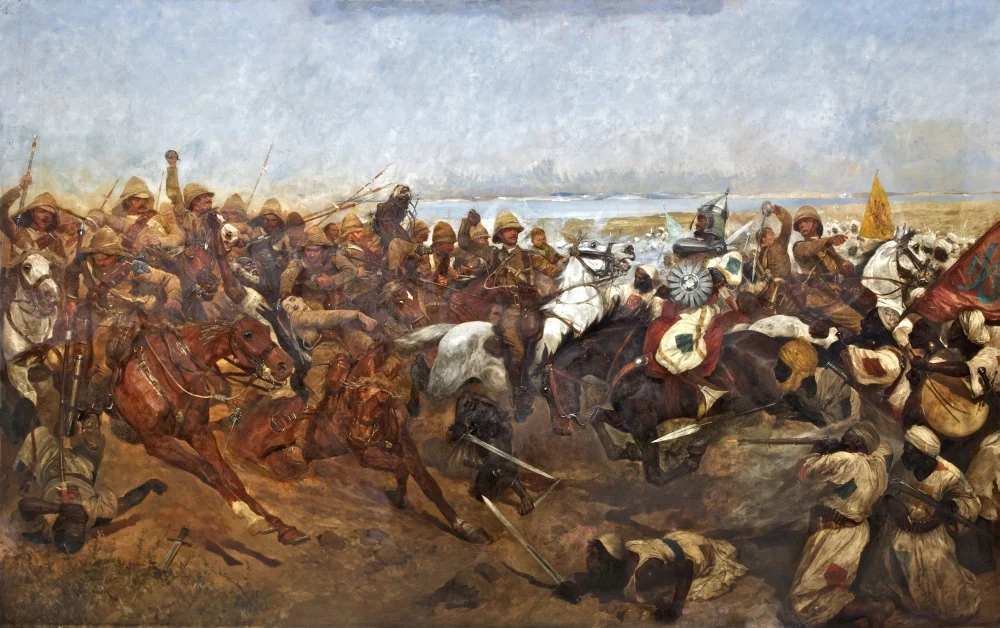
The battle began around 6 a.m. Osman Azrak's force of 8,000 advanced directly at the British line. Some 8,000 more advanced from the northwest. The British artillery opened fire at 2,750 meters. The machine guns worked at closer ranges. The Sudanese soldiers kept coming. By most estimates, 10,000 to 12,000 Mahdist fighters were killed or mortally wounded on that plain. Another 13,000 were wounded and would have died without care. Many did die, untreated, in the days after. Kitchener's losses were fewer than 500. The 21st Lancers conducted what would become one of the last great British cavalry charges, famously mythologized in the 1972 film Young Winston. What the film does not dwell on is that the charge itself was a minor affair compared to the massacre that preceded it. Five hours. That is roughly how long it took to end the Mahdist state as a military power.
The Wounded at Omdurman
After the battle, questions were asked in the British Parliament about the treatment of wounded Sudanese. Reports indicated that many were killed where they lay. Dum-dum bullets, soft-nosed rounds that expanded on impact, had been used to devastating effect. These were recorded issues even in Britain at the time; the Hansard record of 17 February 1899 contains the debate. Some British officers expressed disquiet. Others did not. The official narrative, then and for much of the next century, described the battle in triumphant terms: discipline over disorder, civilization over fanaticism. Churchill's own The River War, published in 1899, oscillated between admiration for Mahdist courage and language that reflected the assumptions of his time. More recent Sudanese historians, and commemorations like those reported by Reuters honoring the warriors who fell fighting the British, have worked to restore the dignity that the victors' accounts subtracted.
Gordon's Revenge
Kitchener had personal motives. General Charles Gordon had been killed at Khartoum on 26 January 1885, after the Mahdist forces overcame his garrison. His death was made into Victorian hagiography; vengeance for Gordon was part of how the British government sold the 1896-98 reconquest campaign to its public. After the battle, Kitchener ordered the exhumation of the Mahdi's body at Omdurman, the mutilation of his corpse, and the taking of his skull as a trophy. The skull was eventually reburied after protests, including from Queen Victoria. It is a detail that sits awkwardly in the triumphant narrative. It was a war of reconquest for the British; it was also, visibly, a war of revenge and of imperial theater.
What the Victory Built
The battle ended Mahdist resistance as a conventional force. The Battle of Umm Diwaykarat a year later finished off the Khalifa's remaining troops. Anglo-Egyptian Sudan was established in 1899 as a condominium, and would last until 1956. The reconquest opened the upper Nile to British control and to the completion of the imperial scheme that ran, in Cecil Rhodes's phrase, "from Cape to Cairo." In Sudan itself, the battle is remembered differently than it is in Britain. It is remembered as the day a British army, armed with the best weapons industrial Europe could manufacture, killed thousands of Sudanese farmers and herders who had answered the Mahdi's call. The warriors are honored. The cost is counted. And on the plain at Kerreri, the wind still blows across a level landscape where on one September morning, more than a century ago, a sovereign Sudanese state died under machine-gun fire.
From the Air
The Battle of Omdurman was fought at Kerreri, at approximately 15.75°N, 32.52°E, about 11 km north of Omdurman on the west bank of the Nile. Nearest airport is Khartoum International (IATA: KRT, ICAO: HSSS). The battlefield is a flat plain framed by the Surkab (sometimes called Surgham) and Kerreri hills. Recommended viewing altitude 4,000-8,000 ft AGL to see the battlefield terrain and the Nile running south toward the Khartoum confluence.
Nearby Stories
- Kalakla 3.6 km away
- Esh Shaheinab 7.7 km away
- Naqa 39 km away
- Musawwarat es-Sufra 82 km away
- Gezira State 118 km away
- Northern Sudan 196 km away