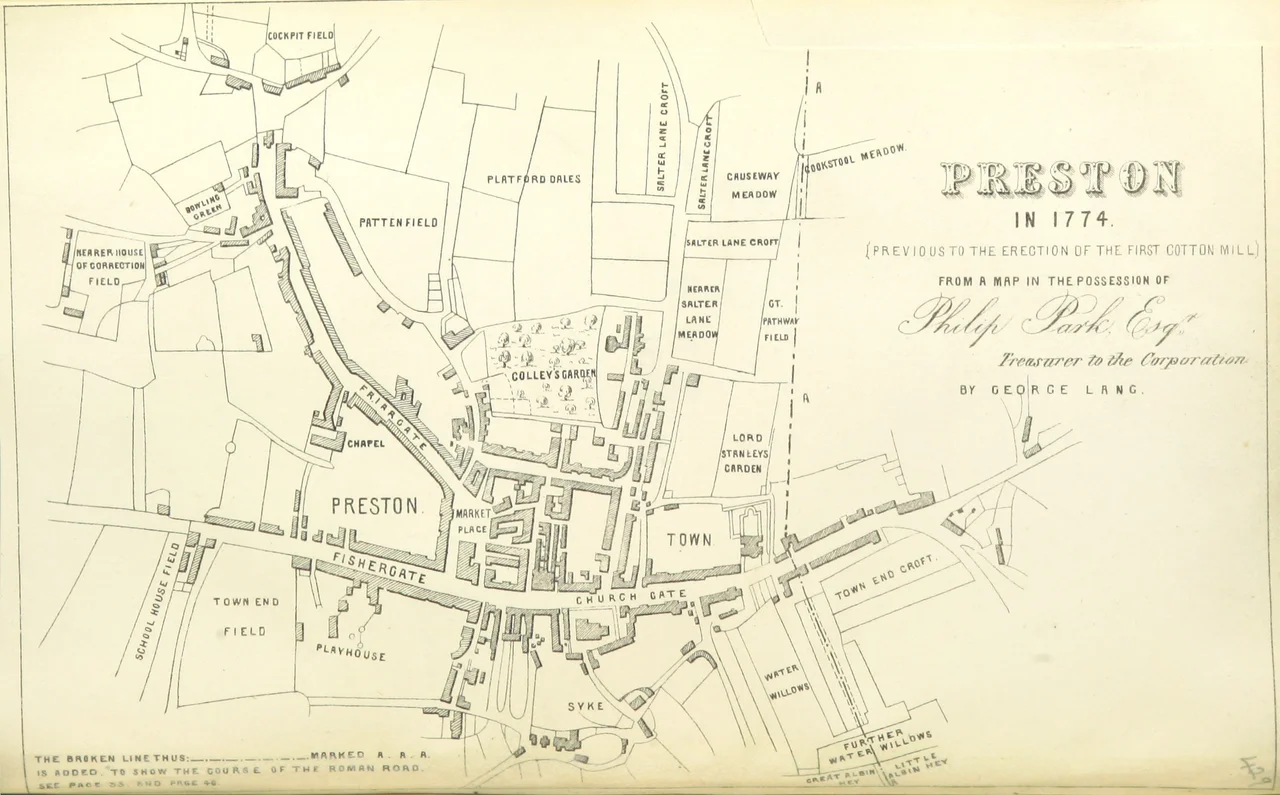
_p2.090_-_Map_of_Preston_as_it_was_in_1774.jpg)
Battle of Preston (1715)
Some historians call it the last battle on English soil. Others argue it was a siege, and that the Battle of Sedgemoor in 1685 was the last true pitched battle, and that what happened at Preston in November 1715 was something else, something messier, six days of barricades and burning houses and street-fighting at point-blank range. The technical category matters less than the result. After two days of fire from upstairs windows and dragoons charging up barricaded streets, the Jacobite commander Thomas Forster, a Northumberland squire who had been chosen for command largely because he was a Protestant, surrendered 1,468 men to General Charles Wills. The Jacobite rising of 1715 effectively ended in the streets of a Lancashire market town.
Marching South
The 1715 rising was the first serious attempt to put James Francis Edward Stuart, the Old Pretender, on the British throne in place of the new Hanoverian George I. In northern England the rising had drawn perhaps four thousand men by the time it reached Preston, a mixed force of English Catholics, Scottish Lowlanders and Highlanders. Their cavalry rode into Preston on the night of 9 November 1715. Government dragoons and militia in the town withdrew toward Wigan without a fight. The Jacobites had taken what was, by any military reading, a strong defensive position. Preston sat at a natural choke-point. The bridge over the River Ribble, half a mile outside the town, could be held by a small force against a much larger one. Forster, against advice, ordered his men to abandon the bridge and pull back into the streets.
The Barricades
When Wills's six regiments arrived from Manchester on 12 November they found Preston barricaded. The principal streets had been blocked with carts, timber and furniture. Jacobite musketeers held the upstairs rooms of the houses behind. Wills, perhaps underestimating his enemy, ordered an immediate frontal attack. It was thrown back with heavy losses. Wills then ordered houses set on fire to drive the defenders out, hoping the flames would spread to the barricaded positions. The Jacobites returned the favour, setting fire to the houses Wills's men had taken. Smoke and burning timber filled the streets between the parish church and the market square. The legend of the action survives in the Lancashire ballad Lo! The Bird is Fallen. On the night of 12 to 13 November, Wills ordered his men to light their own positions for identification. The light helped them see each other. It also helped the Jacobite snipers see them.
The Surrender
George Carpenter arrived with additional government forces from Newcastle on 13 November, and Wills used the new arrivals to seal off any escape route. The Jacobite position became hopeless. Henry Oxburgh, an English Catholic officer, persuaded Forster to open negotiations. When the Scots in the garrison learned what was being discussed, they paraded through the streets threatening anyone who spoke of surrender, killing or wounding several Jacobites in the process. By the morning of 14 November Forster offered an unconditional surrender, which Wills refused unless it also applied to the Scots. After several hours of argument the Scots agreed. At seven in the morning the town surrendered. 1,468 men became prisoners. Seventeen Jacobites had been killed and twenty-five wounded; government casualties were close to three hundred killed and wounded.
Tyburn and Transportation
The senior captives were marched south for trial. Five lords were sentenced to be executed for treason under acts of attainder: the Earl of Winton, Viscount Kenmure, the Earl of Nithsdale, the Earl of Derwentwater, and Lord Nairne. Winton and Nithsdale both escaped from the Tower of London. Nithsdale's escape, organised by his wife Winifred Maxwell, who smuggled women's clothing into his cell the night before his execution and walked him out as a maidservant, became one of the most retold prison-break stories of the eighteenth century. Colonel Oxburgh, who had urged the surrender, was hanged, drawn and quartered at Tyburn the following May. Many of the ordinary Highland prisoners were transported to the American colonies. The Indemnity Act of 1717 pardoned almost all surviving prisoners except members of Clan Gregor, who remained outlaws.
The Last Battle on English Soil?
The claim that Preston was the last English battle is contested in the literature. Sedgemoor in 1685 was a clearer pitched battle. The Battle of Clifton Moor near Penrith on 18 December 1745, during the next Jacobite rising, was a smaller skirmish but unambiguously a battle. The Battle of Bossenden Wood in Kent in 1838 has its own claim. What Preston offered, that the others did not, was the spectacle of an entire town turned into a battlefield: the streets where the fighting happened are still walkable, the parish church still standing, the line of the old market still traceable in the modern layout. The 1715 rising's failure here meant that when the Stuarts came back thirty years later under Bonnie Prince Charlie, they would have to come back through Preston again, and would not get nearly as far.
From the Air
Located at 53.754N, 2.701W in central Preston, Lancashire. Manchester Airport (EGCC) lies 25 nm to the southeast, Blackpool (EGNH) 13 nm to the west. At 2,500 ft AGL, look for the River Ribble curving south of the city, the M6 running through the eastern edge, and the M55 running west toward the Fylde coast. The original fighting took place in the streets between St John's parish church (now Preston Minster) and the central market. Typical Lancashire weather: low ceilings, frequent rain, prevailing southwesterly winds.
Nearby Stories
- Winwick rail crash 1.4 km away
- Hoylake Lifeboat Station 4.4 km away
- Murder of Lindsay Rimer 7 km away
- Mellor Mill 7 km away
- Embsay and Bolton Abbey Steam Railway 7.8 km away
- Piel Castle 11 km away
- Ashton Memorial 13 km away
- Hoylake 35 km away