
Battle of San Lorenzo
The whole thing lasted about fifteen minutes. At dawn on February 3, 1813, on a flat plain above the Paraná River, José de San Martín hid his cavalry behind a convent and waited for royalist troops to climb the steep bank from their ships. When they reached the top, his grenadiers swept in from two sides at once. It was the first time this regiment had ever fought, and the first time San Martín had drawn a sabre in the wars of South American independence. It would also be the only battle he ever fought on what is now Argentine soil - the man who would go on to liberate Chile and Peru began here, in a quarter-hour of dust and noise that cost sixteen of his men their lives.
Why the River Mattered
By 1813 the revolution in Buenos Aires had reasons for cautious hope - victories at Tucumán and Salta had steadied a shaky cause. But the royalist stronghold of Montevideo, though under siege, still controlled the river, and its ships ranged up the Paraná raiding coastal towns for food and money. The new government promoted San Martín to colonel and gave him the Regiment of Mounted Grenadiers, a unit he had trained in the latest tactics of the Napoleonic Wars, and told him to stop the raids. When he learned the royalists meant to plunder the San Carlos Convent near the village of San Lorenzo, he pushed his men hard to get there first.
A Night Inside the Convent
The plain offered no cover - which was the problem, and also, in the end, the solution. The cavalry could not hide in open country, so on the night of February 2 the grenadiers slipped in through the rear door of the San Carlos Convent and went silent. No fires. No talking. From the convent tower, San Martín studied the enemy ships and the ground below through a monocular, working out exactly where the royalists would land and how he would catch them. The reinforcements mattered: a cadet named Ángel Pacheco had ridden ahead and staged fresh horses along the route, which is why an army covered the distance from Buenos Aires in only five days.
Fifteen Minutes at Daybreak
The royalists came ashore at 5:30 in the morning, formed two columns with their cannon, and started up the ladder-shaped path cut into the bank. San Martín gave a short speech, divided his roughly 120 horsemen into two wings, and sent them in - one led by him, the other by Justo Germán Bermúdez. The grenadiers carried no firearms into the charge; they fought with sabre and lance. Surprise and speed undid a force nearly twice their size. The royalists could not form a defensive square, and they broke and fled back toward their ships under covering fire. In a quarter of an hour it was decided. Forty royalist soldiers lay dead. Fourteen grenadiers were killed outright, and two more would die of their wounds.
The Men Who Saved Him
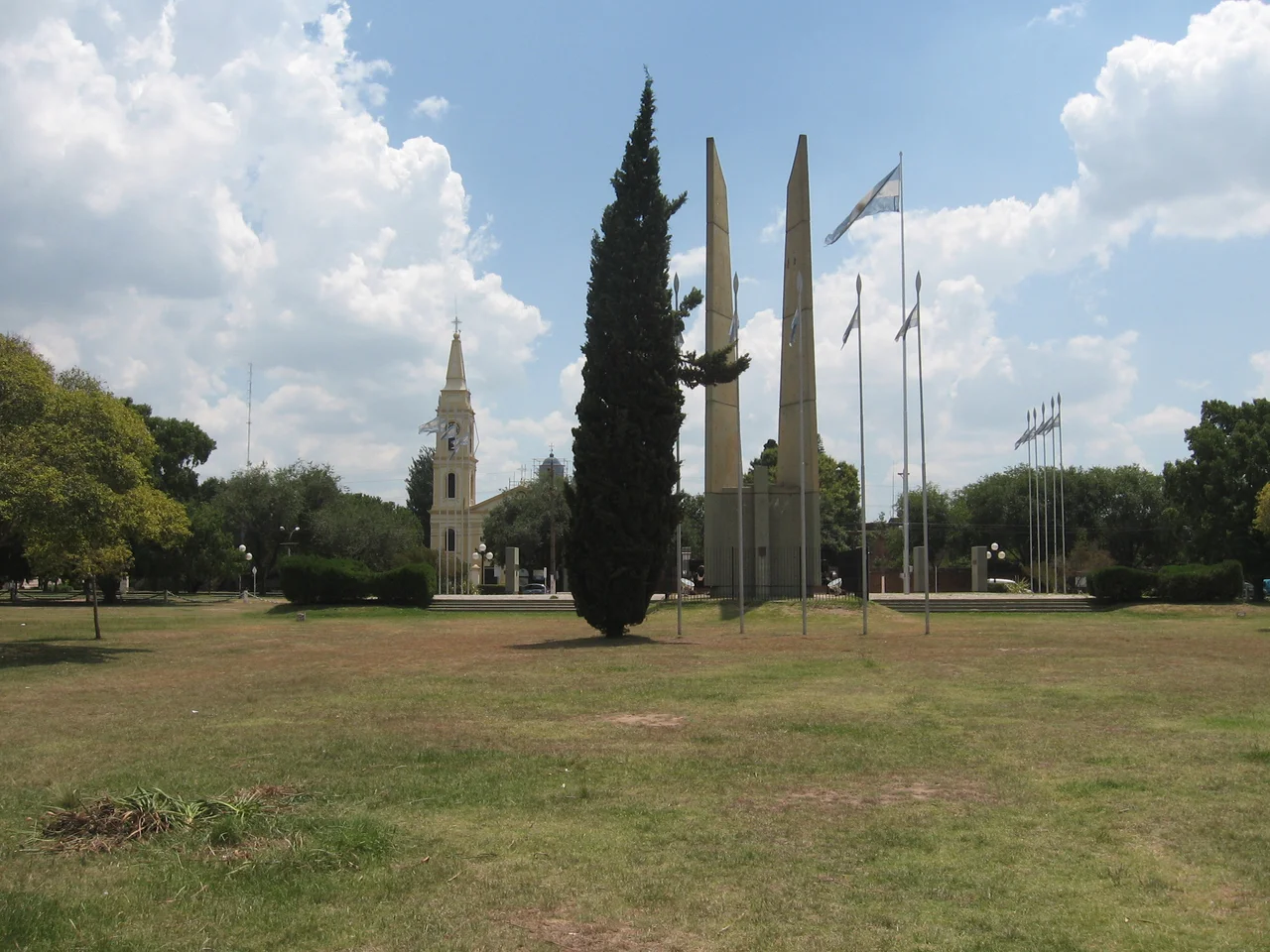
San Martín nearly died in the dust. His horse was shot from under him and fell, pinning his leg, and a royalist - probably the enemy commander himself - slashed his face and put a bullet through his arm. Two of his own men reached him in time: Juan Bautista Baigorria and Juan Bautista Cabral. Cabral was mortally wounded pulling his commander free. San Martín later wrote that Cabral, dying, said he was content - that they had beaten the enemy. Cabral is remembered across Argentina as Sergeant Cabral, though he was in fact a private; some say San Martín, who also spoke Guaraní, translated the young soldier's last words from his first language. Bermúdez, who led the other wing, was shot in the knee and died within days. They are not statistics. The monument here keeps nine memorials for the sixteen dead, grouped by the nine homelands they came from: six Argentine provinces, plus Chile, France, and the Banda Oriental that would become Uruguay.
Mercy After the Charge
What San Martín did next is remembered almost as much as the fight. He took no hostages and demanded no ransom. When the defeated commander, Zabala, asked for help tending his wounded, San Martín gave it - and then invited Zabala to share a large breakfast, hoping to persuade him that the cause of absolute monarchy was not worth dying for. He succeeded; Zabala later joined the patriot army. The battle's military importance was slight, and it changed little in the wider war. But it became legend because of who fought it, and how. The march written for it is counted among the finest in the world, and the stone pine under which San Martín wrote his battle report - the Historic Pine - still stands beside the convent, more than two centuries old.
From the Air
The battlefield - the Campo de la Gloria, the Field of Glory - lies in the modern city of San Lorenzo, Santa Fe, at about 32.75 degrees south, 60.73 degrees west, on the high west bank of the Paraná River roughly 24 km north of Rosario. From the air, orient on the broad Paraná: the river is at its widest here, the west bank rising tall and steep above it. The San Carlos Convent and the battle monument with its eternal flame sit a short distance inland from the bank. The nearest airport is Rosario - Islas Malvinas International Airport (ICAO: SAAR, IATA: ROS), about 30 km to the south. Best viewed at lower altitudes in clear conditions, following the river north out of Rosario past the petrochemical port towns named for the men who fought here.
Nearby Stories
- Battle of Cepeda (1859) 38 km away
- Predelta National Park 41 km away
- Battle of the Tonelero Pass 43 km away
- Ramallo Massacre 80 km away
- Sa Pereira Rail Disaster 106 km away
- San José Palace 150 km away
- Battle of Quebracho Herrado 169 km away
- The Pampas 230 km away