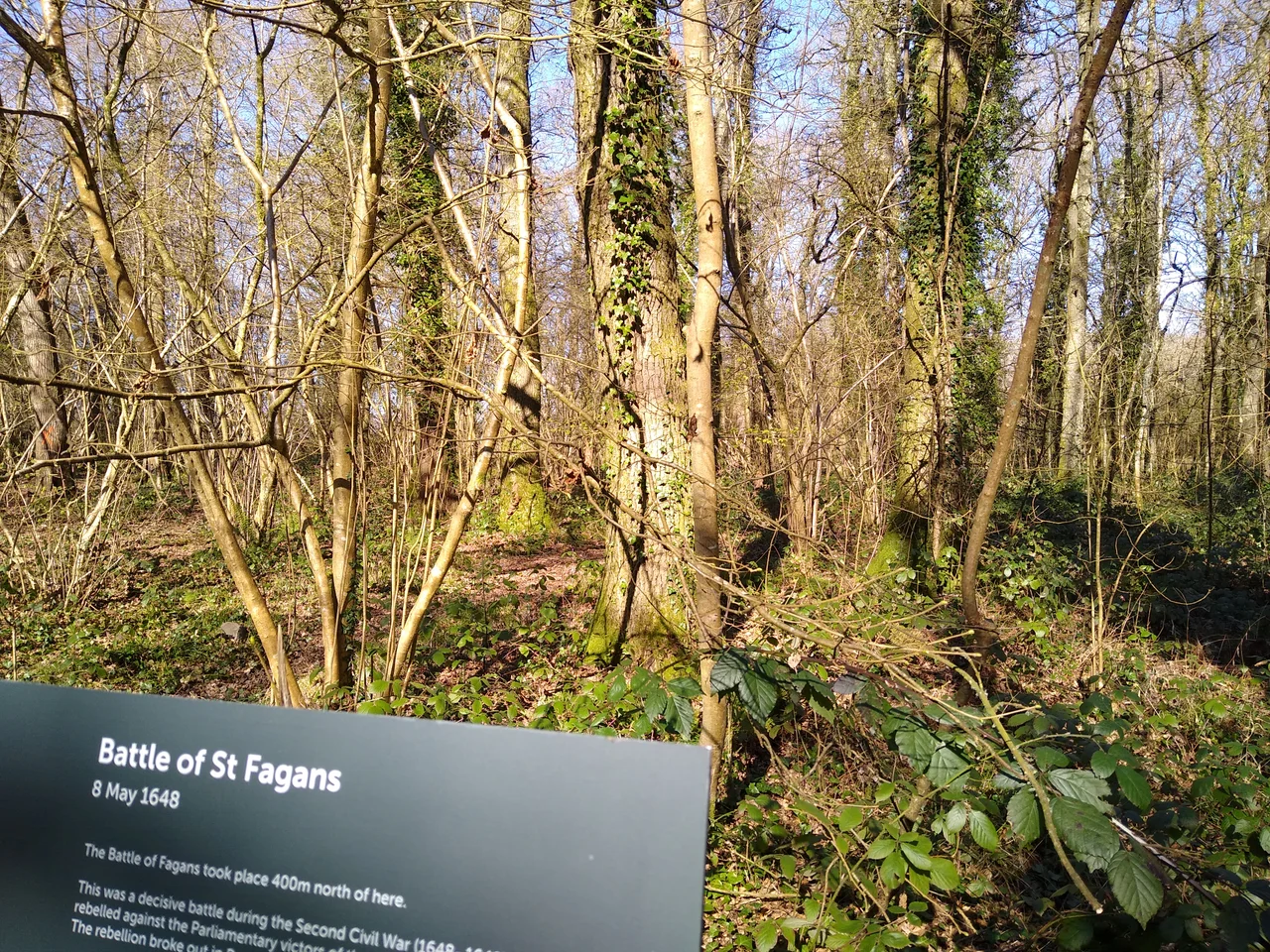

Battle of St Fagans
The Welsh soldiers who attacked Parliament's army at St Fagans on the morning of 8 May 1648 had spent the previous war fighting on Parliament's side. They had not switched ideologies. They had switched because Parliament had not paid them in months, and now wanted to disband them without their wages, and was demanding they hand their fortresses over to strangers from the New Model Army. Hungry, angry, owed money, they declared for the King they had spent six years fighting against. By dawn that May morning they outnumbered the Parliamentarians more than two to one. By mid-morning over 200 of them were dead and 3,000 were prisoners, and Welsh resistance in the Second English Civil War was effectively over.
A Quarrel About Pay
The First English Civil War ended in 1646 with the King defeated. Two years later, in 1648, the country was at war with itself again. The Second English Civil War was not a war of ideas so much as a war of grievances - of unpaid soldiers, of resentful provinces, of factions who had won the first round and could not agree on what to do with the victory. In Pembrokeshire, in early March 1648, the local Parliamentarian commanders John Poyer and Rice Powell refused to hand their fortresses - Pembroke and Tenby castles - over to officers of the New Model Army. Their soldiers had not been paid. They feared being disbanded without their wages and abandoned in a wrecked countryside. Rowland Laugharne, the senior Parliamentarian commander in Wales, joined them. What began as a pay dispute became political when the mutineers opened communications with Charles I. By the end of April, Laugharne had assembled around 8,000 men and was marching east on Cardiff.
Horton's Three Thousand
Colonel Thomas Horton commanded the 3,000-strong detachment Parliament had sent to replace Laugharne and secure Wales. He was a veteran New Model officer doing what veteran officers do: marching to Carmarthen, putting down a separate uprising in Brecon along the way, then occupying Cardiff and quartering his troops in and around the village of St Fagans, west of town. Oliver Cromwell himself was coming from the east with reinforcements. Laugharne understood the arithmetic. If Cromwell joined Horton, the numerical advantage would shift. So Laugharne decided to attack Horton's smaller force before Cromwell could arrive. The Welsh army had men. It did not have training. Up to half of Laugharne's force were levies - poorly equipped, poorly drilled, no match for the veteran New Model infantry and cavalry waiting outside the village. But on paper, 8,000 against 3,000 looks good, and on paper is sometimes all you have.
Dawn at the Nant Dowlais
Early on 8 May, Parliamentarian scouts made contact with the Royalist army about three kilometres outside St Fagans. Horton deployed quickly, taking the centre with most of his infantry, splitting his cavalry and dragoons between the wings - John Okey commanding the left, Nathaniel Barton the right - with two small Forlorn Hopes thrown out in front. Laugharne formed his troops along a wooded ridge 1.2 kilometres northwest of the village. Between the two armies ran a small stream called the Nant Dowlais. Shortly before 8 a.m., Laugharne tried to seize the initiative. He sent 500 infantry across the stream to surprise Horton's centre, hoping to catch the Parliamentarians inside the village. Horton's cavalry charged. The advance guard broke and fled. The element of surprise was lost before the main battle began, and the New Model Army now had time to deploy in the open ground beyond the village where their veteran discipline could work.
The Rout
The fight became general in the fields northwest of the village. High hedges hampered Horton's horsemen in the centre, but on the wings the Parliamentarian dragoons under Okey forced both Royalist wings back. Then a Parliamentarian cavalry detachment under Major Bethel circled and charged the Royalist left and rear simultaneously. The Royalist line panicked. The Welsh levies who had never been properly drilled broke first, and once the rout began it could not be stopped. Over 200 of Laugharne's men were killed. Another 3,000 were taken prisoner - more than the entire size of Horton's army. Laugharne escaped with what was left of his force. He retreated west to join Poyer at Pembroke Castle, but the field army he had spent months assembling was finished.
Cromwell's Hard Spring
Cromwell reached Gloucester on the day of the battle and crossed into Wales shortly after. He left Colonel Isaac Ewer to invest Chepstow Castle, joined Horton at Tenby on 15 May, then marched on Pembroke and besieged it. The Welsh fortresses fell one by one. When they did, Cromwell was finally free to turn east and deal with the larger threat: an invading Scottish army that crossed the border on behalf of the captive King. He met them at the decisive Battle of Preston in August 1648 and destroyed them. The Second English Civil War ended. Charles I was tried and executed in January 1649, with John Poyer himself executed by firing squad in April 1649 - the lot of three convicted leaders had been drawn and Poyer's was the unfortunate one - and Wales settled into the uneasy peace of the Commonwealth. Without St Fagans, Cromwell might have been pinned down in the Welsh borders while the Scots took London. With it, the way east was clear.
The Quiet Village Now
Today St Fagans is best known not for the battle but for St Fagans National Museum of History - the open-air museum of Welsh life that draws a million visitors a year. The battlefield sits in a stretch of farmland just outside the village, mostly hedged fields and woods, with no major monument marking where Laugharne's line stood or where Horton's veterans broke it. The Nant Dowlais still runs through the same ground it ran through that morning. Visitors who know to look can trace the topography that decided the day - the wooded ridge, the open fields, the stream. The battle was small by the standards of the great Civil War set-pieces. Marston Moor and Naseby had been larger. But what happened here in three hours on a May morning settled who would govern Britain, and it happened to people who had spent the years before the battle on the same side, fighting for the same Parliament, against the same king they were now dying for.
From the Air
Located at 51.49°N, 3.27°W, just west of Cardiff in the Vale of Glamorgan. The battlefield lies in farmland outside St Fagans village, near the National Museum of Wales / St Fagans site, with the small Nant Dowlais stream still tracing the line between the two armies. Cardiff (EGFF) is approximately 4 miles east-southeast. Best viewed at 1,500-2,500 feet AGL with the M4 visible to the north and Cardiff's urban edge to the east. The terrain remains mostly farmland and woods with hedged field patterns that recall the seventeenth-century landscape.
Nearby Stories
- Aberfan Disaster 1.3 km away
- Glastonbury 6.5 km away
- Quantock Hills 7.4 km away
- Tyntesfield 7.5 km away
- Tintern 9.2 km away
- The Mumbles Lifeboat Station 19 km away
- Carreg Cennen Castle 20 km away
- Appledore Lifeboat Station 26 km away