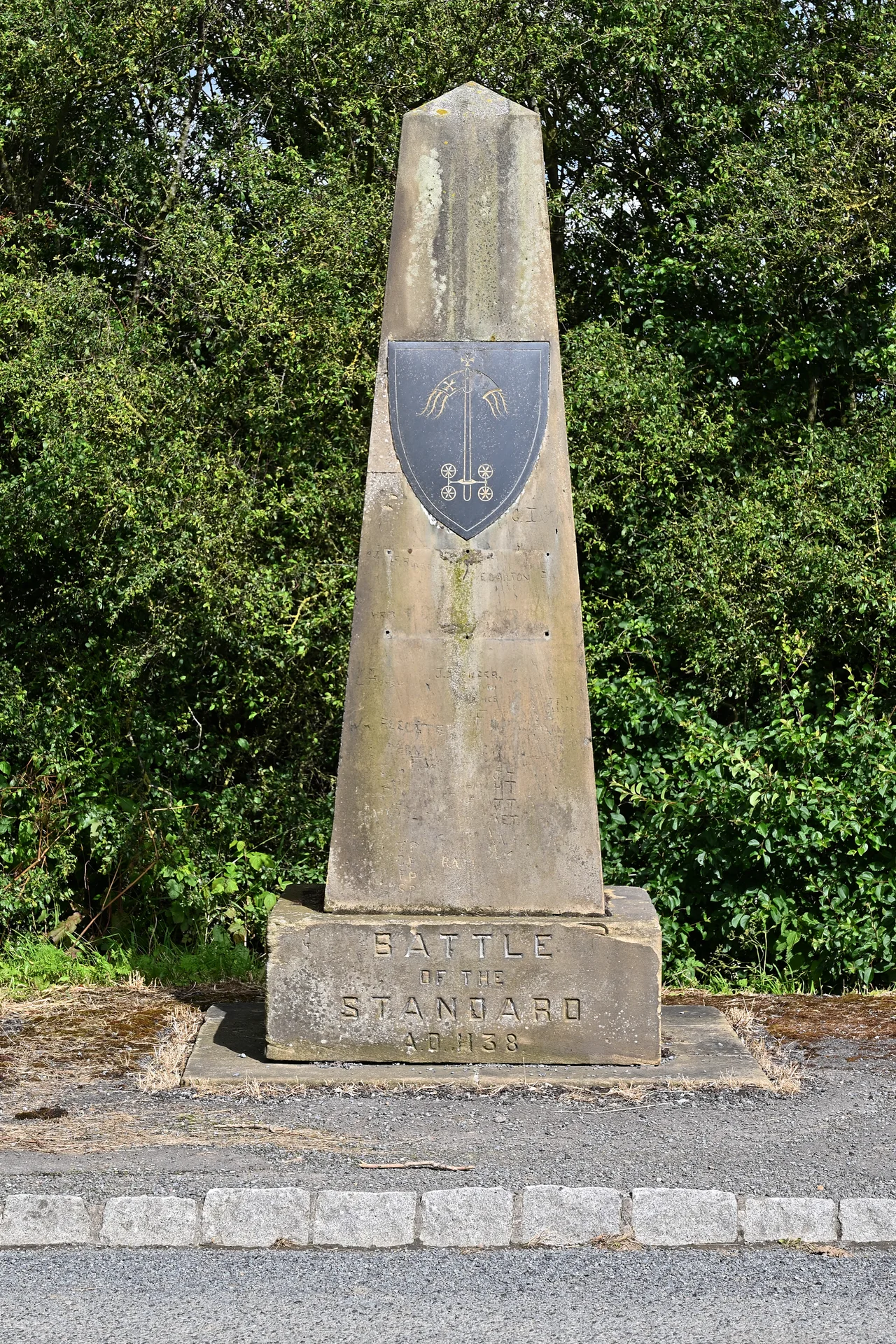

Battle of the Standard
It was the cart that gave the battle its name. Archbishop Thurstan of York had rigged a ship's mast onto a wagon, mounted a pyx with the consecrated host at the top, and run up the banners of the minsters of York, Beverley, and Ripon. The whole contraption stood at the centre of the English line on Cowton Moor, a strange ecclesiastical engine borrowed from contemporary Italian warfare where it was called a carroccio. Around it Yorkshire farmers, baronial retinues from the north Midlands, and dismounted Norman knights waited for the Scots. The morning was 22 August 1138. By noon the Scottish army had disintegrated, and a king who had crossed the Tweed expecting easy conquest was riding hard for Carlisle.
Anarchy and Opportunity
King David I of Scotland had a reasonable case for invading. Henry I of England, who had been David's brother-in-law and patron, had made his nobles swear in 1127 to support his daughter Matilda as heir. David was the first layman to take the oath. When Henry died in 1135, Matilda's cousin Stephen seized the throne instead, plunging England into the long civil war known as the Anarchy. David crossed the border to support Matilda's claim and, not coincidentally, to enlarge his own kingdom. After two months of campaigning in 1136 he had been ceded Cumberland and seen his son Henry made Earl of Huntingdon. By early 1138 he was back, taking Norham Castle on the Tweed and pushing into Northumberland, demanding tribute from settlements and abbeys to spare them plunder. By August he was beyond the Tees, advancing toward York.
The Cart and the Sermon
Stephen could spare almost nothing for the north. He was fighting rebel barons in the south and sent only a small force, mostly mercenaries. The defence was therefore raised by Archbishop Thurstan of York, an old man by 1138 but a formidable organiser. He preached that resisting the Scots was God's work, partly because of widespread shock at Scottish atrocities - chroniclers like Richard of Hexham accused some of David's troops of systematically carrying off English women and children as slaves. The horror was as much about social transgression as raw brutality. Slave-raiding was acceptable along the Welsh and Scottish marches as a revenue source, but Hexham and other monastic writers regarded the scale and explicitness as something darker. Thurstan's response was the standard cart, the carroccio, a Mediterranean military fashion of recent invention. It marked the centre of his line and gave the local militia something sacred to die defending.
Three Hours
Early on 22 August the Scots found the English drawn up on open fields two miles north of Northallerton, on Cowton Moor. The Scottish army formed in four lines and attacked. Their first line, unarmoured spearmen mostly drawn from the Galwegians and the Highlands, charged a wall of armoured men - dismounted Norman knights and men-at-arms - under heavy archery from the English flanks. They could not break through. Within three hours the Scottish army had collapsed, apart from disciplined cores of knights around King David and his son Henry. Henry led a spirited counter-charge with mounted knights. He and David then withdrew separately, in relatively good order, leaving the field but escaping with their personal retinues intact. The chronicles claim heavy Scottish losses both in the battle and in the flight.
The Strange Peace
The English did not pursue far. David fell back to Carlisle and quickly reassembled an army. Within a month the two sides had negotiated a truce that left the Scots free to continue besieging Wark Castle, which eventually fell. And despite losing the battle, David received most of the territorial concessions he had wanted - concessions, the chroniclers say, that had actually been offered to him before he crossed the Tees in the first place. He held the gains throughout the rest of the Anarchy. Only after his death did his successor Malcolm IV have to surrender David's territorial winnings to Henry II of England. The battle that the English remembered as a great victory thus delivered to the loser nearly everything he had set out to win. Some chronicle accounts include an elaborate pre-battle speech celebrating the glorious deeds of the Normans, which historians treat with appropriate scepticism: it tells us less about what was said than about how the Norman-descended writers of the next generation wanted to remember their grandfathers' war.
From the Air
Located at 54.367 N, 1.450 W on Cowton Moor approximately 2 miles north of Northallerton in North Yorkshire. Best viewed at 1,500-3,000 feet AGL. The battlefield is now agricultural land east of the A167 between Brompton and East Cowton, with the East Coast Main Line running north-south through the area. A small monument marks the approximate site. Teesside (EGNV) lies about 15 nm north-east, Leeds Bradford (EGNM) about 40 nm south. The flat ground here, sloping gently from the Cleveland Hills to the Vale of York, is what made it good defensive terrain and what kept it as farmland for nine centuries afterwards.
Nearby Stories
- Studley Royal Park 2.8 km away
- Sheriff Hutton Castle 6.7 km away
- Gordale Scar 7.8 km away
- Moor House-Upper Teesdale 9.1 km away
- Durham University Oriental Museum 11 km away
- Nine Standards Rigg 12 km away
- Rosedale Abbey 13 km away
- German submarine U-2367 77 km away