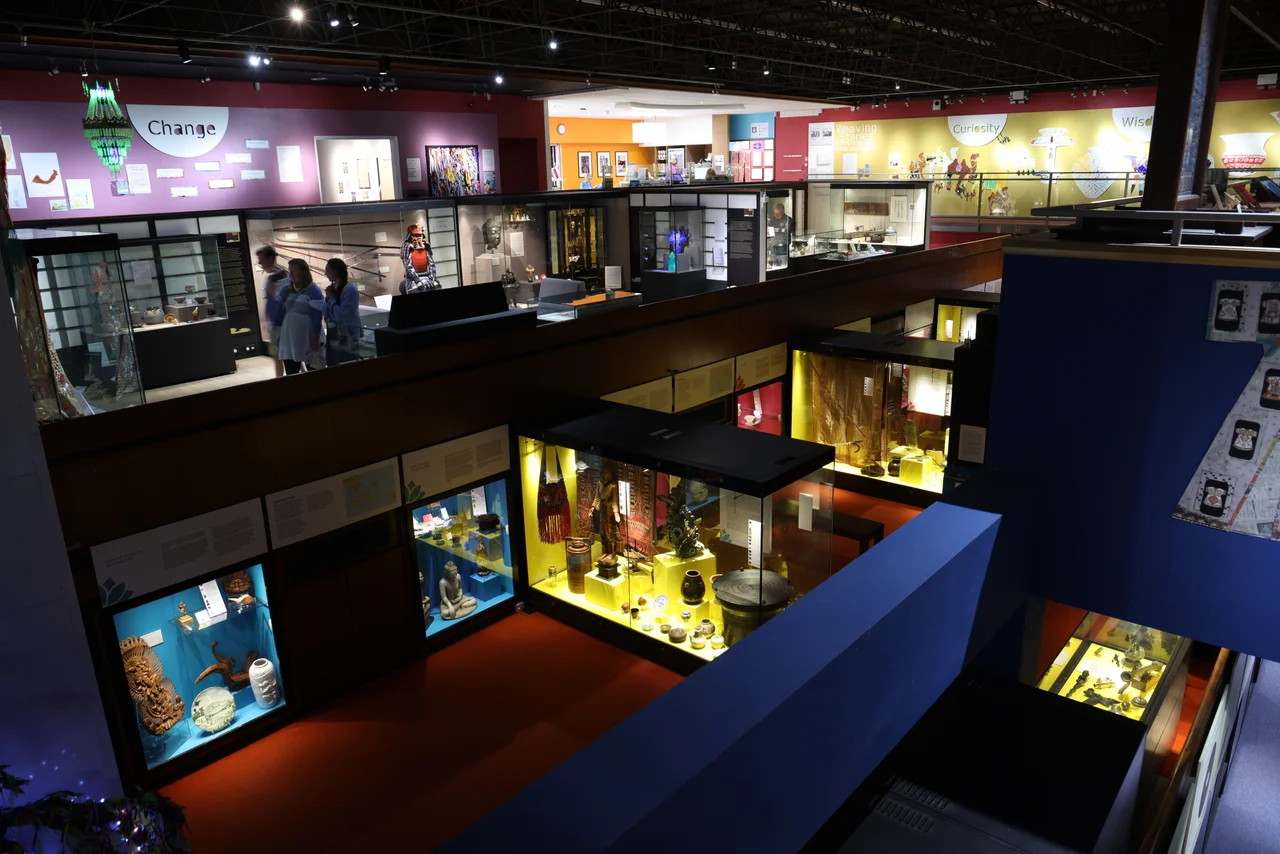

Durham University Oriental Museum
In October 1969, NASA sent a fragment of Moon rock to Durham University's department of earth sciences. Before the analysis began, the rock was put on display at the Oriental Museum for two days. Twelve thousand people came to see it. The museum stayed open until 8:30 in the evening to handle the crowds. It is a strange detail, a piece of the Moon held briefly in a museum dedicated to art and archaeology from the other side of the world, but it captures something true about the Oriental Museum's appetite for the unexpected. The collection that began as a teaching aid for the School of Oriental Studies has been pulling in surprising objects ever since.
The Northumberland Collection
The museum's founding acquisition came from the Fourth Duke of Northumberland's collection, purchased in 1949 by William Thacker, Professor of Hebrew and Oriental Languages. Thacker stored the items, mostly Egyptian and Near Eastern artefacts, in two rooms at Hatfield College, with viewing by appointment only. The Egyptian holdings alone numbered over 2,500 objects, including an 18th-dynasty funeral mask, a shabti of Prince Bahmery, and a statue of the Vizier Paser from the reign of Ramesses II. After the Hatfield College rooms closed in 1956 the collection went into storage. The new museum building opened in 1960 to house everything properly. The 4,600 items from Sir Henry Wellcome's collection joined later, pushing the Egyptian holdings past 6,700 pieces total.
Coronation Bronzes and Chinese Jades
In 1953, as part of the celebrations for the Coronation of Elizabeth II, the Chinese lecturer Raymond Dawson curated an exhibition of loaned Chinese bronzes at Durham. Cosin's Library followed in 1954 with Chinese books and textiles. These two exhibitions changed the course of the collection. Major donations followed. Malcolm MacDonald, the Labour politician and diplomat who had served as British High Commissioner in India and Commissioner-General in South-East Asia, gave his Chinese ceramics collection. Charles Hardinge, formerly Viceroy of India, donated nearly 2,000 pieces of jade and hardstones. The Chinese collection now holds over 10,000 objects covering periods from the Zhou dynasty to the Qing dynasty. About 400 of the roughly 1,000 ceramic pieces come from MacDonald's gift.
The Two-Million Pound Theft
In April 2012, thieves broke into the Oriental Museum and stole Chinese artefacts valued at almost two million pounds. Two jade pieces and a porcelain figurine were taken. Police recovered the items within weeks. In 2013, two men were tried, convicted, and jailed for the burglary. The case attracted national attention not only for its scale but for what it revealed about the international market in Chinese antiquities and the increasingly determined thieves who target British museums to feed it. Durham was one of several institutions hit during a wave of similar burglaries across the United Kingdom in those years. The museum tightened its security afterwards and continued its work.
The Cloak Goes Home
In 2025, the museum returned an 18th-century Māori war cloak called a pauku to New Zealand on a five-year loan to the Auckland War Memorial Museum. The cloak had a rare Tāniko border and was one of only five known to exist in the world. It came to Durham on loan in the 1960s and was gifted to the museum in 1971. From 2017, Rangi Te Kanawa and other Māori experts worked with Durham staff to research and conserve the cloak. The return is the first time this piece has been back in Aotearoa New Zealand since its original creation. Further research will continue during the loan to determine the cloak's specific origins and to discuss its permanent home. The decision reflects a wider movement in museum ethics about objects collected during the colonial period.
Forgotten Volunteers and Returned Flags
In 2017 the Oriental Museum staged the first exhibition held anywhere in Britain on the Chinese Labour Corps, the roughly 140,000 Chinese volunteers who assisted the British Army in the First World War, digging trenches and handling supplies on the Western Front. Their contribution was almost entirely forgotten in the United Kingdom for a century. In 2021 the museum returned two Japanese Good Luck Flags to the families of their original owners. The flags had been taken as souvenirs during the Second World War, then sat in collections for decades. One had been held by the university for many years before its inscriptions were identified in 2018; the other was held temporarily at the request of police. Each act of return tells a story about who collected what during the imperial age, and about what museums in the 21st century are choosing to do about it.
From the Air
The Oriental Museum sits at 54.76 degrees north, 1.58 degrees west, on Elvet Hill on the south side of central Durham. Newcastle Airport (ICAO: EGNT) is 19 miles north. Teesside International (EGNV) is 23 miles south-east. From the air the museum is on the university's main academic precinct, south of the medieval peninsula. The cathedral and castle stand 1 kilometre north on their hilltop above the River Wear. The East Coast Main Line viaduct crosses the city west of the peninsula. The wider Durham city occupies a system of low hills and valleys, with the A1(M) bypassing to the east. River fog from the Wear valley sometimes settles over Durham on calm mornings. Visibility from cruise altitude is usually good in summer; winter sees frequent low cloud and reduced ceiling values typical for the north-east of England.
Nearby Stories
- Hadrian's Wall Path 1.8 km away
- Killingworth 2.2 km away
- Allenheads 9.2 km away
- Nine Standards Rigg 11 km away
- Catterick Bridge Explosion 12 km away
- Rosedale Abbey 19 km away
- Saltburn Pier 20 km away
- Alexander L. Kielland (Platform) 306 km away