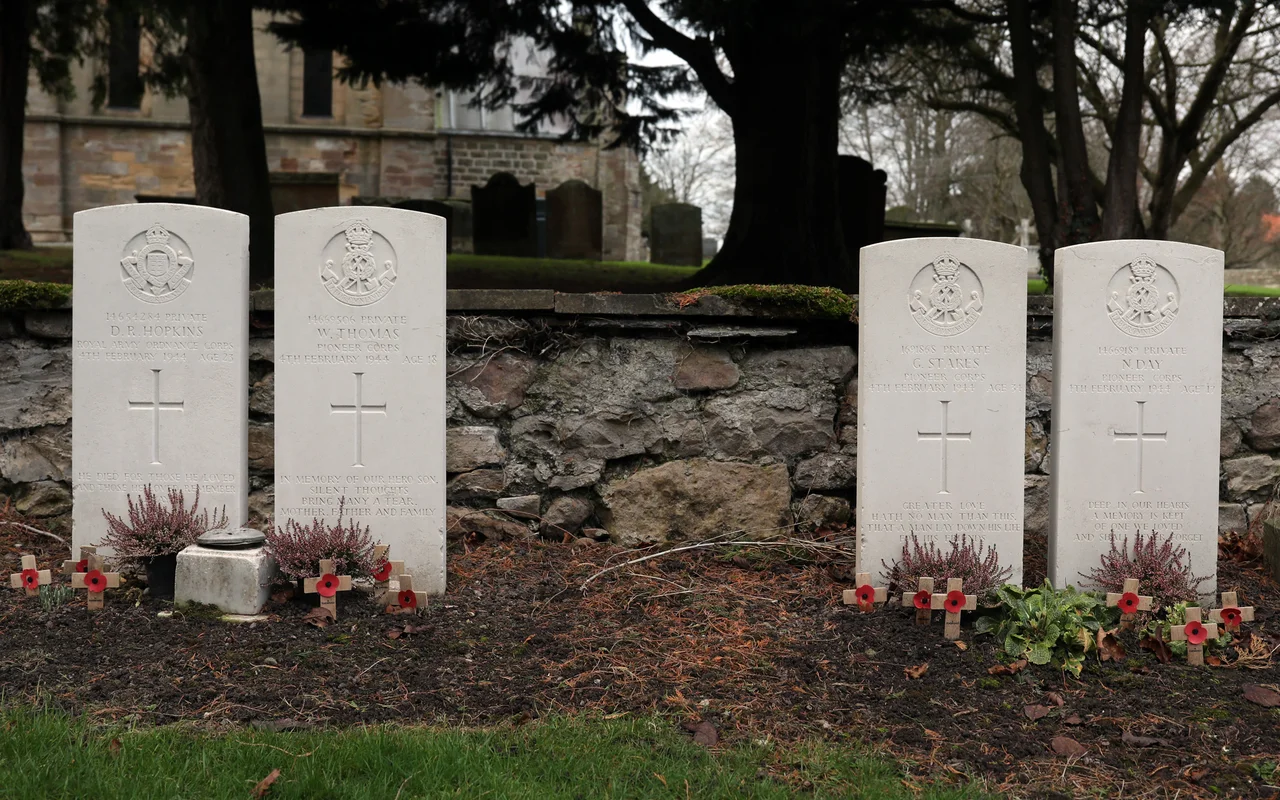

Catterick Bridge Explosion
Friday afternoons at Catterick Bridge station were always busy. Service personnel from the surrounding camps queued for weekend trains, the goods yard rattled with the constant traffic of a wartime branch line, and the station hotel did brisk business in beer for soldiers about to head home for a few hours. On 4 February 1944, just before four o'clock, the goods yard exploded. Twelve people were killed instantly. More than a hundred were injured. The railway hotel was destroyed. Almost nobody outside North Yorkshire ever heard about it, because the country was four months from D-Day and the explosives that detonated had been bound for the invasion of France.
The Wartime Branch Line
Catterick Bridge station sat on the Eryholme to Richmond branch of the London and North Eastern Railway, connecting Richmond to the East Coast Main Line. By 1944 it was the freight gateway for the vast Catterick army camp - a sprawling training and logistics base that had ballooned during two world wars into the largest military complex in northern England. The goods yard handled everything the army needed: rations, fuel, kit, vehicles, and steadily increasing amounts of ammunition as the D-Day buildup accelerated. On the day of the disaster, soldiers were loading rail wagons with explosives destined for the invasion stockpiles being assembled along the south coast. One witness later told the local newspaper that he had watched the same loading crew days earlier handling ammunition carefully, two men to a box. On 4 February, he said, they were practically throwing them into the wagons.
Four O'Clock
A large explosion ripped through the goods yard at about 3:55 pm. The four privates loading the wagons were directly at the epicentre of the blast. Three were from the Royal Pioneer Corps; the fourth from the Royal Army Ordnance Corps. Their remains were not initially recovered. Three days afterward the Northern Despatch was still listing them as missing. What survived of them was eventually buried in four graves in the churchyard of St Mary's at Hornby, five miles to the south-west. The other dead included the stationmaster of Catterick Bridge, two female clerks from the goods office, a Royal Air Force serviceman, one other military casualty, and several civilians. Two of the dead were never identified. The Military Court of Inquiry that convened afterwards apportioned no blame and recorded all twelve deaths as accidental. A theory that a primed grenade had been mixed into the consignment was raised and not resolved.
Quiet Heroism
A lorry driver in a hut more than thirty feet from the blast was thrown off his feet and badly wounded. Despite his own injuries he joined the rescue parties, working through the wreckage knowing perfectly well that unexploded ordnance was scattered everywhere. For this he was awarded the Edward Medal by King George VI, gazetted in June 1944. The medal is now in the keeping of Richmond Council. Another improvised act of courage stopped a worse disaster: a taxi driver ran up the line carrying a makeshift flag, flagging down an incoming train before it could pile into the wreckage on the damaged track. The trains were frequent on Friday afternoons, the station was crowded, and a second collision could have multiplied the casualties many times over. He is not named in the surviving accounts. The railway hotel was destroyed in the blast. Local legend insists that the cellars were raided for the beer that survived, and that the hotel's licence to sell alcohol continued formally in force until 1984 because nobody could be bothered to have it cancelled.
The Censored Disaster
The British Army's own report into the explosion was conducted but its findings were not released to the public inquiry or to the press, on wartime grounds. An inquest was held the following day on the eight identified casualties. Beyond that, the disaster was effectively buried beneath the censorship covering all military matters in the months before D-Day. Newspapers in the spring of 1944 had little space and even less freedom for stories about ammunition handling errors at a North Yorkshire siding. The dead were locally mourned and locally remembered. Some of their names appear on the war memorial at Brompton-on-Swale, near to where the station stood. The branch line itself closed to passengers in 1969 under the Beeching cuts. Today there is almost nothing left of Catterick Bridge station, and almost no public memory of what happened in its goods yard on a Friday afternoon four months before the Normandy landings.
From the Air
Located at 54.392 N, 1.653 W at the historic site of Catterick Bridge railway station near Brompton-on-Swale, North Yorkshire. The station site is roughly 1 mile north-east of Catterick village on the River Swale. Best viewed at 1,500-2,500 feet AGL. The line of the former Eryholme to Richmond branch railway is still partly traceable through the landscape. The much larger modern Catterick Garrison military base spreads to the south-west. Teesside (EGNV) lies about 20 nm north-east, Leeds Bradford (EGNM) about 40 nm south. The A1(M) motorway runs along the original Roman Dere Street, crossing the Swale just east of the site.
Nearby Stories
- Studley Royal Park 2.8 km away
- Sheriff Hutton Castle 6.7 km away
- Gordale Scar 7.8 km away
- Moor House-Upper Teesdale 9.1 km away
- Durham University Oriental Museum 11 km away
- Nine Standards Rigg 12 km away
- Rosedale Abbey 13 km away
- German submarine U-2367 77 km away