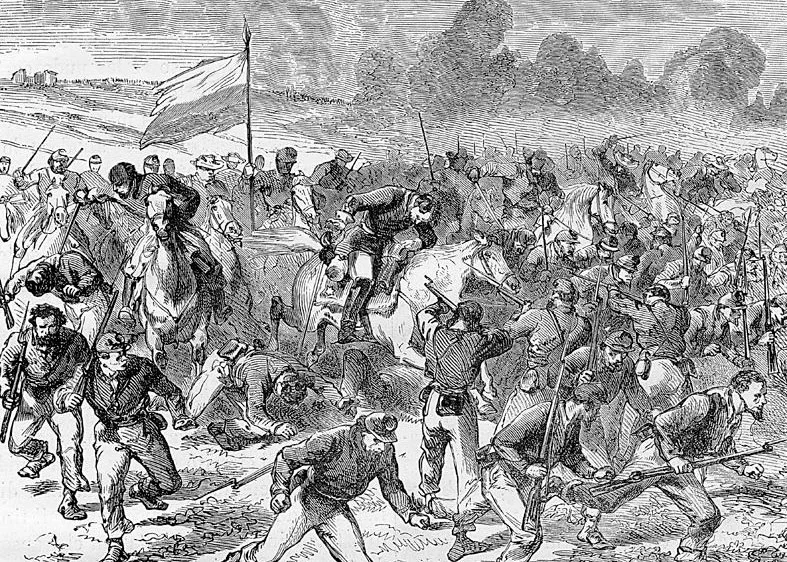

Battle of Yaguachi
Colonel Francisco Gonzalez was leading his Spanish Royalist column down a forest path so narrow his men could only march four abreast. It was the morning of August 19, 1821, and Gonzalez believed he was closing in on the flank of a Patriot army he had been ordered to destroy. What he did not know was that the Patriots had known he was coming for days. A young general named Antonio Jose de Sucre had built an espionage network that read Spanish plans almost as fast as they were drafted. At eleven o'clock that morning, a second Patriot general, Jose Mires, saw the Spanish column stretched thin in the trees and made a decision that saved the independence of Guayaquil.
A Province That Declared Itself Free
In October 1820, the port city of Guayaquil did what most Spanish colonies had not yet dared to do: it declared independence outright, established the Free Province of Guayaquil, and raised an army. The new Patriot force marched north toward Quito, won the Battle of Camino Real, and seemed briefly unstoppable. Then the Spanish reorganized. The Guayaquil army was defeated three times in succession and forced to retreat back to the coast. The Junta of Guayaquil, desperate, appealed to Simon Bolivar in Gran Colombia for help. Bolivar sent General Antonio Jose de Sucre - a twenty-six-year-old Venezuelan officer who would, in the years that followed, win Ayacucho and become the first president of Bolivia. In July 1821, Sucre was staging his forces at Babahoyo, waiting for the rains to end so he could climb into the highlands.
The Royalist Pincer
Spanish General Melchor Aymerich, commanding Royalist forces from Riobamba with 2,000 soldiers, planned a classic pincer. He would lead his main army west from Guaranda down to Babahoyo and pin Sucre against the coast. Meanwhile, Colonel Francisco Gonzalez would come down from the southern highlands and strike Sucre's flank at Yaguachi. Two columns, two angles, one trapped Patriot army. It was a sound plan - if the plan stayed secret. It did not. Sucre's intelligence network reported the Spanish movements in detail, and on August 19th he dispatched General Jose Mires with orders to intercept Gonzalez in the foothills before the Spanish could reach the open country around Yaguachi.
Eleven in the Morning
Mires found Gonzalez's column stretched out on a narrow forest trail, four men across at most, picking its way through the mountain woods. The terrain that should have protected the Spanish instead trapped them. Mires saw what the moment demanded: attack now, before Gonzalez could form a proper battle line or find better ground. At 11 a.m. he placed himself at the head of the Guayaquileno Second Battalion and the Santander Battalion of Colombian auxiliaries and struck. The volleys were fast and accurate. The Spanish column, unable to deploy, was forced to give ground. Gonzalez's men were not cowards - they fought hard for each retreat - but they could not undo the geometry of the path they were trapped on. Slowly, then faster, they broke.
The Ledger of Cone
When it was over, Gonzalez escaped with only 120 men. On the battlefield he left 400 dead and wounded, more than 500 prisoners, and a fortune in weapons, ammunition, and war supplies - which the Patriots immediately turned against the Spanish cause. The Patriots counted 20 dead and 25 wounded. It was a victory bought almost for free. The battle is also called the Battle of Cone, after a nearby landmark, and it remains one of the decisive moments of Ecuador's independence. When word reached General Aymerich that Gonzalez's wing had been annihilated, he abandoned his march on Babahoyo and retreated to the highlands. The pincer had closed on empty air.
The Road to Pichincha
Yaguachi did not end the war in Ecuador. That would take until May 24, 1822, when Sucre would climb the slopes of Pichincha outside Quito and win the battle that finally freed the country. But without Yaguachi there would have been no Pichincha. Sucre's army survived intact, his foothold at Babahoyo held, and the Free Province of Guayaquil retained the independence it had claimed less than a year before. The captured Spanish weapons equipped Patriot battalions for the climb into the sierra. A decade later, Ecuador, Colombia, and Venezuela would split apart into separate republics. Bolivar would die discouraged. Sucre would be assassinated in 1830 at the age of thirty-five. But on the road from Yaguachi to Pichincha to Ayacucho, the young general was still rising, and the forest path where a Spanish column had marched four abreast would be remembered as the place it began.
From the Air
Battle site at 2.17S, 79.65W, in the Guayas floodplain east of Guayaquil where the Andes begin to rise. The present town of Yaguachi lies along the road from Guayaquil toward Milagro. Jose Joaquin de Olmedo International (SEGU) lies 20nm west; approach from the Guayas River to see the foothills where Mires caught Gonzalez's column strung out on the forest trail. Best flown mornings before the inland heat builds.
Nearby Stories
- Pedro Carbo Canton 14 km away
- Babahoyo 18 km away
- Ingapirca 27 km away
- Alausí Canton 28 km away
- Santiago de Bolivar 28 km away
- Pedro Carbo 43 km away
- 2023 Guayas earthquake 47 km away
- Battle of Punta Malpelo 122 km away