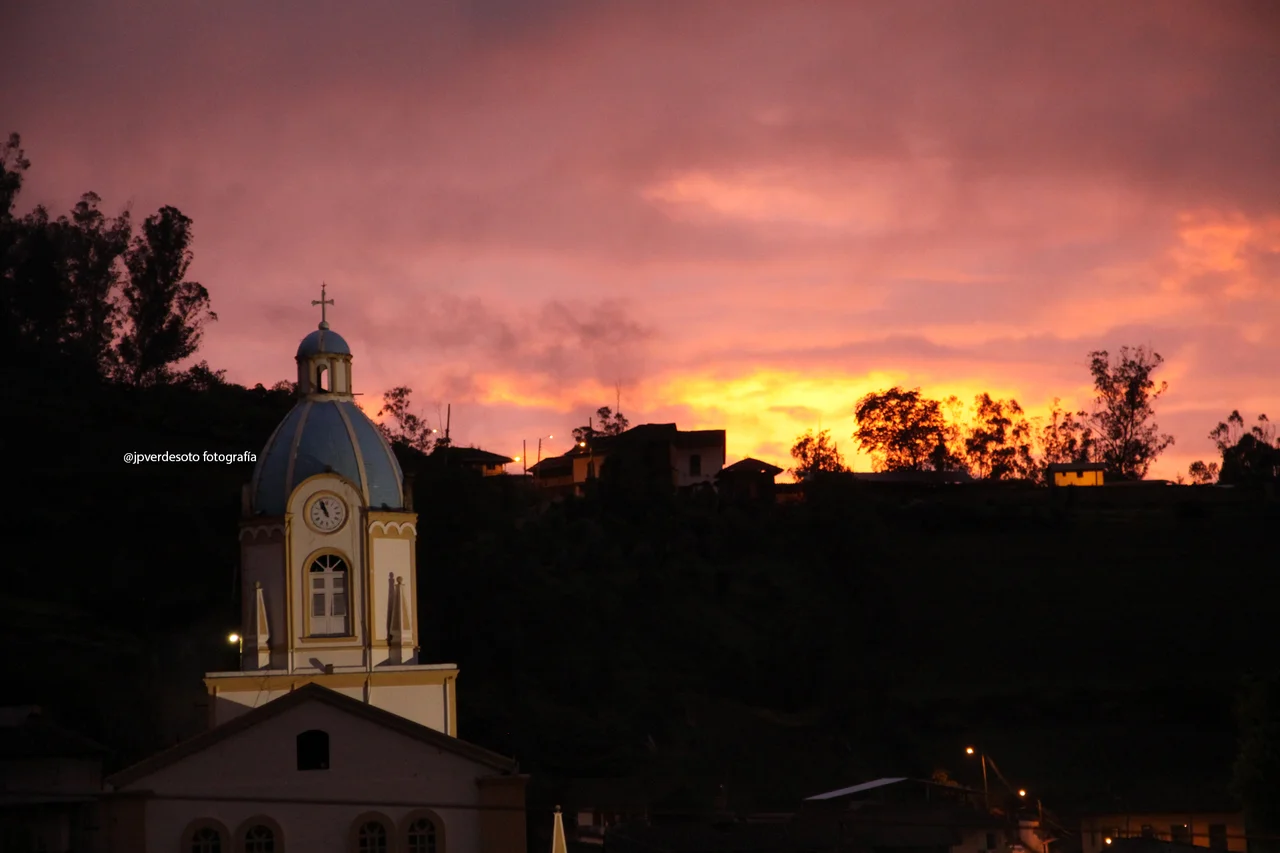

Santiago de Bolivar
Pajaro Azul, they call it - Blue Bird. It is aguardiente, distilled in small stores around the main plaza in Santiago de Bolivar from sugarcane grown in the surrounding fields. The name refers to the color the liquid takes on after the distillation, when various herbs are sometimes added to infuse it. The bottle sits behind the counter, and if you know to ask for it, someone will pour you a shot. Santiago is a small colonial town in the central Andes of Ecuador, fifteen kilometers from Guaranda, five kilometers from San Jose de Chimbo, the kind of place where a drink has a proper name and the recipe still belongs to specific families.
The Route of the Saints
Santiago sits on what Ecuadorians call the Route of the Saints - a cluster of nearby towns founded by Spanish conquistadors more than five centuries ago, each named for a Christian saint: San Lorenzo, San Simon, San Vicente, San Jose de Chimbo, and Santiago itself, the Spanish form of Saint James. Driving the route takes you through rolling Andean agricultural country, past adobe houses, whitewashed churches, terraced fields climbing the hillsides, and small plazas where elderly men sit on benches in the afternoon. The Spanish founded these towns along major communication routes of the old indigenous road network. The roads are paved now, in good condition, and the forty-minute drive between Santiago and Guaranda is one of the pleasant ones in this part of the country.
Mornings with a Wood-Fired Oven
One of the best things a visitor can do in Santiago is learn to make bread with a local family using a traditional wood-burning oven. The ovens here, built of adobe, hold heat for hours after the fire is out. Local women shape tortillas de maiz and tortillas de trigo - corn and wheat flatbreads, specifically - slide them onto the hot stone floor, and pull them out minutes later smelling of smoke and flour. The cooking is the kind that becomes invisible when it is done every day. For a visitor, participating in the routine turns the morning into something you will remember. Pork is another local specialty, prepared simply. Local coffee, brewed strong, goes with everything.
Carnival and the Festival of Health
Santiago has two big festivals each year. Carnival falls in February, a traditional parade that sweeps through the whole region - drums, masks, music, water fights that start as play and escalate throughout the afternoon. Families come home from wherever they have moved, and the town doubles or triples in population for a few days. In July, the town celebrates the Festival of Senor de la Salud - Lord of Health - with multiple days of religious processions and secular festivities, organized by Santiago residents and those who have returned from across the country. The combination of Catholic piety and public celebration follows a pattern familiar anywhere in the Andes. The religion gets folded into the civic calendar, the saint becomes a reason for the town to gather.
Cashca Totoras, What Remains
Twenty minutes from Santiago by car, along a dirt road, lies the Cashca Totoras Protected Forest and Reserve. This is one of the last stands of medium-altitude endemic Andean forest, a remnant of the subtropical high-altitude ecosystem that once covered this region more broadly. The biodiversity here is unique and largely unstudied - plants and animals adapted to the specific thermal regime of cloud forest at intermediate elevation. The forest is threatened by logging. Projects to protect it have engaged the local community through community-based tourism initiatives, trying to make conservation economically viable by giving visitors a reason to pay for guided walks through the remaining canopy. The landscape between Santiago and the reserve is striking on the drive, layered ridges and valleys descending toward coastal Ecuador to the west.
Ivo Mora's Paintings and Other Quiet Reasons
The main church in Santiago holds religious art worth seeing. Outside town, water mills turn on the banks of the Santiago River - working mills, not museum pieces, still grinding grain for local families. Above town, a hill called La Loma offers photography angles and long views across the Andean fields. And somewhere in Santiago, the painter Ivo Mora maintains a studio and gallery; asking around town will usually turn up directions. His work is locally famous, not internationally known, which is fitting for a place this size. The pace of Santiago is slow by design. Pickup trucks from the main plaza will take visitors anywhere for a negotiated price. Horses can be hired by asking at the square. Hitchhiking is easy - the locals tend to be friendly about stopping. None of these arrangements are scheduled. They happen when they happen, and that is the point.
From the Air
Santiago de Bolivar sits at 1.70 degrees south, 79.00 degrees west, in the central Andes of Ecuador. The nearest airports are Guayaquil (SEGU/GYE) about 100 miles to the southwest and Quito (SEQM/UIO) about 130 miles to the north. There is no local airfield. Flying over this area reveals the rugged Andean interior, with Guaranda visible 15 km to the north. The surrounding terrain is mountainous with river valleys and patchwork agricultural fields. Cool mountain climate at 2,500-3,000 meters elevation, with substantial cloud cover much of the year.
Nearby Stories
- Salinas de Guaranda 10 km away
- Pailón del Diablo 11 km away
- Babahoyo 18 km away
- Sangay National Park 20 km away
- Samborondón 30 km away
- Alausí Canton 31 km away
- Buena Fe Canton 57 km away
- Cueva de los Tayos 126 km away