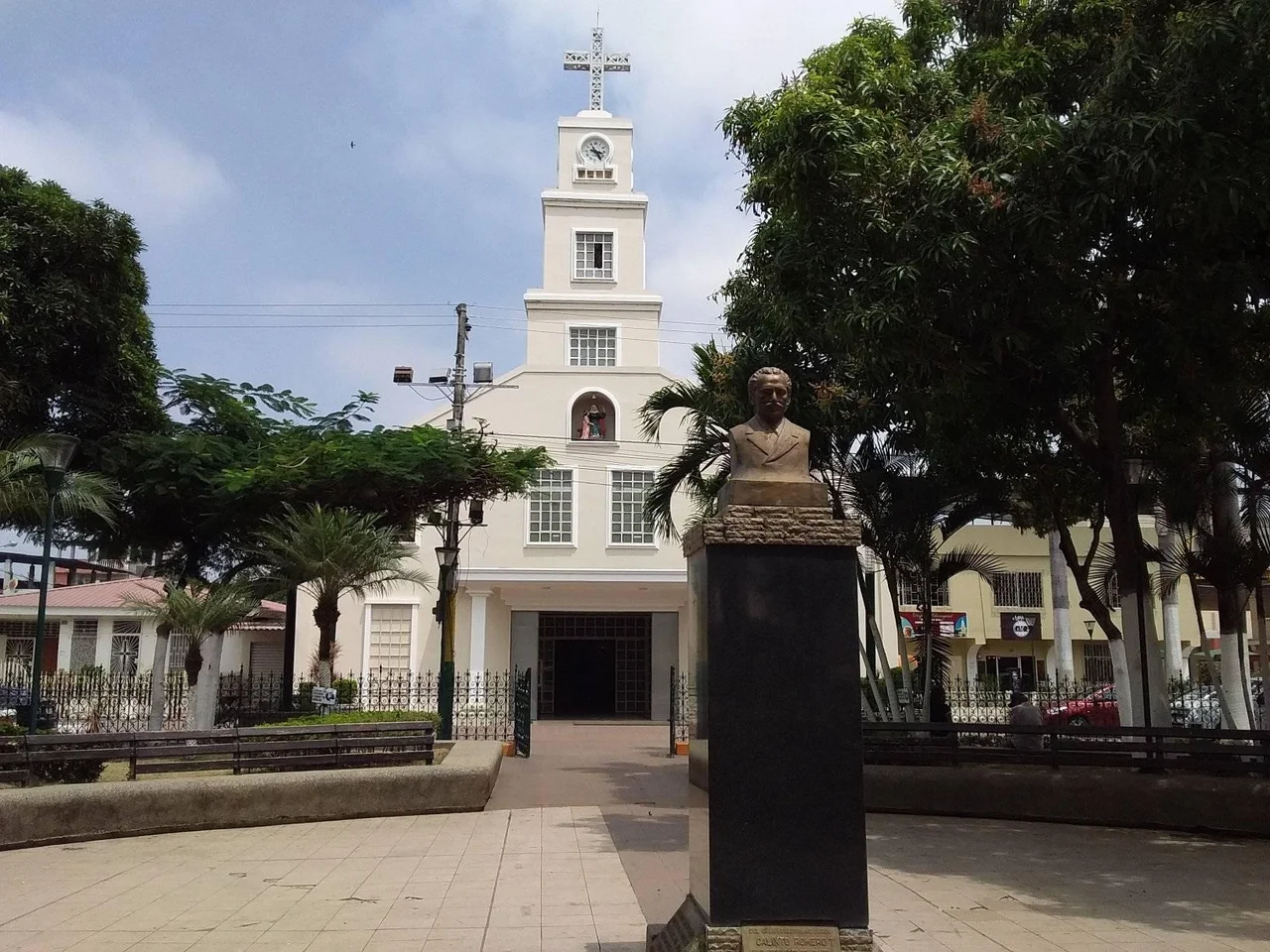

Samborondón
The name is Irish, by way of Spain, by way of sixth-century legend. Samborondón comes from Saint Brendan - San Borondón in Spanish - the Irish monk who, according to the medieval Navigatio Sancti Brendani, sailed west from Ireland in search of paradise and found islands that drifted, whales that surfaced as landmasses, and a promised land beyond the sunset. Spanish settlers carried his name to their colonies, and in the long list of New World towns bearing it, Samborondón sits on a peninsula in coastal Ecuador - a wedge of land where the Babahoyo and Daule rivers merge to form the Guayas. Today it is also where Guayaquil's wealthy live.
Two Rivers, One City
The geography here is liquid. The Babahoyo and the Daule run down from the Andes and the interior, converging just upstream of Guayaquil to become the Guayas - the river that flows past Ecuador's largest city and into the Gulf of Guayaquil. Samborondón occupies the peninsula where that convergence happens, and La Puntilla - the 'little point' at the peninsula's tip - is the neighborhood that everyone actually means when they say Samborondón. Cross one bridge and you are in Guayaquil proper. The commute is short enough that La Puntilla functions as a bedroom community for the city's professional class, though calling it a bedroom community undersells the scale.
Gated City
La Puntilla is a landscape of urbanizaciones cerradas - gated communities where guards check cars at entrance booths and private roads wind between palm-lined homes. The Friedrich Ebert Foundation has published studies on what Samborondón represents: a new kind of city shaped by concerns about security, built deliberately separate from the public fabric of Guayaquil. The shopping centers reflect the same logic. Riocentro Entrerios has stores, a hypermarket, a food court, a cinema. The Village Plaza, inaugurated in August 2010, houses a Supermaxi hypermarket and more than ninety stores. Plaza Lagos, Bocca, La Piazza, La Torre, Las Terrazas, Alhambra, Plaza Navona - the names alone sketch the aspirations, a parade of European-coded brand identities in a tropical Ecuadorian suburb.
The School Migration
As the wealth moved east, the schools followed. Colegio Menor, Abdon Calderon, Torremar and Delta (associated with Opus Dei), Nuevo Mundo, Liceo Panamericano, Monte Tabor - most of Guayaquil's elite private schools opened branches or relocated to Samborondón. The German School Guayaquil inaugurated a second kindergarten here on April 13, 2009. Twenty-three public elementary schools also serve the canton. The first university came in 1994, when the Universidad de Especialidades Espiritu Santo opened its doors. Ecotec followed. ESPOL, the Technical University of the Littoral, runs a smaller annex called PROTCOM that offers a limited set of associate degrees. The effect is a kind of educational gravitational pull - if you live in Guayaquil and can afford the choice, your children probably cross the bridge every morning to study.
History Rebuilt
Samborondón itself is older than the suburbs that now define it. The town was founded on May 24, 1776, and achieved independence on October 10, 1822. Since October 31, 1955 it has been a canton. But the Samborondón most visitors see is Parque Historico, a combined botanical garden, zoological park of local fauna, and open-air museum with reconstructions of historical buildings. It is one of the main tourist attractions in the Guayaquil metropolitan area, a place designed to remind residents of a coastal Ecuadorian past that the gated communities around it tend to abstract away. Guides lead school groups past replicas of nineteenth-century river-town architecture while capybaras and sloths watch from their enclosures.
The Saint's Strange Afterlife
Saint Brendan, meanwhile, has had an unusually durable second life in Spanish folklore. San Borondón, in Canary Islands tradition, is a phantom island that appears and disappears in the Atlantic - sometimes glimpsed from Tenerife or La Palma, never successfully landed on. Sailors have reported it for centuries. It shows up on old maps, placed somewhere west of the Canaries, then quietly removed when no one could find it again. The Ecuadorian town bears no such mystery. It is firmly attached to the peninsula where the Babahoyo and Daule meet. But the name carries a faint residue of that older story - the medieval Irish monk, the vanishing island, the westward voyage toward a paradise just out of reach.
From the Air
Samborondón sits at 1.96 degrees south, 79.73 degrees west, on the peninsula where the Babahoyo and Daule rivers converge to form the Guayas. Fly over this area to see the distinct Y-shape of the river junction and the dense cluster of gated developments in La Puntilla. Jose Joaquin de Olmedo International Airport (SEGU/GYE) in Guayaquil is immediately across the river - Samborondón is effectively part of the Guayaquil metropolitan area. Tropical savanna climate (Koppen Aw) means warm year-round with a pronounced wet season from December through April.
Nearby Stories
- Santiago de Bolivar 13 km away
- Pedro Carbo Canton 23 km away
- Alausí Canton 34 km away
- Ingapirca 38 km away
- Ventanas 39 km away
- Coastal Lowlands (Ecuador) 49 km away
- 2023 Guayas earthquake 66 km away
- Battle of Punta Malpelo 140 km away