
Coastal Lowlands (Ecuador)
Encebollado for breakfast. That is the test. A bowl of fish soup with red onion and yuca, served hot in a country that sits on the equator, eaten before nine in the morning by men in rubber boots heading to the banana fields. The Coastal Lowlands of Ecuador do not bother with the colonial grandeur that tourists expect from South America. What they offer instead is a different rhythm entirely: Pacific light, Afro-Ecuadorian drums, the constant green hum of plantations that stretch to the horizon, and a dialect of Spanish so distinct it shares more with Havana than with Quito.
Where the Rainforest Was
Before bananas, there was forest. The Coastal Lowlands once carried tropical rainforest all the way to the Pacific - a dense, dripping canopy that has almost entirely disappeared. In its place: the banana farms that made Ecuador the world's largest banana exporter, the sugar cane fields of the Guayas basin, the rice paddies of Los Rios. El Oro Province calls itself the banana capital of the world and is not exaggerating. The transformation was brutal and it was fast. What remains of the original dry forest and moist forest ecosystems survives mostly in protected fragments, like the Ecuadorian dry forests which retain barely one percent of their original extent. The coast tells an honest story about what agriculture does to a landscape, and what it leaves behind when it is done.
A Different Spanish
The coastal dialect makes outsiders listen twice. Ecuadorians from the Andes speak a crisp, formal Spanish that moves deliberately. Coastal Ecuadorians speak fast, swallow their consonants, and share features with the Spanish of the Caribbean - particularly the way final s sounds dissolve into aspirated breath. Listen for long enough and the coastal accent stops sounding like carelessness and starts sounding like music. This is the Spanish of Afro-Ecuadorian Esmeraldas, of Guayaquil's port workers, of Manabi fishermen hauling in nets at dawn. It is the language in which encebollado is ordered and ceviche is argued about, where the right amount of lime matters enormously and everyone has an opinion about it.
Salinas to Montanita
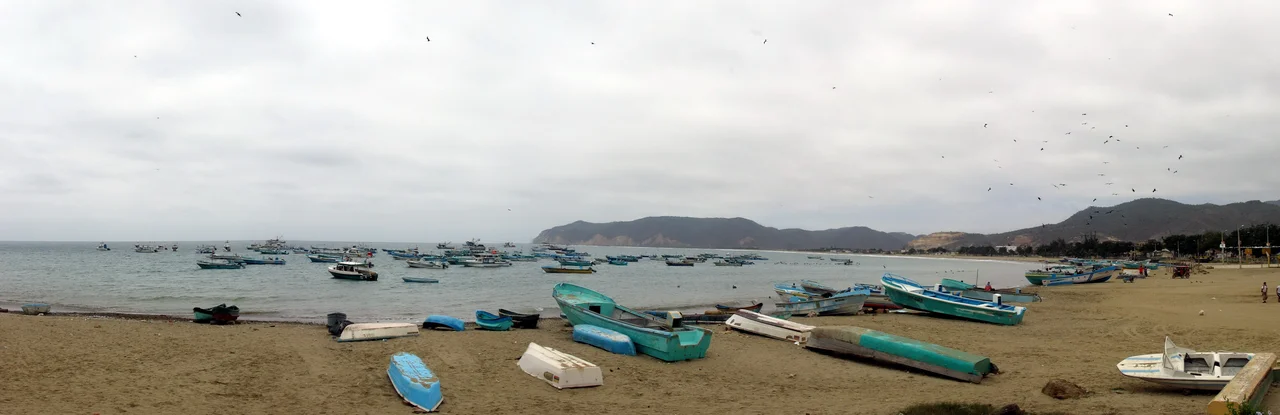
The beach culture splits between two temperaments. Salinas, on the Santa Elena peninsula, is where middle-class Ecuadorians go on holiday - a curved bay, high-rise apartments, families with coolers, the orderly rituals of vacation. Drive north and the scene shifts. Montanita, a few hours up the coast, belongs to the surfers. The waves here break consistently enough to have drawn international attention, and the town has grown around that fact, with hostels spilling into thatched bars and travelers cycling through in long, sunburned rotations. The beach communities north of Guayaquil are the heart of Ecuadorian coastal tourism. South of Guayaquil, until the Peruvian border near Tumbes, the coast goes quieter - mangroves and shrimp farms and mostly working towns.
The Two Ceviches
Coastal food punches above its weight. Ecuadorian ceviche differs from Peruvian - it tends to be soupier, served with leche de tigre pooling in the bowl, often made with shrimp rather than fish. Encebollado, the morning hangover cure and breakfast of fishermen, uses albacore tuna in a broth of tomato, onion, and yuca, served with chifles (fried plantain chips) and popcorn on the side. The combination sounds strange on paper. In practice, eaten at a plastic table by the water at seven in the morning, it is one of the great breakfasts in South America. Seafood defines the coast: corvina, shrimp from the Guayas estuary, the black scallops that move across the border from northern Peru. Guayaquil's markets are the nerve center of this economy, where fishermen unload before dawn and restaurants send buyers to pick through the catch.
Isla de la Plata
Off the coast of Manabi sits a small island that tourists have nicknamed the Poor Man's Galapagos - Isla de la Plata, accessible from the town of Puerto Lopez. The nickname undersells it. The island hosts blue-footed boobies, frigatebirds, and albatross, and the waters around it see humpback whales between June and September during their migration. For travelers who cannot afford the airfare and expedition costs to reach the actual Galapagos, Isla de la Plata delivers a convincing taste of the same volcanic-island-meets-seabird-rookery experience. Machalilla National Park, on the adjacent mainland, preserves one of the most intact stretches of Ecuadorian dry forest remaining. Together they form the coast's richest natural draw.
The Guayaquil Orbit
Everything coastal eventually passes through Guayaquil. Ecuador's largest city by population, its main commercial port, and its international aviation hub, Guayaquil is the Pacific-facing engine of the country. From here buses fan out to every coastal town, international flights connect to Miami and Madrid, and the Guayas River delivers shrimp and bananas to the world. The city itself is not conventionally pretty - it traded colonial architecture for commerce long ago - but the malecon along the river has been rebuilt into a long pedestrian promenade, and the historic neighborhood of Las Penas climbs a steep hill of painted houses that photographs well at sunset. For aviators, Guayaquil's Jose Joaquin de Olmedo International Airport is the gateway.
From the Air
Coastal Lowlands center at 1.38 S, 80.38 W, extending along the Pacific from the Colombian border to Peru. Recommended cruise 7,000-9,000 feet over Manabi and Guayas provinces for coastal visibility. Primary airports: Guayaquil Jose Joaquin de Olmedo (SEGU), Manta Eloy Alfaro (SEMT), Esmeraldas Coronel Rivadeneira (SEES). Pacific haze common in mornings; afternoons often clearer. Watch for the band of banana plantations running inland from the coast - geometric green patchwork unmistakable from altitude.
Nearby Stories
- Portoviejo 14 km away
- Pedro Carbo 28 km away
- Guayas Province 35 km away
- Western Ecuador Moist Forests 36 km away
- Ventanas 40 km away
- Salinas (Ecuador) 100 km away
- Malpelo Plate 479 km away