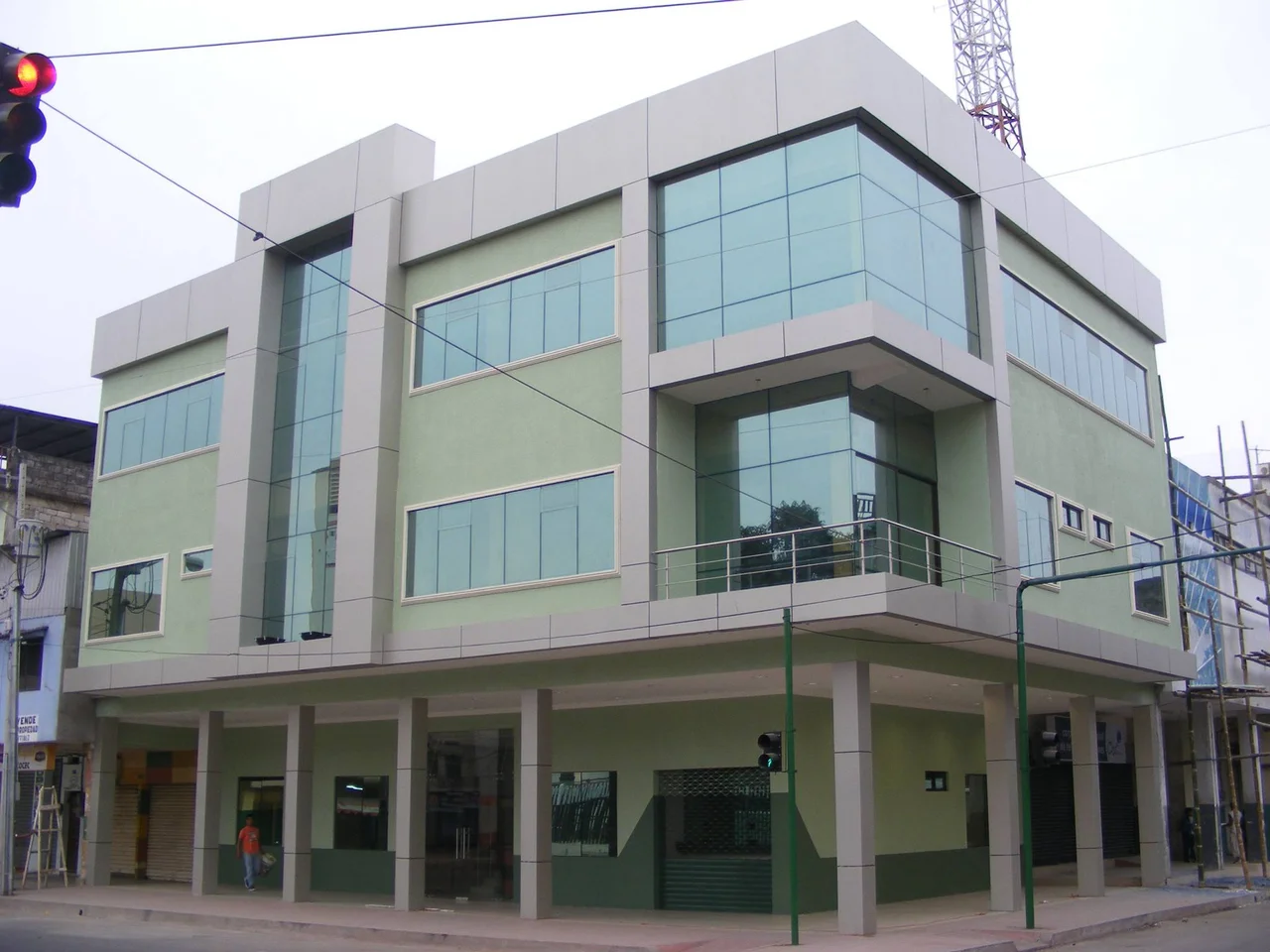

Ventanas
The story most people in Ventanas will tell you begins with a house. A colonial-style home belonging to a man named Martinez, set on the bank of the Zapotal River, notable for having an unusual number of windows. Mountain traders coming down from the highlands with their mules would stop to barter at the store he ran out of the house. When they arranged to meet, they said: vamos a la casa de las ventanas - let's go to the house with the windows. Over time the town that grew up around that store kept the name. Others prefer a second version: the place was called Ventanas because it was a window - a literal opening - between the Andean foothills and the coastal plain, the point where mountain products met coastal markets. Both stories may be true. Either way, the windows stuck.
Corn Capital
At the entrance to the city, at an intersection called La Y, a reinforced concrete monument rises several meters above the road - a sculpture of a maize cob, unmistakable from a distance. Ventanas calls itself La Capital Maicera del Ecuador, the Corn Capital of Ecuador, and the claim is backed by decades of production. The broader economy now runs more on bananas than on corn, and the city exports cocoa, coffee, rice, soybeans, passion fruit, and pigeon peas as well. But the corn identity persists, partly because the monument is too recognizable to ignore, and partly because the annual harvest festivals and the markets along the Zapotal still treat maize as the ceremonial center of the agricultural year.
From Parish to Canton
Ventanas became an administrative parish in 1846, attached then to the Puebloviejo canton in what was, at the time, Guayas Province. In 1860, President Gabriel Garcia Moreno - the conservative Ecuadorean strongman who shaped much of the country's 19th-century political architecture - issued the decree creating Los Rios Province, and Ventanas was transferred along with Puebloviejo into the new jurisdiction. Independence from Puebloviejo came slowly. In the decades that followed, local councilors Gilberto Gordillo Ruiz and Rafael Astudillo Cardenas organized what the town remembers as the emancipatory assembly - a public meeting held in the basement movie theater of Don Nicanor Florencia Machado's house, where residents argued the case for becoming their own canton. It worked. On November 10, 1952, Ventanas was officially cantonized.
The River in the Middle
The Zapotal River splits the city into three parts. The central zone, on one side, holds the commercial district - the markets, banks, and restaurants. South of the river is largely residential, with older neighborhoods and some marginal settlements. North houses both residential suburbs and the industrial zone. The Zapotal itself is fed by a network of smaller rivers - the Lechugal, Oncebi, Sibimbe, Macagua - before it runs through the city and continues downstream under a different name, the Caracol. Every summer, when the rains ease and the water drops, a small beach of sand and stones emerges in the city center. Residents come to swim and rest. Some of the older women still wash clothes along the bank, as the custom used to require.
A Dormitory City
Ventanas does not stand alone. It sits within the orbit of Babahoyo, the Los Rios provincial capital, close enough that the two cities function as parts of a single metropolitan area. Thousands of workers commute from Ventanas to Babahoyo each day by land. Babahoyo itself connects to Guayaquil, so many of the region's workers live three cities away from where they labor. The 2022 census put Ventanas at 41,531 residents in the urban area, making it the thirty-eighth-largest city in Ecuador and the fourth largest in Los Rios. The greater Babahoyo conglomerate holds more than 250,000. The rhythm of commuting shapes the economic life: markets open early, buses fill before dawn, and the Malecon along the Zapotal fills up in the evenings when the commuters return.
Miss Ecuador and the Governor
Ventanas has produced people who went elsewhere. Connie Jimenez, born in the city in 1995, won Miss Ecuador 2016 and then entered politics - she later served as Governor of Los Rios Province. Her tenure made international news in 2023 when her home was shot at in an attempted assassination, part of the broader surge of drug-trafficking-related violence that has reshaped coastal Ecuador in recent years. The city has also produced footballers - Jimmy Izquierdo, Patricio Urrutia, Edwin Villafuerte - and at least one football manager, Humberto Pizarro, along with a handful of national politicians. For a mid-sized Ecuadorean city, the export of talent has been consistent, even if many of those talents have had to navigate an Ecuador that has grown increasingly hard to live in peacefully.
From the Air
Coordinates 1.45 S, 79.47 W, elevation roughly 24 meters, on Ecuador's coastal plain in Los Rios Province. The Zapotal River cuts east-west through the city, and from 5,000-8,000 feet the river channel is a distinctive landmark surrounded by green banana and corn fields. Nearest major airport is Jose Joaquin de Olmedo (SEGU/GYE) in Guayaquil, about 115 km southwest. Hot, humid tropical climate with a wet season December to June; annual rainfall averages 2,120 mm. Visibility generally good but afternoon thunderstorms common in the wet months.
Nearby Stories
- Pedro Carbo 11 km away
- Salinas de Guaranda 14 km away
- Babahoyo 14 km away
- Ecuadorian dry forests 25 km away
- Andean Highlands (Ecuador) 28 km away
- Quevedo 30 km away
- Portoviejo 39 km away
- Alausí Canton 57 km away