
Cueva de los Tayos
Every spring the Shuar people slip into the mouth of Cueva de los Tayos on vine ladders, carrying bamboo torches, to harvest fledgling oilbirds from the ledges where the adults nest. They have done this for centuries. The cave took its name from those birds - tayos in the local Spanish, guacharos elsewhere - and for most of its history that was the cave's entire story. Then in the 1970s a Hungarian-Argentine adventurer named Juan Moricz told anyone who would listen that deep inside the cave, beyond tunnels carved by non-human hands, rested a library of golden books. The cave has not been the same since.
Geography of the Deep
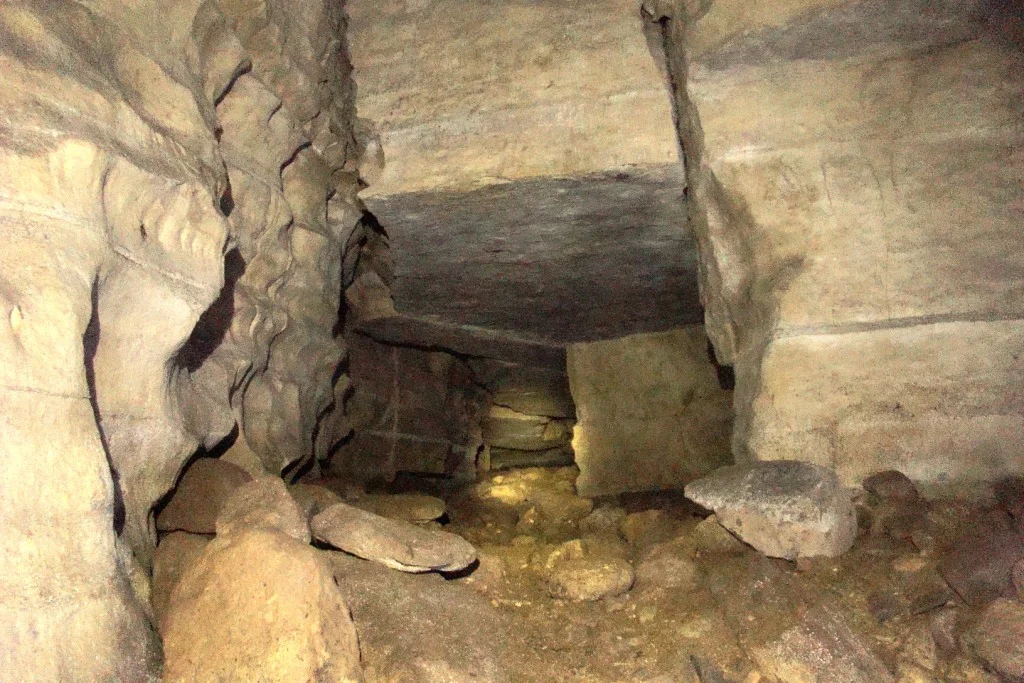
The cave sits on the eastern slopes of the Andes in Morona-Santiago province, where the mountains fold into the western edge of the Amazon rainforest. Its principal entrance opens at roughly 800 meters elevation within a dry valley floor, the shaft dropping 65 meters straight down through thinly-bedded limestone and shale. GPS fixed the floor at 539 meters above sea level in 2008. From there, 4.6 kilometers of spacious passages thread back into the rock, ending at a sump where water blocks further travel. One chamber measures some ninety meters across. The cave has a vertical range of 201 meters, making it the longest mapped cave in Ecuador as of 2023. Written accounts of the place go back to at least 1860, and in the 1960s gold-seekers and Ecuadorian military personnel began poking around in earnest.
Moricz and the Metal Library
Juan Moricz arrived in Ecuador convinced that the ancient Magyars - his own people, he believed - had once sailed to the Americas. In 1969 he claimed to have entered Cueva de los Tayos and found the Metal Library: shelves of yellow metal, stone sculptures, a polished stone desk, enormous books made of gold and inscribed with hieroglyphs he variously called Phoenician and cuneiform. Four extraterrestrials, he said, had spoken to him telepathically in the chamber, congratulating him on his cleverness. He refused to reveal the location. Anyone wishing to verify the claim, he explained, would need to pay him. His own evidence for Magyar hyperdiffusion - the thesis that a white race had founded civilization across the Americas - has been thoroughly debunked by linguists and archaeologists, who have characterized his work as racial mythology rather than scholarship.
Von Daniken and the Astronaut
Erich von Daniken, whose 1968 book Chariots of the Gods? had seeded a global industry of ancient-astronaut speculation, seized on Moricz's claims for his 1973 follow-up The Gold of the Gods, describing mounds of treasure and alien-engineered tunnels. The publicity drew a Scottish amateur archaeologist named Stan Hall, who in 1976 organized one of the largest and most expensive cave explorations ever mounted - over a hundred people, funded jointly by the governments of Ecuador and the United Kingdom, including British and Ecuadorian military personnel, a film crew, eight professional British cavers, and, improbably, former Apollo 11 commander Neil Armstrong. The man who had walked on the moon seven years earlier now rappelled into a limestone cave in the Ecuadorian jungle, searching for a library no one could find. The cavers produced a meticulous survey map. They did not produce the library.
Competing Accounts
Other witnesses gave their own versions. Captain Petronio Jaramillo Abarca said a Shuar friend had led him into the library as a child - shelves of yellow metal, hundreds of books that resembled geometry textbooks, and, for some reason, a nine-foot-tall golden skeleton in a crystal coffin. His widow later stated flatly that she had never believed him. In 1968 a group of Mormons had sought out Moricz because they suspected the metal plates he described might be the golden plates of Joseph Smith's vision. Moricz accepted their fee and led them into the region but, according to expedition member Avril Jesperson, clearly had no idea where he was going. Jesperson concluded Moricz had probably never visited the cave at all. The stories changed with each telling - which is, of course, how mythology works.
The Cave That Remains
In 2018 Expedition Unknown dragged the legend back to television when host Josh Gates and Stan Hall's daughter Eileen descended into the cave with Shuar guides. They found no library. What they and every other serious expedition found was a beautiful, scientifically interesting cave system - limestone passages carved by ancient groundwater, colonies of oilbirds echolocating through the dark, and rock formations that have been called the Moricz portal because they happen to look squarish. The consensus of the archaeological community is that the Metal Library never existed. The cave is real, the birds are real, and the Shuar people who have used it for generations remain its truest guides. What was invented was the gold.
From the Air
Coordinates 3.05 deg S, 78.21 deg W, in Ecuador's Morona-Santiago province on the eastern slopes of the Andes where they meet the Amazon rainforest. The cave mouth lies near the Santiago and Coangos rivers at roughly 800 m elevation, though the region's terrain climbs rapidly westward. Nearest airports: Macas (SEMC) to the northwest, Shell Mera (SESM) further north. This is tropical rainforest with dense cloud cover and sudden weather; surface visibility is often limited, and there is no airstrip at the cave itself.
Nearby Stories
- Santuario de la Virgen de la Nube 13 km away
- Gualaceo Canton 20 km away
- Saraguro People 63 km away
- Ingapirca 79 km away
- Nambija Mine Disaster 103 km away
- Borja, Peru 127 km away
- 2021 Northern Peru Earthquake 183 km away
- Ecuadorian Amazon 241 km away