
Saraguro People
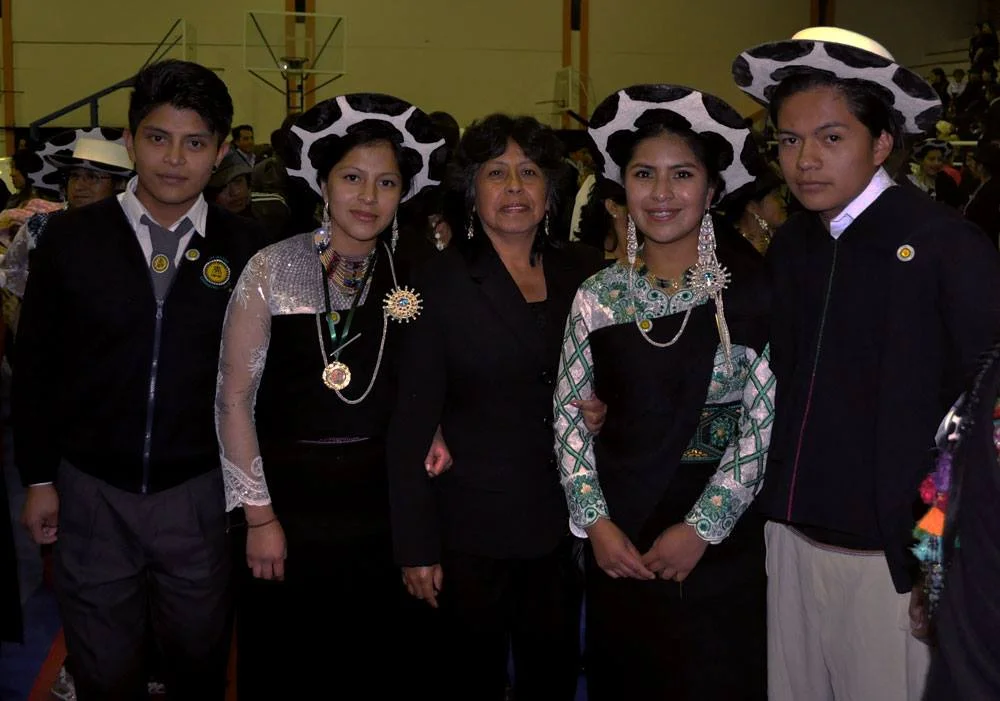
A Saraguro girl takes a selfie with friends during Kapak Raymi, the Great Celebration held each December in Saraguro canton. She wears an anaco - the wool outer garment, black - over a blouse with embroidered edges that match her girdle. Her hat is woolen, white with black designs, heavy enough that holding it straight takes practice. Around her neck, a silver tupu holds her rebozo in place, passed down from her mother, who received it from her grandmother. She lifts her phone. The carunculated caracara, the bird whose black-and-white feathers her clothing echoes, may or may not be circling overhead. The photo gets posted. This is what continuity looks like in 2026.
The Inca Who Walked the Kapak Nan
The Saraguro tell their own origins. According to their oral traditions, their ancestors were elite soldiers in the Inca army, resettled to the area by imperial decree in the fifteenth or early sixteenth century. The Inca used a policy called mitma - forced population transfers that could move up to 80 percent of a province's population to new territory. The goal was to weaken regional resistance and spread loyal populations throughout the empire. A Spanish document supports this origin account. The Saraguro were settled along the Kapak Nan - the great Inca road - which ran from Cuzco through Tumebamba, the northern Inca capital, and onward to Quito. Maintaining that road, and the communications it enabled, was serious imperial business. The Saraguro occupied a link in the chain. The pre-Inca inhabitants of the region were probably the Palta or the Cañari. Inca ruins remain in the area, though the town of Saraguro itself was founded later by the Spanish.
Black and White, and What They Mean
A long-standing theory holds that Saraguro black clothing represents mourning for the death of Atahualpa, the last Inca emperor, killed by the Spanish in 1533. That theory has been debunked by scholars. The actual origin of the colors is older and more specific. According to the chronicler Cieza de Leon, and confirmed by Saraguro oral tradition, black and white in Inca symbolism represented ceremony and nobility. As descendants of elite soldiers, the Saraguro retained the colors along with other markers of high Inca status - the men kept the long braided hair that was another sign of nobility. The clothing also references the Curiquingue, or carunculated caracara, a bird whose black-and-white plumage made it a symbol of Inca royalty. The Curiquingue still inhabits the Saraguro parish and the high paramos. Its image appears in the costumes worn during Kapak Raymi, the December solstice celebration that is central to Saraguro cultural life.
How They Kept Their Land
Most Andean indigenous communities lost significant territory during Spanish colonization and the subsequent centuries of independent Ecuadorian policy. The Saraguro retained more of their land than most, and the reason is specific and strategic. Under Spanish rule, the Saraguro were assigned to operate and maintain an important tambo - an inn or way-station - along a major communication route, the same route their ancestors had served under the Inca. The Saraguro successfully argued to colonial authorities that running the tambo required them to retain their land and its resources. They continued managing the tambo until the 1940s, when a motor road finally reached the area and the way-station system became obsolete. By then, land tenure had been established long enough that dispossession became harder. Initial Saraguro hostility to the Spanish and their indigenous allies, oral tradition holds, also played a role.
The Work of Continuing
Saraguros today are doctors, architects, engineers, musicians, lawyers, teachers, artisans, entrepreneurs, politicians, and activists. Many combine professional careers with agro-pastoralist work on family land. Luis Fernando Sarango Macas - lawyer, PhD in Jurisprudence, rector of the Pluriversidad Amawtay Wasi - has helped build networks of indigenous universities across Latin America and authored The Education Paradigm of Abya Yala. Salvador Quishpe Lozano, born in Zamora in 1971, has served as prefect of Zamora Chinchipe and run for the Ecuadorian presidency as a Pachakutik candidate. Abel Sarango was elected the first indigenous mayor of Saraguro canton, despite the canton having the highest indigenous population in southern Ecuador. Carmen Lozano has led peaceful marches defending water and territory against mining concessions. Her words, quoted widely: 'As ancestral peoples with their own autonomy, we do not accept anyone, that no government or company takes away our right to life.'
New Instruments, Old Songs
Young Saraguro musicians have been reworking their cultural inheritance for decades. Some perform traditional music with innovations in violin technique that scholars have written academic papers about. Others, primarily young men, have built connections with heavy metal subcultures - listening to national and international metal bands, forming their own, organizing concerts in Saraguro itself. A researcher who has followed this scene calls it a creative and selective process, through which young Saraguros discard, amplify, and reinvent aspects of what they consider authentic Saraguro musical culture. The point is not that the old ways are disappearing. The point is that being Saraguro in 2026 does not require rejecting the modern - it means bringing the long tradition of indigeneity forward, into whatever forms the present requires. Activists continue fighting for food sovereignty, water protection, and autonomy from the state. The selfies and the mingas coexist. The young woman at Kapak Raymi wears her grandmother's tupu.
From the Air
Saraguro canton sits at 3.62 degrees south, 79.24 degrees west, in the southern Andes of Loja Province, Ecuador. The nearest airport is Catamayo Airport (SETM/LOJ) about 35 miles to the southwest. Cuenca (SELT/CUE) is about 90 miles to the north. Flying over this area reveals rolling Andean highlands at 1,800-2,800 meters elevation, with agricultural terraces climbing the hillsides and the town of Saraguro visible as a small urban cluster. The Panamerican Highway runs through the canton, following roughly the same route as the old Inca Kapak Nan. Cool mountain climate with significant cloud cover.
Nearby Stories
- Pasaje Canton 1.4 km away
- El Oro Province 13 km away
- Loja, Ecuador 16 km away
- Puyango Petrified Forest 23 km away
- Girón, Azuay 25 km away
- Cueva de los Tayos 68 km away
- Borja, Peru 150 km away
- Eastern Cordillera Real Montane Forests 199 km away