
Puyango Petrified Forest
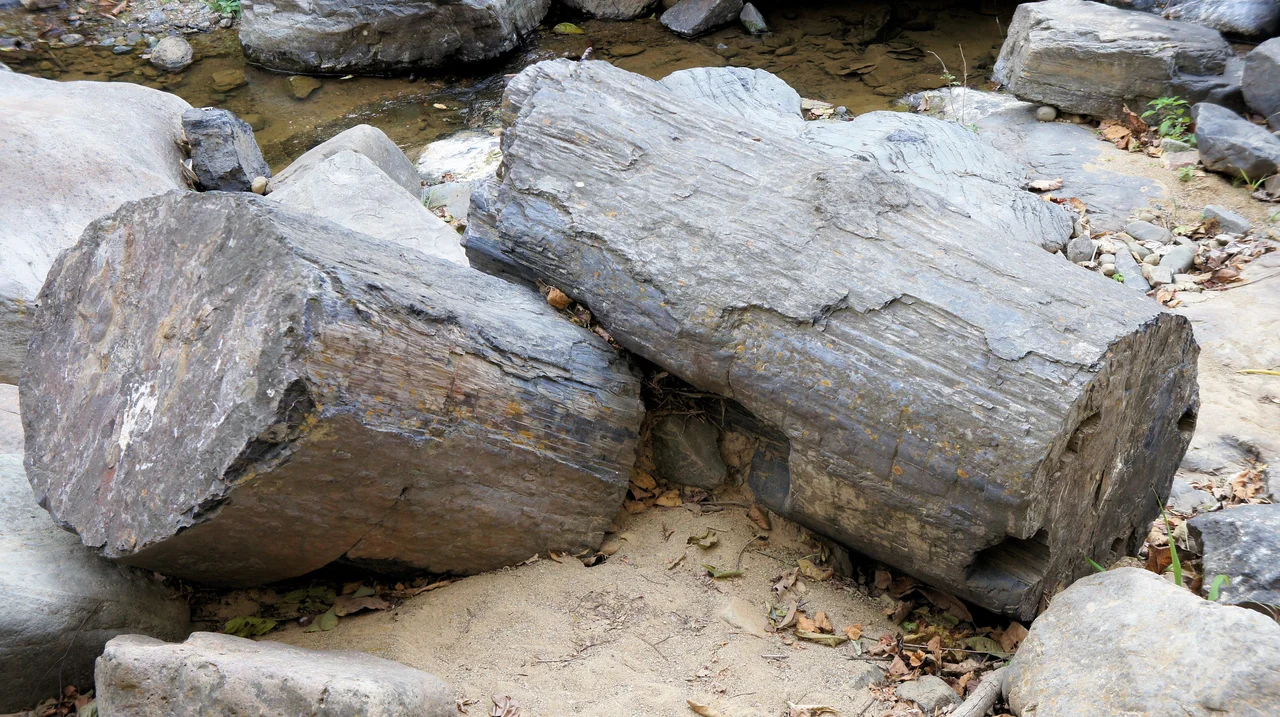
A trunk 15 meters long and two meters across lies on its side where the earth revealed it. It is the largest specimen in the Puyango Petrified Forest, and it is roughly 100 million years old. Once it was an Araucarioxylon conifer, part of a Mesozoic forest that lived here when dinosaurs walked the ground beneath it. Then came the burial. Volcanic ash or river sediment or the slow accumulation of centuries pressed the wood into the earth, silica-rich water seeped through the fibers, and the cellular structure of the tree was replaced atom by atom with stone. What remains is a record written in mineral: every growth ring preserved, every knot visible, every branch still attached to the trunk it grew from.
A Sea Became a Forest Became a Quarry
The story of this 2,658-hectare site is layered in the most literal sense. The oldest fossils at Puyango, reaching back 500 million years, belong to marine organisms. Bivalves and ammonites and echinoderms once swam or drifted here when the land was seabed. Then the sea withdrew, and forests grew where the water had been. Those forests were buried, too, and their wood fossilized. Geological movements pushed the deposits back to the surface across four distinct formations dating from the late Cretaceous period, roughly 100 million years ago, though individual fossils span nearly half a billion years. The forest that produced the petrified trunks was dominated by Araucarioxylon conifers, kin to the monkey puzzle and Norfolk pine, which once dominated southern hemisphere forests when Gondwana was still intact. The fossils also include leaves from four genera of primitive plants that resemble modern ferns and palms.
The Paleobotanist's Arizona
Robert E. Shoemaker, an American paleobotanist, spent 1975 and 1976 studying the deposits and concluded that the concentration of petrified trunks in such a compact area was one of the largest collections of its kind in the world, comparable to Arizona's Petrified Forest National Park. The comparison is apt. Arizona's park is famous for trunks scattered across desert badlands where erosion has been peeling back the overburden for millions of years. Puyango is younger in exposure and younger in fame, but the geology is cousin in principle. Sediment buried forests, silica replaced wood, uplift brought the results to the surface. The difference is the setting. Puyango sits in the Puyango River valley between 360 and 500 meters elevation, in one of the last remaining tracts of tropical dry forest in southwestern Ecuador, where strong slopes and ravines have preserved an ecosystem that has largely disappeared from the region.
Birds Among the Fossils
The protected forest around the petrified trees has become as valuable to biologists as the fossils themselves are to paleontologists. In 2005, BirdLife International designated the area an Important Bird Area, citing 161 recorded species including 43 endemic to the Tumbesian dry forest region of western Ecuador and northwestern Peru. This is bird country precisely because it is rare country. The Tumbesian forests have been heavily converted to agriculture throughout the region, and Puyango preserves one of the few substantial remnants. Multicolored grasshoppers grow up to 14 centimeters long here, sharing the slopes with lizards and small mammals. The mean temperature is a comfortable 22.5 degrees Celsius, and the dry season from May to December is the ideal time to walk the trails. During the wet season, more than 900 millimeters of rain transforms the landscape into something almost unrecognizable, with the river rising and the dormant plants returning to life.
The Protection of Borders
The reserve straddles the provinces of El Oro and Loja in the southwest of Ecuador, and its management reflects that division. Protection arrived in 1987, when the area was formally declared a protected forest to preserve both the fossils and the dry forest ecosystem. Today the prefectures of Loja and El Oro share oversight with the municipalities of Puyango and Las Lajas. The site is not yet inscribed on UNESCO's World Heritage list, though it appears on Ecuador's tentative list of candidates. Access is possible year-round, but the dry months offer the clearest views of the fossils and the easiest walking. Visitors who reach the forest find a place where deep time has been pressed flat and laid out for inspection, a hundred million years preserved at walking pace between the living trees of today.
From the Air
Located at 3.90 degrees south, 80.01 degrees west, in the Puyango River valley of southwestern Ecuador near the Peruvian border. From altitude the forest appears as a darker patch of dry forest in an otherwise agriculturally converted landscape. The nearest major airport is Santa Rosa International Airport (SERO) near Machala, about 120 kilometers northwest. Catamayo Airport (SETM) in Loja lies about 90 kilometers east. Best visibility is during the long dry season from May to December. Expect haze during transitions between seasons and heavier cloud during the short wet season from January to April.
Nearby Stories
- Gonzanamá 2.4 km away
- Department of Tumbes 12 km away
- Saraguro People 25 km away
- Loja, Ecuador 28 km away
- El Oro Province 29 km away
- Ayabaca province 55 km away
- Ignacio Escudero District 81 km away
- Las Vegas culture (archaeology) 167 km away