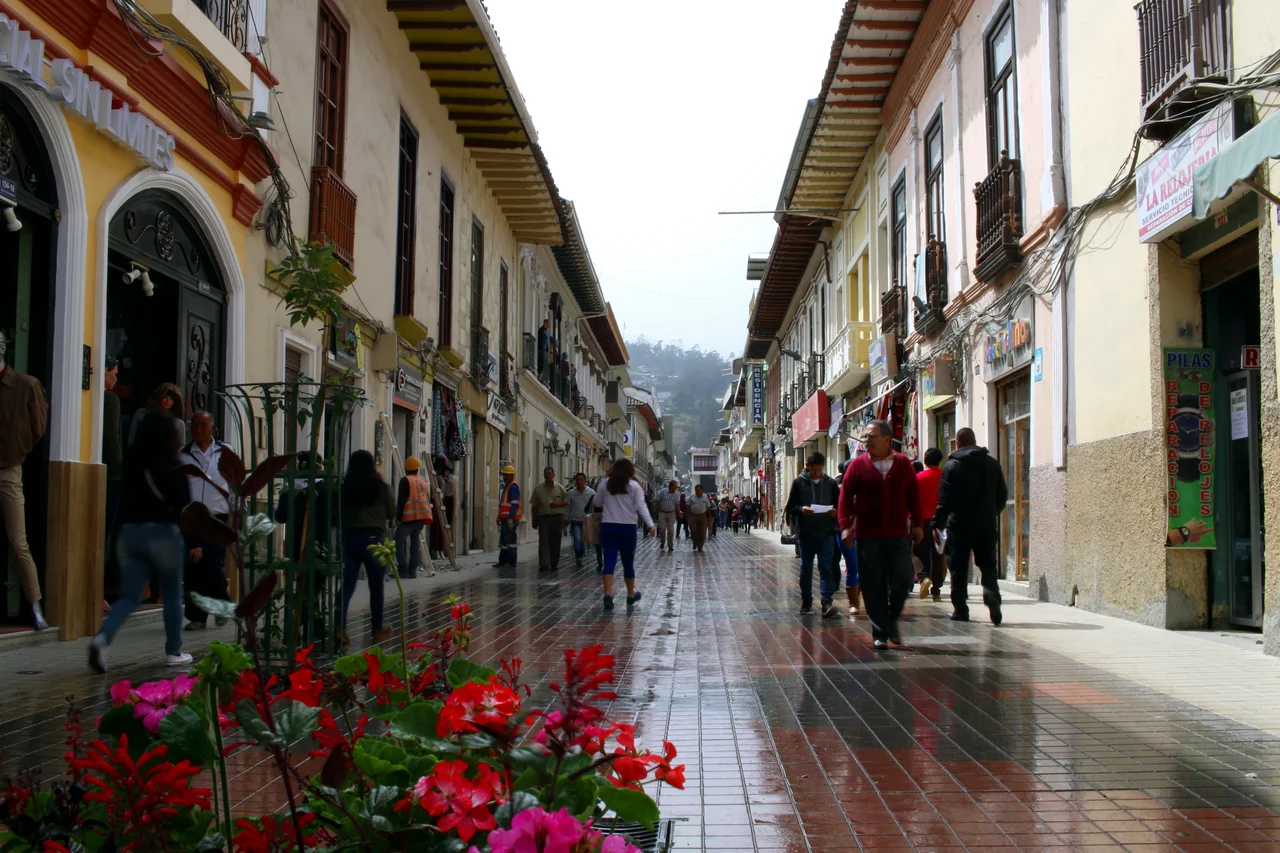

Loja, Ecuador
The saying in Loja goes like this: one who cannot play the guitar can sing a song, one who cannot sing can write a verse, and one who cannot write a verse reads a book. The people here know what they are. Loja calls itself the musical and cultural capital of Ecuador, and the claim is not idle. Founded in the Cuxibamba Valley (the Quechua name means smiley valley) in 1548, the city has produced poets, presidents, composers, and singers across five centuries. It also runs the oldest botanical garden in Ecuador, operates the country's first wind power station, and lit its streets with electricity before any other Ecuadorian city when a small hydroelectric plant began operating in 1897.
Founded Twice, Moved Once
Alonso de Mercadillo, a Spanish captain, first founded Loja in the mid-1540s at La Toma in the Catamayo canyon. The site proved unhealthy. Earthquakes damaged the settlement, malaria outbreaks sickened the colonists, and by 1548 Mercadillo concluded that the city had to move. On 8 December 1548, he refounded Loja in the Cuxibamba Valley, naming it after his own birthplace of Loja in the Kingdom of Granada, Spain. The new site sat in a broad glacial valley at 2,060 meters elevation, cradled between two rivers, the Zamora and the Malacatos, with microclimates varied enough to grow everything from tropical fruits to highland grains. It worked. About a century later, another earthquake leveled the town, but this time Lojanos rebuilt on the same spot rather than abandon it. That pattern of stubborn persistence shows up in nearly everything about the city.
The City That Got Electricity First
Loja is widely credited as the first city in Ecuador to have electric lighting. A small hydroelectric plant began operating in 1897, and the Loja Hydroelectric Plant was formally inaugurated in 1899 as the country's first commercial hydro facility. Lojanos walked their streets under electric lamps while Quito and Guayaquil, the capital and the coast's largest city, still relied on lanterns and gas. The innovation was typical of a town that has always punched above its weight. In more recent years, Loja built Ecuador's first commercial wind power station, with eleven generators and a visitor center just outside the city. The province is also one of Ecuador's main coffee-growing regions, and Lojanos treat their harvest with the seriousness of people who know what they have.
A Clock Tower for Independence
On 18 November 1820, Loja declared its political independence from Spain, one of several southern highland cities to break with colonial rule that year. The formal Acta de Independencia was not recorded until 17 February 1822, but November 18 remains the civic commemoration. Later that year, Simon Bolivar passed through Loja during the campaigns that consolidated Gran Colombia, and local accounts still record his visit. The most visible monument to independence stands on the Plaza San Sebastian, also called the Plaza of Independence. A 32-meter clock tower rises over the square, its four faces carved with brass bas-reliefs depicting scenes from the city's history. The church beside it, consecrated to St. Sebastian in 1660 to ward off earthquakes, was rebuilt in 1900 after the old structure finally gave way to one too many tremors.
The Virgin Who Walks
Each year between 30 May and 15 August, thousands of faithful walk the statue of the Virgin of El Cisne from the town of El Cisne, 45 kilometers north of Loja, to the city's main cathedral. The procession shuts down traffic along the route, and participating in it is a mark of civic pride. The Virgin stays in Loja's cathedral for about six months before being carried back north on 1 November. The Cathedral itself contains original adobe work from the 16th century, though the current building dates from 1838, its predecessor lost to yet another earthquake. It is one of the largest churches in Ecuador and serves as the seat of the Roman Catholic Diocese of Loja. Lojanos walk the Virgin back and forth on their shoulders because they have always done so, and because faith here is embedded in the rhythm of the year.
Poets, Presidents, and Pianos
Loja has birthed a remarkable number of Ecuadorian intellectuals and leaders. Pablo Palacio, Benjamin Carrion, Miguel Riofrio, and Angel Felicisimo Rojas all came from here, writers whose work shaped modern Ecuadorian literature. Isidro Ayora, president of Ecuador from 1926 to 1931, was born in Loja. Matilde Hidalgo, physician, poet, and the first Ecuadorian woman to vote, was a Lojana. The city's Conservatorio Nacional de Musica has trained generations of the country's most influential musicians, and live music spills out of small clubs most evenings of the week. On Sundays, the local police band plays in the Plaza de Independencia outside the San Sebastian church. Walk the historic center following the orange stripe painted on the sidewalks and you visit colonial-era churches one after another, the Puerta de la Ciudad (modeled after the coat of arms granted by King Philip II of Spain in 1571), and murals and frescoes that crowd nearly every wall. The guitar, the song, the verse, the book, in that order, and always in some combination.
From the Air
Located at 3.99 degrees S, 79.20 degrees W in a high Andean valley at 2,060 meters (6,758 feet) elevation, surrounded by mountains in Ecuador's southern sierra. Best viewed from 10,000 to 14,000 feet to see the glacial valley layout with the Rio Zamora and Rio Malacatos running through the city. Nearest airport: Ciudad de Catamayo Airport (SETM/LOH) about 30 kilometers west in Catamayo, serving flights to Quito and Guayaquil. The morning mist Lojanos call the windy season drift (June and July) can reduce visibility before midday; afternoon flights are often clearer.
Nearby Stories
- Vilcabamba 7.7 km away
- Saraguro People 8.8 km away
- El Oro Province 23 km away
- Puyango Petrified Forest 23 km away
- Poechos Reservoir 92 km away
- Cueva de los Tayos 93 km away
- Borja, Peru 137 km away
- 2021 Northern Peru Earthquake 219 km away