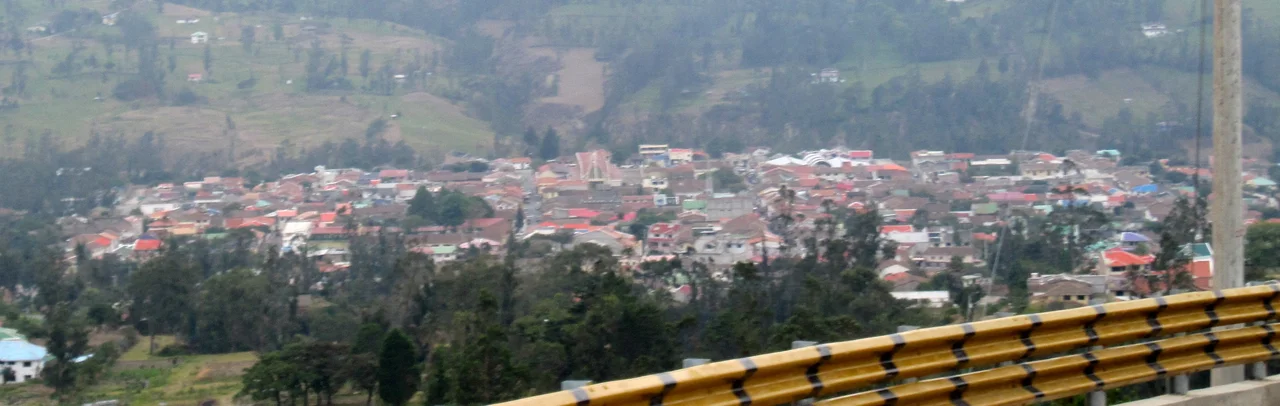

Girón, Azuay
The Inca called it Pacaybamba - "valley of the guava tree." The Spanish renamed it for a man who never stayed. Captain Francisco Hernandez Giron passed through this narrow valley in 1534, left his name behind, and went off to other adventures on his way to becoming one of colonial Peru's more notorious rebels. Four and a half centuries later, the town still carries his surname, though almost no one who lives here thinks about Captain Giron. What they think about is the Senor de Giron - a wooden crucifix believed to end droughts and bring prosperity - and the treaty signed here in 1829 that ended a brief, bitter war with Peru. A village of about 4,353 people in Ecuador's Azuay Province holds onto two inheritances, one colonial and one national.
The Valley Before the Name
Before anyone spoke Spanish or Quechua here, this was Leoquina territory - one of the many small cultures scattered through the southern Ecuadorian Andes before the Inca swept through in the late fifteenth century. The Inca named it Pacaybamba for the guava trees that grew wild along the valley floor. Then came 1534, the arrival of the Spanish, and the displacement of the Indigenous inhabitants who drifted up into the surrounding hills and countryside to get away from the ranches the newcomers built. Colonial land ownership concentrated in few hands. Social stratification hardened. The Indigenous culture retreated to the high paramo while Spanish cattle grazed the bottoms. Nothing about this pattern was unique to Giron - what happened here happened across the Andes. But it shaped the town that emerged.
Promoted, Demoted, Promoted Again
Ecuadorian politics has long had an appetite for administrative reorganization, and Giron lived through all of it. First a villa (small town), then a canton in 1824, then absorbed by Cuenca in 1854, then a canton again in 1884, then demoted in 1890, and finally made canton permanently in 1897. In 1890 it briefly governed the parishes of San Fernando, La Asuncion, Nabon, Cochapata, Ona, Pucara, and Zhaglli - but nearly all of those were later promoted to their own cantons, leaving Giron today with just two rural parishes under its administration: La Asuncion and San Gerardo. The town's population of about 4,353 (2022 census) sits inside a parish of about 8,441 people - many residents living outside the main town, working the surrounding countryside.
The Casa de los Tratados
In 1829, Gran Colombia was fighting Peru over disputed border territory - an old argument that had been building since the wars of independence. The climactic battle at Tarqui, a valley just north of Giron, was won by Gran Colombian forces under Antonio Jose de Sucre. The peace treaty that followed - the Treaty of Giron, or the Convention of Giron - was signed in this small town on February 28, 1829. The house where the signing happened is now the Casa de los Tratados museum, displaying weapons, uniforms, and instruments of the Ecuadorian army. Sucre was assassinated the following year. The border dispute with Peru would keep rumbling into the twentieth century, all the way to the 1941 war and the 1998 Brasilia Accord. But for a moment in 1829, in a farmhouse in Giron, it looked briefly settled.
Water, Waterfalls, and Guinea Pigs
Giron sits between rivers. The Rio Giron runs into the Rio Rircay, which feeds the Rio Jubones heading west to the Pacific. Lesser streams branch off into the surrounding hills: El Chorro, Rio Falso, Rio Mandur, Rio El Burro, Rio Manzano, Rio Rosas o Zhurzha, Rio San Gregorio. Lakes scatter the high country: Laguna de San Martin, Chapana, Guandeleg, Zhogra. And about five kilometers above the town, the El Chorro waterfalls drop in a series of cascades that have become the canton's most popular tourist draw. The climate is milder than nearby Cuenca's - pleasantly temperate rather than chilly. In the parish of La Asuncion, one community-run business raises guinea pigs, the cuy that Ecuadorians consider a traditional delicacy. It is not a wealthy place. The canton's oral tradition is richer than its artisanal output.
The Crucifix That Brings Rain
In the central church, above the town's plaza, hangs El Senor de Giron - a wooden crucifix that local belief says can call rain during droughts and prosperity during lean years. Every year the town holds the Fiesta de Toros del Senor de Giron in honor of the icon, a festival blending Catholic devotion with older agrarian traditions. For a farming and ranching town tucked between rivers and mountains along the Cuenca-Machala highway, the specifics matter: will there be enough water this season? Will the crops come in? Will the cattle do well? The Senor de Giron is asked these questions. The valley does what valleys do - turns guava green in the wet years, brown in the dry, and keeps the name a Spanish captain left here in 1534 whether or not anyone still thinks about him.
From the Air
Giron sits at approximately 3.16 degrees south, 79.15 degrees west, in the Andean foothills of Azuay Province, along Highway 80 between Cuenca (about 45 kilometers to the north) and Machala on the coast. Elevation is roughly 2,200 meters. Nearest major airport is Mariscal Lamar International (SECU) at Cuenca, approximately 25 nautical miles north. From altitude, look for the narrow river valley with the town tucked against the Rio Giron, the El Chorro waterfall above the settlement, and the southern Andean cordillera rising to the east. Andean cloud cover is often heavy in the afternoon during the wet season (December through May); mornings offer clearer views of the valley structure.
Nearby Stories
- El Oro Province 16 km away
- El Guabo Canton 18 km away
- Saraguro People 32 km away
- Santuario de la Virgen de la Nube 49 km away
- Cueva de los Tayos 61 km away
- Clock Tower of Guayaquil 69 km away
- Sangay National Park 118 km away
- Borja, Peru 184 km away