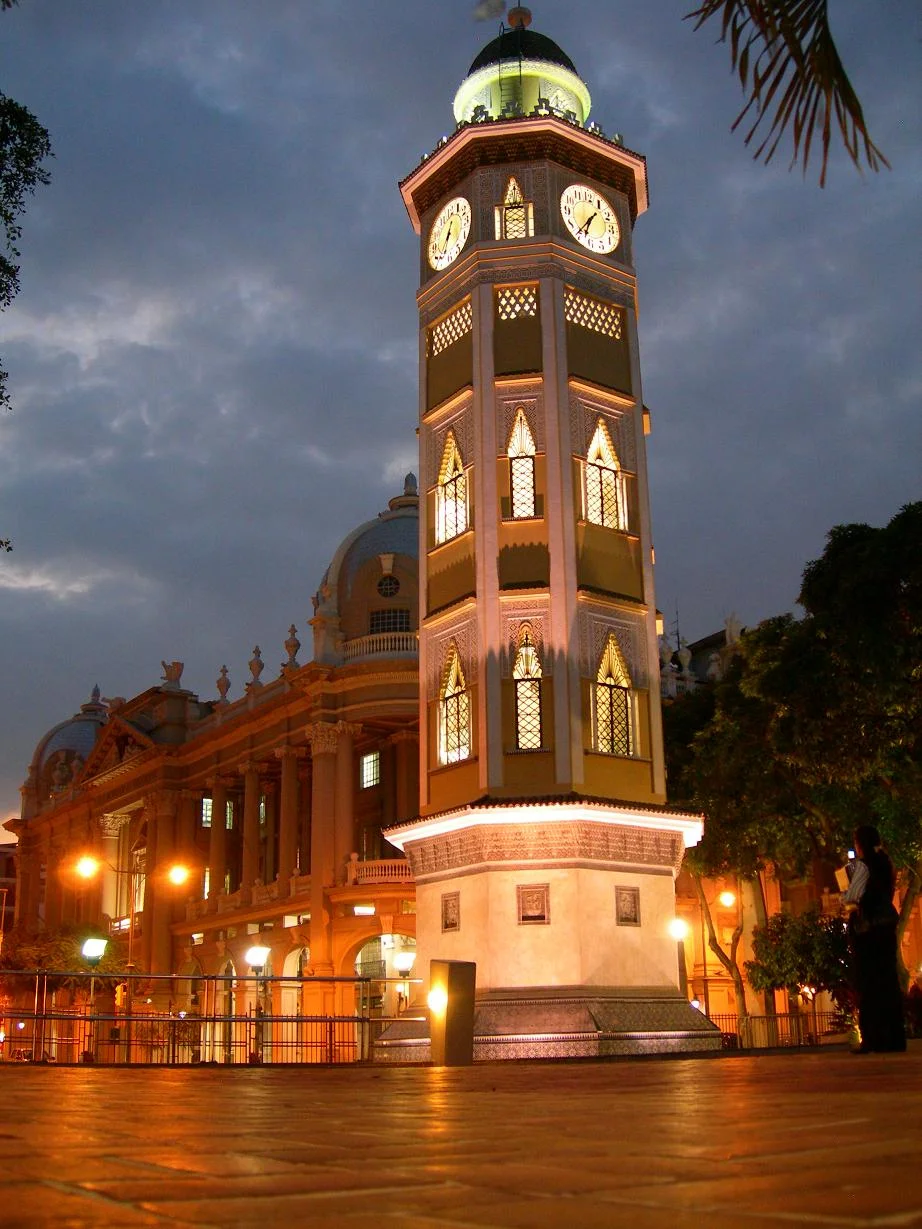

Clock Tower of Guayaquil
The clock is older than the tower that holds it. In 1842, Ecuadorian businessman Manuel Antonio de Luzarraga loaned the city of Guayaquil enough money to import an English-made clock - and almost from the moment it arrived, the clock has been in motion. It has lived on top of a wooden cabildo building, on the roof of the city's old food market, on a temporary iron tower covered in cement, and finally on the Moorish Tower of 1931 where you can still see it today. Four towers in 89 years. The clock kept working. One architect died before his tower was finished. Another architect ornamented the winning design six years after it opened. The bell rings every hour. Since June 2023, you can climb up and stand next to it.
A Jesuit Clock That Had to Leave
There had been clock towers in Guayaquil before the English clock arrived. The first was built sometime in the mid-eighteenth century by the Society of Jesus, as part of the monastery and school of San Francisco Javier founded in 1705. That tower - and its Jesuit makers - did not survive the changing politics of the Spanish Empire. On February 27, 1767, Charles III of Spain issued an edict expelling the Jesuits from the Americas, and by 1769 the order had complied and left Guayaquil. Their tower and clock passed through intermediate owners - dismantled and rebuilt by Salvador Sanchez Pareja in 1783, purchased in 1800 by Santiago Espantoso along with the Jesuits' building - and ran in continuous operation until 1829. Then the old clock finally gave out.
Luzarraga's Loan
Guayaquil in the 1830s was broke. Magistrate Juan de Aviles requested in 1837 that the city buy a new clock; the funds were considered too expensive, and nothing happened for five years. The solution, when it came, was financial rather than political. The House of Luzarraga - one of the great merchant families of nineteenth-century Guayaquil - loaned 6,000 pesos to the municipality at the request of Governor Vicente Rocafuerte. The money went to England for a proper mechanical clock, which arrived in Ecuador on September 9, 1842, and was inaugurated that October. The clock was installed above the Casa del Cabildo, the wooden municipal building on Diez de Agosto Street that had stood since 1817. The Cabildo had actually bought the Jesuit clock from Espantoso for 300 pesos back in 1817, but that one never worked right again after its disassembly. Luzarraga's English clock worked.
The Fire Scare and the Move
In the late nineteenth century Guayaquil fell prey to a widespread belief that tall buildings encouraged the spread of fires - a not-unreasonable fear in a city that had burned repeatedly. The clock came down, the tower on the Cabildo roof was dismantled, and in 1905 the clock was moved to the new Mercado de la Orilla. The old wooden Cabildo, heavily dilapidated, was considered too ruinous to be a home for precision machinery. It was demolished for safety in 1908. The market was supposed to be temporary; it became another kind of permanence. In 1909 the market building was extended by two floors so the clock could be seen from farther away and its chimes heard better throughout the city. For sixteen years the clock kept time from a food market. It worked.
An Iron Tower and a Dead Architect
In 1920 the city finally decided the clock deserved its own monument. A standalone site was chosen on Malecon street, and on June 6, 1921, the city contracted construction of an iron tower covered in cement. The project was estimated at 10,000 sucres. The architect was Nicolas Virgilio Bardellini Seminario, with decorations by Emilio Soro. The plan was approved on July 26. On August 9 - two weeks later - Bardellini died. His heirs were asked to complete the tower, and construction began on September 22, 1921. The 23.5-meter iron tower was inaugurated on April 25, 1923. It did not last. The structural calculations turned out to be wrong; the tower would not be sound for the long term. By 1930 the city was planning again.
The Moorish Tower
The fourth tower is the one still standing. In 1930, Miguel Angel Garbo, president of the Municipal Council, ordered construction of what became known as the Torre Morisca - the Moorish Tower - designed by engineer Francisco Ramon and architect J. Perez Nin y Landin. Construction began in 1930 and the tower was inaugurated on May 24, 1931. In 1937, architect Juan Orus Madinya modified both interior and exterior with the additional ornamentation that gives the tower its iconic silhouette today - arched windows, geometric ornament, a stacked tiered profile that earned the Moorish name. The bell was repaired to ring every hour, which it still does. Ninety years later, the clock Luzarraga imported from England in 1842 is still keeping time above Guayaquil. Since June 2023, visitors can climb the tower Thursday through Sunday, 10 a.m. to 5 p.m., and stand beside the mechanism as it ticks. Four towers. One clock. Every hour, on the hour, the bell still rings.
From the Air
The Moorish Tower sits at 2.19S, 79.88W, on the Malecon 2000 along the Guayas River in downtown Guayaquil. Tower rises roughly 23-25 meters above street level; visible from the air against the riverfront. Jose Joaquin de Olmedo International Airport (SEGU) is immediately west. Best viewed from the east bank of the Guayas River on approach; the tower anchors the south end of the downtown historic district, with Parque Seminario and the cathedral a few blocks inland. Daytime flights reveal its Moorish-revival ornamentation and pale color clearly against the river.
Nearby Stories
- Guayas Province 20 km away
- Montañita 29 km away
- Santa Elena, Ecuador 39 km away
- 2023 Guayas earthquake 48 km away
- El Cajas National Park 50 km away
- Santiago de Bolivar 57 km away
- Alausí Canton 67 km away
- Department of Tumbes 158 km away