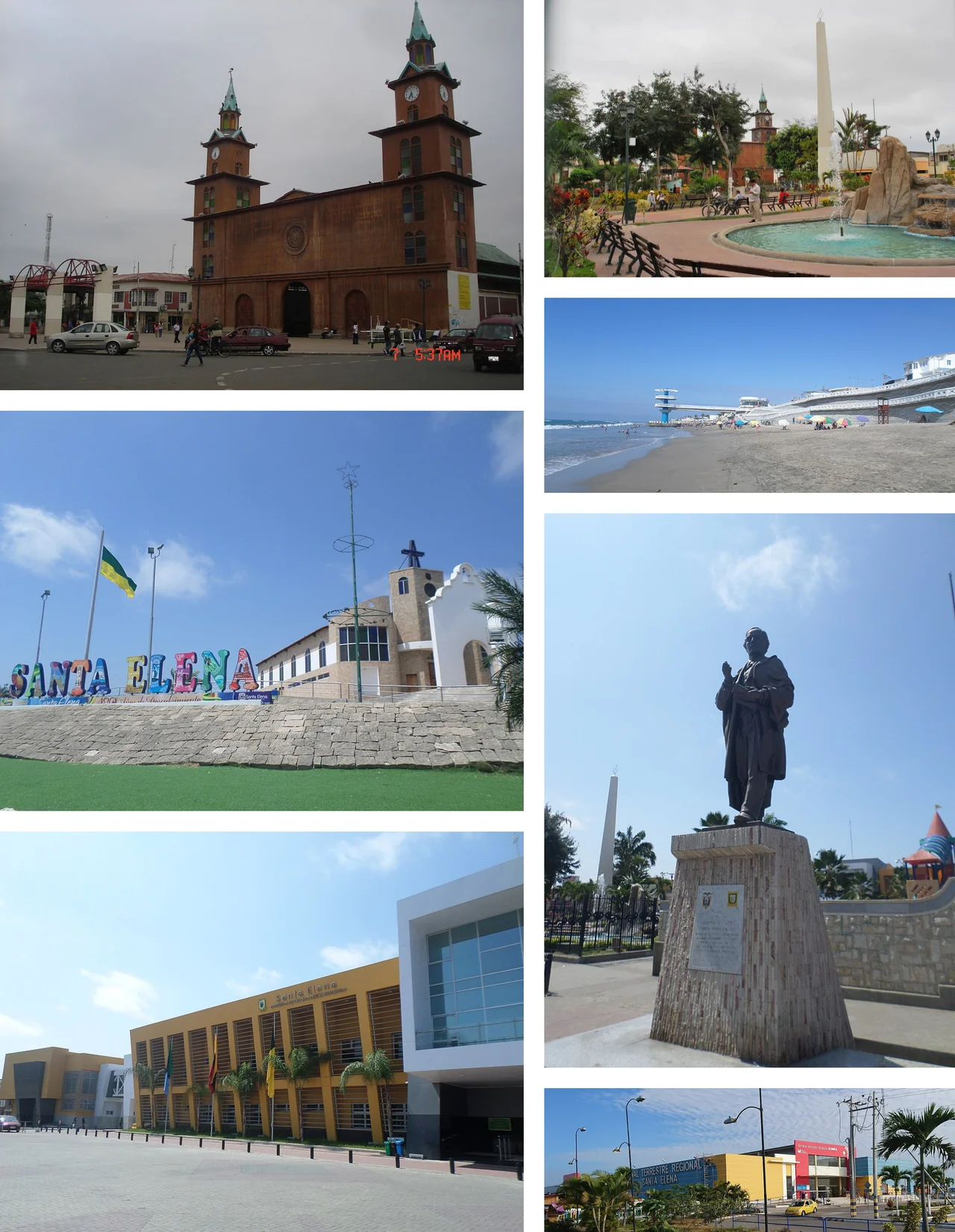

Santa Elena, Ecuador
They were placed in the ground in an embrace. Two people - we do not know who they were or why they died - buried together in what is now the Santa Elena Peninsula of southwestern Ecuador, at a time when pyramids had not yet been imagined in Egypt and agriculture was a new idea in most of the world. Nine thousand years after their burial, archaeologists found them, still embracing. Ecuadorian newspapers called them the Lovers of Sumpa, Los Amantes de Sumpa, and compared them to Romeo and Juliet. They have become one of the most famous archaeological discoveries in the country, but the simpler truth is this: somebody, nine thousand years ago, arranged these two bodies in a final gesture of closeness, and that gesture survived the intervening time.
Sumpa Was the Original Name
Before the Spanish arrived and renamed everything, the place was called Sumpa. Today's Santa Elena is the capital of both the province and the canton that share its name, sitting on the Ecuadorian peninsula near Guayaquil. The archaeological site here is regarded as the country's most important, largely because of what was excavated starting in 1977 - when Olaf Holm, director of the Anthropology Museum at the Central Bank of Ecuador, asked the American archaeologist Karen E. Stothert to take on the project. Stothert's team worked the pre-ceramic deposits for decades. They found evidence of a culture nobody had documented before, one that turned out to be the earliest settled people in Ecuador.
Las Vegas, the First Ecuadorians
The culture that Stothert identified is called Las Vegas, named after a local ranch near the original dig. Las Vegas flourished from 8,800 to 4,600 BC along the Ecuadorian coast - a stretch of four thousand years, roughly twice as long as the entire recorded history of Europe to the present. The people who made up this culture were hunter-gatherers transitioning into early agriculture. Archaeologists found artifacts, remains of houses, and what was almost certainly a garbage dump - the unglamorous but informative leavings of daily life. The biggest discovery came when the team uncovered a cemetery of about 200 people, all buried over centuries, each placed in the ground by the people who had known them. Among those burials were the Lovers of Sumpa.
What the Embrace Means
There is considerable speculation about how the two bodies in the embrace died. One theory holds that they were stoned to death, possibly executed together. Another points out that the surviving skeletons show no definitive cause, and that the speculation may say more about our desire for drama than about the historical reality. Karen Stothert herself has written about the ethical implications of putting ancient remains on public display - how archaeologists should frame these finds, what responsibility they carry toward the people whose ancestors might be the Las Vegas. What is not in dispute is that somebody chose to bury these two together, arranged their bodies in a deliberate posture, and left them to the ground. The gesture was intentional. It has outlasted every empire, every religion, every political system that came after.
The Museum That Finally Got Built
For years after the discovery, the site struggled for funding. Rising oil prices meant the Ecuadorian government could barely supply enough money to pay for guards to protect the artifacts, let alone build proper facilities. Meanwhile, the media attention on the Lovers of Sumpa doubled Santa Elena's population in twenty years as tourism and curiosity drew people to the area. In 1997, the Museo Amantes de Sumpa y Centro Cultural finally opened to the public. The museum displays three of the burials - including the Lovers - behind protective glass, used by teachers and archaeologists like Stothert as teaching tools. Ecuador has no legal or moral restrictions on the public display of ancient remains, though the museum handles the practice with considerable care. The site has become a center for heritage education and a touchstone for understanding coastal Ecuadorian identity.
A Culture Being Preserved
The descendants of the Las Vegas and the cultures that followed them still live along this coast, though centuries of colonization and modernization have eroded many traditions. The Santa Elena archaeological program has worked to fold cultural and heritage content into local school curricula - children in Santa Elena now learn about the Lovers of Sumpa as part of their education, the same way children in Athens learn about the Parthenon. The difference is that the Lovers are closer in time to their own ancestors than Athens is to modern Greeks. They have become a kind of anchor for coastal Ecuadorian identity, a reminder that the people who lived here before colonization had their own complex lives, their own ways of marking death, their own gestures of love. The embrace outlasts everything else.
From the Air
Santa Elena sits at 2.23 degrees south, 80.86 degrees west, on the peninsula of the same name in southwestern Ecuador. The nearest airport is General Ulpiano Paez Airport (SESA/ESLS) in Salinas, about 8 miles to the west. Jose Joaquin de Olmedo International (SEGU/GYE) in Guayaquil is about 80 miles east. The Santa Elena Peninsula juts westward into the Pacific, distinctively shaped from the air. Hot, dry climate maintained by the Humboldt Current - conditions stay relatively stable year-round with minimal rainfall.
Nearby Stories
- Montañita 13 km away
- Urdesa 28 km away
- Palestina Canton 40 km away
- 2023 Guayas earthquake 59 km away
- Battle of Punta Malpelo 118 km away
- Cabo Blanco, Peru 199 km away
- Talara Refinery 266 km away
- Malpelo Plate 575 km away