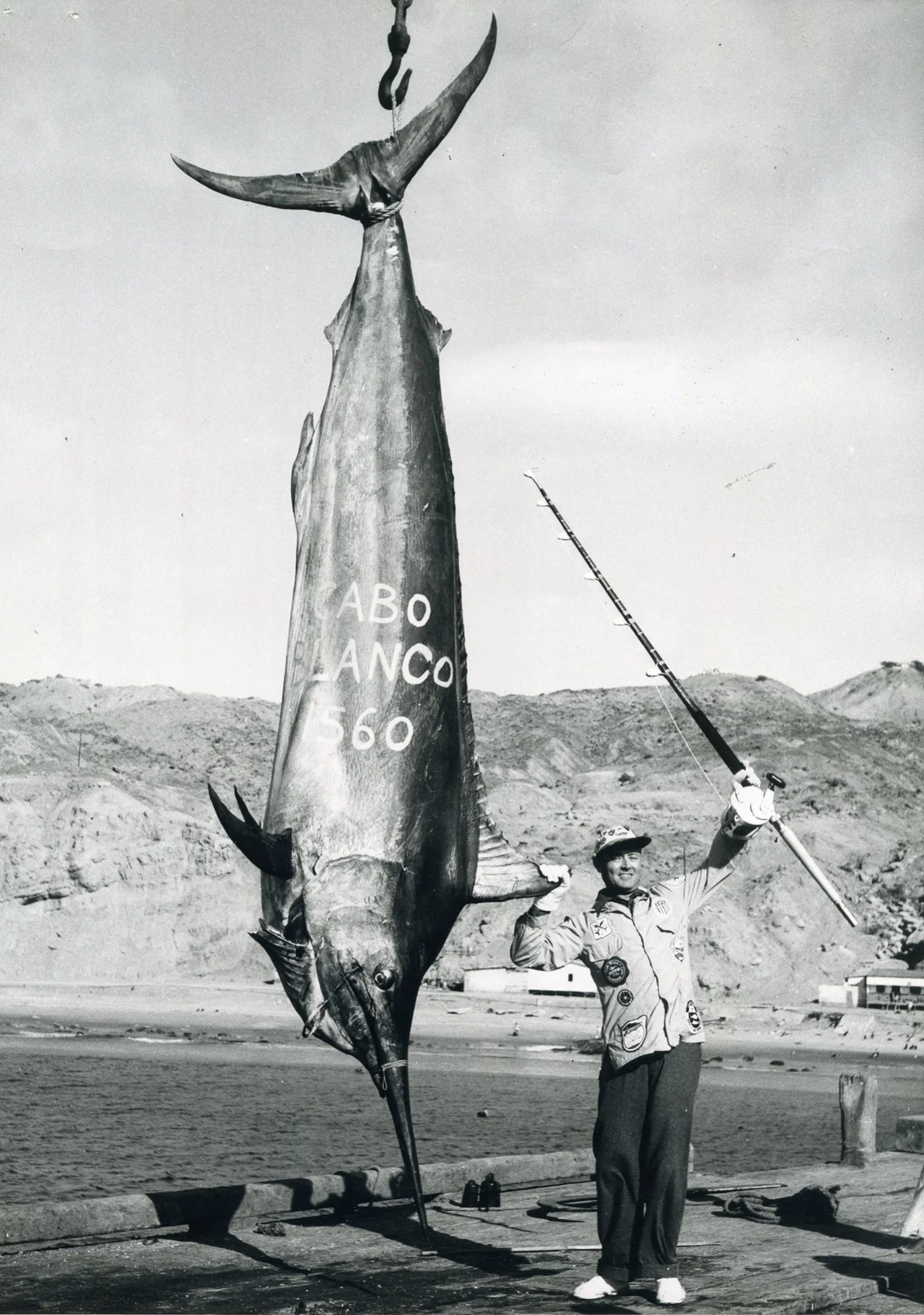

Cabo Blanco, Peru
In 1953, an oilman from Texas named Alfred Glassell Jr. hooked a black marlin off the coast of Cabo Blanco, Peru. He fought it for an hour and forty-five minutes. The fish weighed 1,560 pounds. It remains, more than seventy years later, the IGFA all-tackle world record for the species. A few years earlier, Ernest Hemingway had spent more than a month at the same small fishing village, trying to catch one himself while a film crew waited to splice the footage into the movie version of The Old Man and the Sea. He caught a 700-pounder. He was happy enough. Hemingway is gone. The Cabo Blanco Fishing Club is a memory. What remains at Cabo Blanco now is something he never saw coming: a wave.
The White Cape
Cabo Blanco - the white cape - sits on Peru's desert northwest coast, three kilometers from El Alto in Talara Province, Piura Region. It is a small place, about twenty full-time locals living between the water and the pale coastal mountains that give the cape its name. The Humboldt Current flows north here along the Peruvian coast, cold and nutrient-rich, and where that cold water meets the warm equatorial currents moving south, the ocean mixes violently enough to feed almost everything. Krill, anchovies, tuna, dolphinfish. And marlin - big marlin, black and blue and striped, drawn to the confluence in numbers that drew a generation of big-game fishermen halfway around the world to find them.
Hemingway's Month
The Cabo Blanco Fishing Club opened in 1951 and for the next two decades was one of the most famous sport-fishing destinations on the planet. Hemingway arrived in 1956, a few years after Alfred Glassell Jr. caught the world-record black marlin off the same water. A film crew was working on the Warner Brothers adaptation of The Old Man and the Sea, and Hemingway had come to help them land the underwater footage they needed. He stayed more than a month. The fishing was good enough that he hooked a 700-pound marlin - not a record, not a first, but a respectable fish in a year when respectable fish at Cabo Blanco routinely topped a thousand pounds. The footage Hemingway helped land made it into the film. Some of the underwater shots you see in the 1958 movie were filmed here.
The Record That Still Stands
In 1952, the socialite Patsy Pulitzer - granddaughter of the newspaper publisher - caught a 1,230-pound black marlin off Cabo Blanco, a then world-record fish for a woman; Sports Illustrated later featured her in 1961 as one of its Worlds Loveliest Sportswomen. It was, at the time, the world-record black marlin for a woman. A year later, on August 4, 1953, Alfred Glassell Jr. landed his 1,560-pound fish, setting the IGFA all-tackle record that still stands. The Smithsonian has Glassell's marlin - preserved from the fish's own skin - on display. But the pelagic fishery that made those records possible began to thin. Industrial longlining, overharvesting of the bait fish that sustained the marlin, warming waters - by the 1970s the club's great years were over, and by the 1980s Cabo Blanco was what it had been before: a quiet fishing village with a faded sign.
The Peruvian Pipeline
In 1979, a Peruvian surfer named Sergio 'Gordo' Barreda drove up from Lima to check the break. What he found was one of the best left-handed tube rides on the Pacific rim - a hollow, powerful wave peeling over a sand-and-rock bottom, working best when Pacific swells from Hawaiian storms arrived about five days after the Hawaiians surfed them. Surfers began calling it the Peruvian Pipeline, after the Banzai Pipeline on Oahu. In the 1990s, before modern forecasting, the best way to know when Cabo Blanco would fire was to phone Hawaii and count days. Today, surfers from Lima, 700 kilometers south, and from around the world pack into a single tight takeoff zone when the swell hits. Other waves break along the same coast. Almost everyone fights for this one.
The Pier and the Wave
A few years ago, someone proposed building a concrete fishing pier directly through the takeoff zone of the Cabo wave, which would have destroyed it entirely. The proposal also happened to be technically difficult to execute - the surf that makes the wave famous makes pier construction hazardous. Sanity prevailed. The pier was built about 150 meters north instead, replacing an older wooden one that the sea had finally destroyed. It still clips the tail end of the longest rides, but the wave itself survives. The village survives. The 2010 Peruvian film Undertow - Contracorriente in Spanish, directed by Javier Fuentes-Leon - was shot here, using the village's rhythm of nets and waves as a backdrop. Hemingway's fishing club is gone. Glassell's record still stands. And every winter, when a big Hawaiian swell arrives on schedule, a new generation arrives to ride what the old one did not know was waiting.
From the Air
Coastal village at 4.25S, 81.23W, on Peru's arid northwestern coast about 1,100km north of Lima. Elevation at sea level, backed by pale coastal mountains that give the cape its name. Capitan FAP Victor Montes Arias Airport (SPTN, Talara) lies 30nm south; Piura (SPUR) is 80nm east-southeast. Clear, stable flight weather most of the year thanks to the Humboldt Current's cooling influence. Approach from the south to trace the long desert coastline; low-altitude passes at dawn catch the surf break working best.
Nearby Stories
- Punta Arenas, Peru 11 km away
- Cerros de Amotape National Park 35 km away
- Department of Tumbes 35 km away
- Poechos Reservoir 41 km away
- Battle of Punta Malpelo 116 km away
- San Cristóbal (Galápagos) 906 km away
- San Cristóbal Island 918 km away
- Easter Island: The Mystery of Rise and Collapse 3840 km away