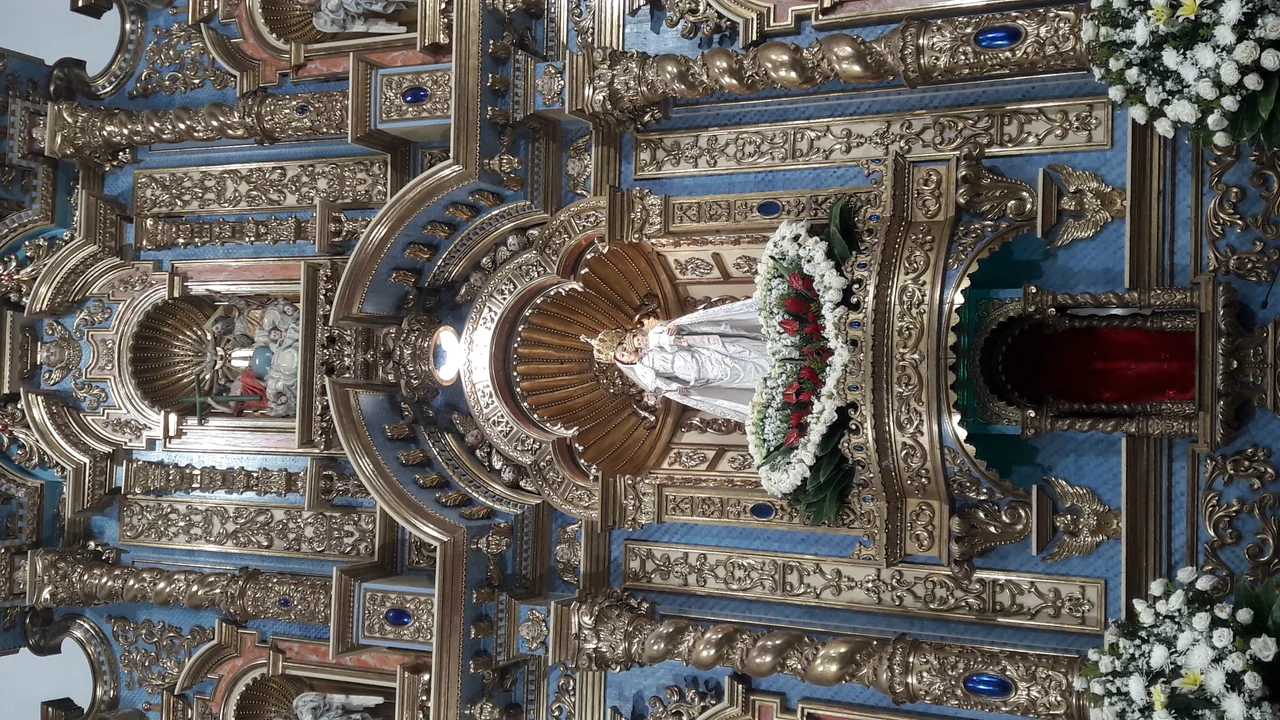

Santuario de la Virgen de la Nube
In 1696, the story goes, Bishop Sancho de Andrade y Figueroa of Quito fell seriously ill. The people of Guapulo, a village on the outskirts of Quito, organized a Rosary procession toward the cathedral to pray for his recovery. On December 30, around 4:30 in the afternoon, a woman appeared in the late afternoon sky - the Virgin Mary, resting on a white cloud, witnessed by some five hundred in the procession and many more in the surrounding hills. The bishop recovered. Ecuadorians have called her Virgen de la Nube - Virgin of the Cloud - ever since. More than three centuries after the vision, the sanctuary that bears her name still draws pilgrims on the first of January, when some forty thousand people converge on the small city of Azogues to venerate her image. The building they come to is itself a kind of offering.
Stone Carried from the Hill Above
The sanctuary sits in the eastern part of Azogues, capital of Canar Province, about four hundred kilometers south of Quito where the original vision occurred. Construction began in 1912 and did not finish until 1954 - forty-two years of work, done with stone carved from the Abuga hill that rises just behind the church. Every step of the sanctuary's grand staircase, every block of its walls, came from that single hillside. The Republican-era design blends simplicity with scale. Inside, the high altar is carved entirely from fine wood and covered in gold leaf. At its center is the image of the Virgin of the Cloud, carved in 1899 by Don Daniel Alvarado Bermeo, an artist from nearby Cuenca. The image is smaller than visitors sometimes expect, given the pilgrimage it anchors.
The Minga That Built It
Much of the construction was organized through mingas - communal work gatherings that have been part of Andean life since well before the Spanish arrived. Chronicler Fr. Jose Maria Idigoras recorded that up to two hundred people would participate in a single minga, hauling stone, mixing mortar, setting blocks. A minga was not paid labor. It was reciprocal community work, offered in exchange for the expectation that others would do the same when needed. Building a church this way meant that everyone in Azogues and the surrounding villages had family connections to the walls rising on the edge of town. On September 17, 1919, the fraternity coordinating the work was elevated to guardianship. To increase devotion, groups called CHORUS of the Virgin were formed, thirty families each. By 1927, there were twenty-one of these choirs.
Canonization and Catastrophe
On October 24, 1965, the Franciscan community at Azogues formally requested canonical recognition of the Virgin of the Cloud. The Catholic Church approved public worship and assigned a liturgical feast day on January 1, 1967. The sanctuary had its official standing. Four years later, on July 27, 1971, a major earthquake struck southeastern Ecuador. Its effects were felt across northwestern South America. Half of the sanctuary was seriously damaged. A large retaining wall that protected the building collapsed. The community rebuilt. The wall had to be restored, the structural damage assessed and repaired, the sanctuary brought back into working order. It was the kind of blow a building recovers from slowly. The pilgrimage continued through the rebuilding, pilgrims walking past scaffolding and piled stone to reach the altar.
The Monument on El Abuga
On the Abuga hill above the sanctuary stands a monument - the Nuestra Senora de la Nube, or more commonly the Virgen de La Nube in El Abuga. The statue depicts the Virgin Mary holding the infant Jesus, standing high enough to be visible from much of Azogues below. The scale is considerable. Pilgrims who have made the journey to the sanctuary often continue up the hill to reach the monument, adding the climb as a final act of devotion. The relationship between the carved stone of the sanctuary and the statue looking down on it is deliberate - the building honors the apparition, the statue mirrors it, and the hill itself supplied the material for both. Few shrines anywhere integrate the geography this completely into the devotion.
Two Days a Year
The major festivals of the Virgen de la Nube fall on January 1 and May 31. On the first day of the new year - the feast day proper - groups of priests arrive from convents throughout Ecuador to help the Franciscans at Azogues handle the volume of pilgrims. Caravans of buses pull in from across the country and, increasingly, from abroad. The processions through the main streets of Azogues have become as much a tourist attraction as a religious observance, though for most participants the distinction barely registers. The approximately forty thousand people who attend are there for the Virgin. The Franciscan friars prepare every act of worship with care, the procession fills the streets, and the building that took four decades of community labor to construct absorbs the crowd without complaint. Then the pilgrims go home, and the sanctuary quiets again until May 31.
From the Air
Santuario de la Virgen de la Nube sits at 2.74 degrees south, 78.84 degrees west, on the eastern side of Azogues in Canar Province, Ecuador. The nearest major airport is Mariscal Lamar International (SELT/CUE) in Cuenca, about 20 miles to the south. Flying over this area reveals the Andean highlands of southern Ecuador, with Azogues visible as an urban cluster and the carved stone sanctuary distinguishable on the eastern edge of the city. The Abuga hill rises immediately behind the sanctuary - look for the Virgin monument on its summit. Cool Andean climate at about 2,500 meters elevation.
Nearby Stories
- Tarqui, Cuenca Canton 12 km away
- Cueva de los Tayos 23 km away
- Empresa de Ferrocarriles Ecuatorianos 30 km away
- Battle of Yaguachi 39 km away
- 2023 Guayas earthquake 41 km away
- El Guabo Canton 50 km away
- Eastern Cordillera Real Montane Forests 67 km away
- Sangay National Park 99 km away