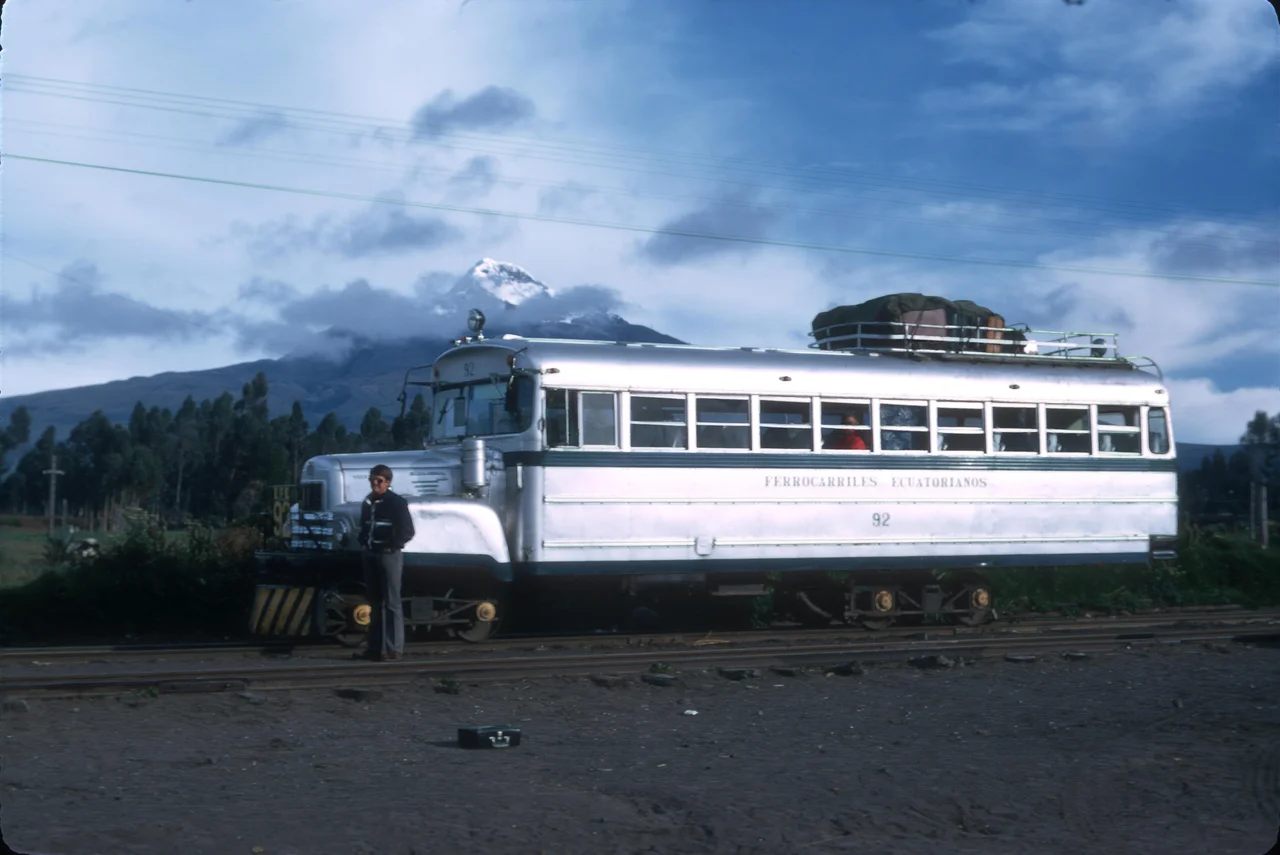

Empresa de Ferrocarriles Ecuatorianos
A train was once supposed to connect two countries that no longer exist as they did then. In 1892, an American engineer named Colonel William Findlay Shunk - the same man who designed the New York Elevated - drafted a route for the InterContinental Railway, a chain of rails meant to run from the United States through Central America, Colombia, Ecuador, all the way to Argentina. That railway never got built. But Shunk's work was not wasted. Five years later, his son-in-law's brother signed a contract with President Eloy Alfaro to rehabilitate a crumbling Ecuadorian line and carry it over the Andes. The train that emerged would climb from sea level to 11,800 feet, shunt back and forth across a cliff called the Devil's Nose, and become one of South America's most audacious engineering acts.
The Dream of Two Ecuadors Joined
Ecuador in the nineteenth century was functionally two countries. There was the humid coast around Guayaquil, Pacific-facing and mercantile, and there was the Andean sierra around Quito, highland and Catholic and conservative. A journey between them by mule took days. President Gabriel Garcia Moreno started the first railway in 1861, and by 1888 tracks had reached Bucay at the base of the mountains. But the climb to Quito was the hard part. That challenge fell to Eloy Alfaro, the liberal revolutionary who saw the railway as a tool to break the Catholic Church's hold on national life and usher Ecuador into the twentieth century. He turned to the Harman brothers of Staunton, Virginia - Archer as financier, John as chief engineer - who formed the Guayaquil and Quito Railway Company in New Jersey in 1897.
The Devil's Nose
Between the towns of Alausi and Sibambe, the Andes show their teeth. To gain roughly 500 meters of altitude in a near-vertical span of only about twelve kilometers, the engineers carved a pair of switchbacks up the rock face they named Nariz del Diablo - the Devil's Nose. Trains run forward, stop, reverse onto a higher track, stop again, then run forward once more, climbing the cliff in a zigzag. Construction between 1897 and 1908 cost hundreds of lives to yellow fever, malaria, landslides, and falls from the rock. When the line finally reached Quito in 1908, Ecuadorians lined the streets to watch the first locomotive arrive. The G&Q had joined coast and sierra, Guayaquil's bananas and Quito's highlands, at 2,850 meters of mountain elevation and roughly 450 kilometers of track.
Side Branches and Cut Lines
The Andean spine was only part of the system. Smaller railways crept across Manabi Province and the coastal plain: Bahia de Caraquez to Chone opened in 1912, ran for fifty years, then vanished by the mid-1960s. A line from Manta to Santa Ana served from 1913 to 1946. The Guayaquil-to-Salinas route ran until 1954. On the southern coast, a narrow-gauge railway linked Puerto Bolivar to the interior of El Oro Province, intended to reach Loja but stopping at Piedras; services drifted into irrelevance by around 1971. The Northern Division from Quito to the Colombian border was not completed until 1957. At its peak the national network totaled 965.5 kilometers - the largest infrastructure project the country had ever attempted.
The Slow Abandonment
El Nino came in 1997 and 1998, and the rains took out bridges, embankments, and long stretches of track. By the 2008 centennial only about 10 percent of the railway was operational. The Pan-American Highway had done most of the rest of the damage, siphoning passengers and freight onto buses and trucks. President Rafael Correa declared the railway a national cultural patrimony in 2008 and poured money into rehabilitation. Short sections reopened as tourist lines: El Tambo to Banos del Inca in 2009, Duran to Yaguachi in 2010, the Devil's Nose switchbacks in 2011, Ibarra to Otavalo in 2014. A premium service called Tren Crucero ran the full Southern Division, and travelers could cross Cotopaxi's shadow or the Avenue of Volcanoes in restored carriages. Then came 2020.
Ruins and Revivals
COVID-19 shut everything. All trains stopped running on March 17, 2020. By May 19, Executive Decree No. 1057 had ordered the extinction of Ferrocarriles del Ecuador Empresa Publica, beginning a liquidation that continued through at least 2021. The national railway, 147 years after its first Yaguachi-to-Milagro section opened in 1873, was formally dissolved. But tracks do not vanish as easily as companies. Local efforts have restarted tourist service on the Ibarra-Otavalo stretch in Imbabura Province, and the Alausi-Devil's Nose switchback was slated to return in late 2024 under Chimborazo Province management. The Tren Crucero dining cars sit in yards; the old Riobamba station building became a municipal market before a new one was built beside the bus terminal. Ecuador's railway in the sky, as the British press once called it, is neither running nor entirely dead.
From the Air
The main trunk of the former Empresa de Ferrocarriles Ecuatorianos network threads between Duran near Guayaquil (approximately 2.18 degrees south, 79.83 degrees west) and Quito (0.18 degrees south, 78.47 degrees west). The geographic heart of the system - including the Devil's Nose switchback at Alausi - sits near 2.20 degrees south, 78.85 degrees west, in Chimborazo Province. From altitude, the climb is visible as a thin line crossing the western Andean cordillera; look for switchbacks near Sibambe and the mountain towns of Riobamba, Latacunga, and Ambato stepping up the Avenue of Volcanoes. Nearest hubs are Mariscal Sucre International (SEQM) in Quito and Jose Joaquin de Olmedo International (SEGU) in Guayaquil. High-altitude visibility is best in the dry season, June through September.
Nearby Stories
- Ingapirca 10 km away
- Sangay National Park 13 km away
- Babahoyo 15 km away
- Battle of Yaguachi 22 km away
- Santiago de Bolivar 27 km away
- Eastern Cordillera Real Montane Forests 43 km away
- 2023 Guayas earthquake 58 km away
- Cueva de los Tayos 69 km away