.jpg)
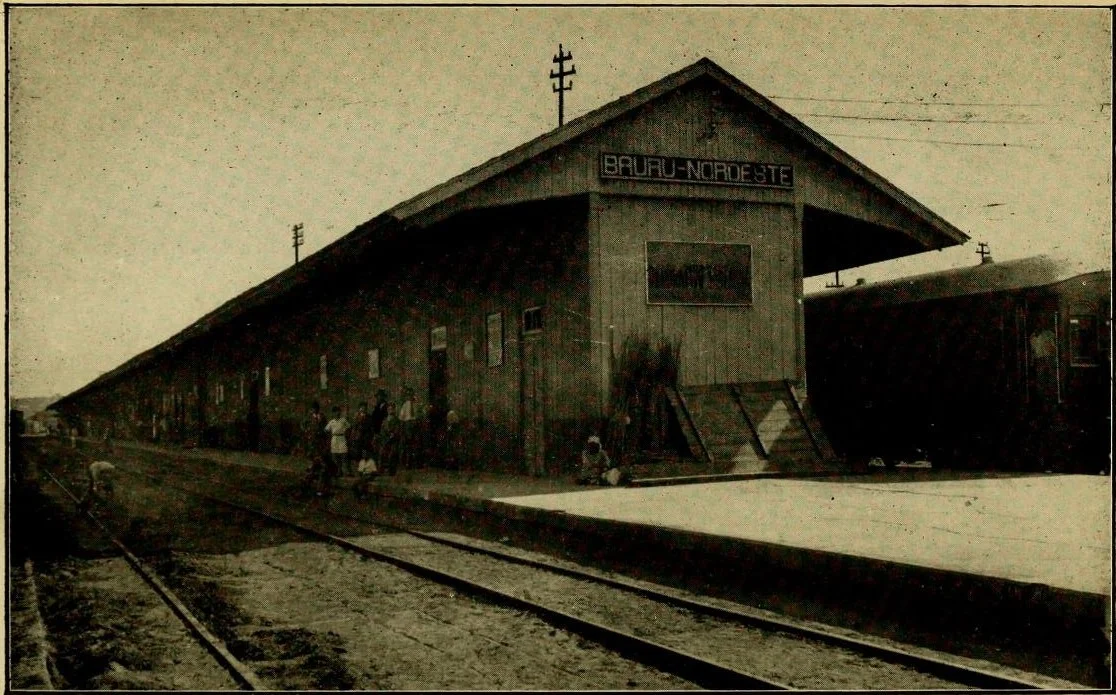
Bauru Station (NOB)
The last passenger train pulled out of Bauru on March 14, 2001 - a Tuesday, unremarkable except that a century of rail history stopped with it. For most of the twentieth century, this station was not a destination. It was a beginning. The Estrada de Ferro Noroeste do Brasil, the Northwest Railroad, started here and ran west toward Cuiaba, toward Corumba, toward the Bolivian border - more than 1,600 kilometers of track pushed through cerrado and pantanal to connect coastal Sao Paulo to the Brazilian interior. Every passenger headed to those places passed through the doors of the Bauru station. Belgian and French financiers funded the line. Brazilian engineers surveyed it. The building that still stands on the site was inaugurated on September 1, 1939, and when it opened, it was one of the three largest railroad junctions in Brazil.
The Wooden Beginning
The Companhia Estrada de Ferro Noroeste do Brasil was created in 1904 with an ambitious mandate: link the Sao Paulo rail network to Cuiaba, capital of distant Mato Grosso. The financing came from Belgian, French, and Brazilian sources, and the line began construction in November 1904, starting from the Bauru station of the Sorocabana Railway. The Bauru station of the Noroeste went up beside it - a simple wooden building, put together to house ticket offices and dispatch rooms until something more permanent could replace it. It opened with the railroad on September 27, 1906. In the meantime, the Noroeste continued using the Sorocabana building as an actual boarding point, because the new wooden structure was never quite finished enough to handle the growing passenger flow on its own. In 1910, the Companhia Paulista extended its own tracks to Bauru, and the junction of three railroads - Sorocabana, Noroeste, and Paulista - made Bauru one of the most important rail cities in the interior of Sao Paulo.
The Long Path to a New Station
By the 1930s the wooden building was overwhelmed. Plans for a replacement began in 1933, when the Sao Paulo government proposed leasing the Noroeste and building a single new terminal for all three railways. The proposal was shelved, but the idea of a new Noroeste station persisted. In July 1934, the Ministry of Transportation and Public Works approved the project. The state government and the Companhia Paulista formed a joint venture called Sociedade Melhoramentos da E.F. Noroeste do Brasil Limitada on August 18, 1934, and construction began on December 5, 1935. The structure was largely complete by June 1936, but the rail yard expansion dragged on, with land still being expropriated in 1939. The station opened on September 1, 1939. Complementary work dragged until 1942. The first floor housed ticket offices, baggage dispatch, and technical rooms for all three railroads; Noroeste administrative offices occupied the upper floors.
The Busy Decades
By 1959, the station received 28 daily trains - sixteen from the Companhia Paulista, eight from the Noroeste (which had recently been absorbed into the Federal Railway Network), and four from the Sorocabana. It was a functional, working junction, not a monument. Suitcases and freight crates moved through the concourse every hour of the day. Freight traffic kept the station vital long after passenger traffic started to thin. In 1971, Sorocabana and Paulista - by then merged into Fepasa - agreed to consolidate their ticket, baggage, and technical services through the Noroeste offices, freeing employees for assignments elsewhere. But the glory years were already ending. In 1976, Fepasa closed the old Sorocabana passenger services. The Bauru-Corumba line continued, connecting the state capital region to the Pantanal and beyond, but the schedule shrank as highways expanded. By the early 1990s, the Bauru-Corumba train ran only two days a week.
Closure and Afterlife
The Federal Railway Network deactivated the Bauru-Corumba train in January 1993. Only Fepasa passenger services remained, connecting Bauru to destinations within Sao Paulo state. Then, on March 14, 2001, the successor concessionaire Ferroban shut down the last passenger services. The station went dark. The silence was shocking after nearly a century of arrivals and departures. In 2006, administration of the building was transferred to the Bauru City Hall, which has managed the structure since. The building still stands - a concrete-and-stucco edifice of 1930s institutional styling, facing a wide platform where trains no longer stop. Railroad enthusiasts and urban historians have campaigned to preserve it and turn it into a museum. The Regional Railway Museum in Bauru holds artifacts from this line and many others. The Noroeste station itself remains, waiting to be reimagined - a reminder of the era when Brazil's interior was still reached by rail.
From the Air
Located at 22.32 S, 49.08 W in the city center of Bauru, Sao Paulo state. Nearest airports are Bauru Airport (SBAU), just 3 km from the station, and the larger Bauru-Arealva Airport (SBAE) about 30 km east. The city sits at around 525 meters elevation on the western Sao Paulo plateau. Terrain is rolling cerrado and agricultural land. The old Noroeste line itself can still be traced westward from the station, a thin trace across the countryside heading toward Mato Grosso do Sul. Best viewing during the May-October dry season.
Nearby Stories
- São Paulo (state) 20 km away
- Caetetus Ecological Station 23 km away
- Captaincy of São Paulo 63 km away
- Adamantina Formation 69 km away
- Titanochampsa 94 km away
- Vassununga State Park 99 km away
- Campinas Cathedral Shooting 208 km away
- Vila Velha State Park 308 km away