
Adamantina Formation
The rocks look ordinary at first glance - reddish sandstones and mudstones stacked in quiet sequence across western Sao Paulo state. But the Adamantina Formation is a graveyard, and what has been exhumed from it is extraordinary. Titanosaurs the size of buses. Crocodiles that ran on four upright legs. Armored sphagesaurids with cheek teeth that chewed plants like mammals long before mammals were large enough to matter. The formation captures a slice of Late Cretaceous Brazil, roughly 87 to 72 million years ago, during the long closing act of the age of dinosaurs. For paleontologists, this is one of the most productive dinosaur-bearing formations in South America - and a window into the strange, distinctive fauna that evolved after Gondwana broke apart.
The World That Made These Rocks
To understand the Adamantina Formation, you have to imagine a world where Brazil and Africa had only recently pulled apart. During the Early Jurassic, the supercontinent Pangea began breaking up, and as Gondwana split, the Parana Basin subsided to form a vast inland depression stretching across what is now Brazil, Paraguay, Uruguay, and Argentina - roughly 1.1 million square kilometers of basin. The separation was violent: flood basalts erupted across the continent, forming the thick Serra Geral Formation that still underlies much of southern Brazil. On top of these volcanic rocks, sediments accumulated through the Cretaceous, and the Adamantina is one of five formations that make up the Bauru Group, laid down as the basin quietly subsided through thermo-mechanical processes. A zircon crystal in the formation has been dated to 87.8 million years, and contemporary formations in Argentina place the upper bound at around 72 million years - a fifteen-million-year window of South American life.
The Crocodiles That Ruled the Land
If the Adamantina has a signature group, it is not the dinosaurs. It is the notosuchians - strange, terrestrial crocodiles that filled ecological roles lions and wolves fill today. Baurusuchus was a pursuit predator with long legs and serrated, knife-like teeth, built to run down prey rather than ambush it. Armadillosuchus was covered in bony armor like its namesake, and Caipirasuchus and Sphagesaurus had cheek teeth shaped like mammal molars, suggesting they ground up plants. Aphaurosuchus kaiju - named for the Japanese word for "giant beast" - had a skull bristling with heavy teeth. Mariliasuchus and Montealtosuchus have been recovered in multiple specimens complete enough to reconstruct their postures and behaviors. This is not the fauna you expect. For most of human imagination, crocodilians crouch in rivers and wait. In the Adamantina, they were running, chasing, chewing - doing the things other continents assigned to mammals.
Titans and Theropods
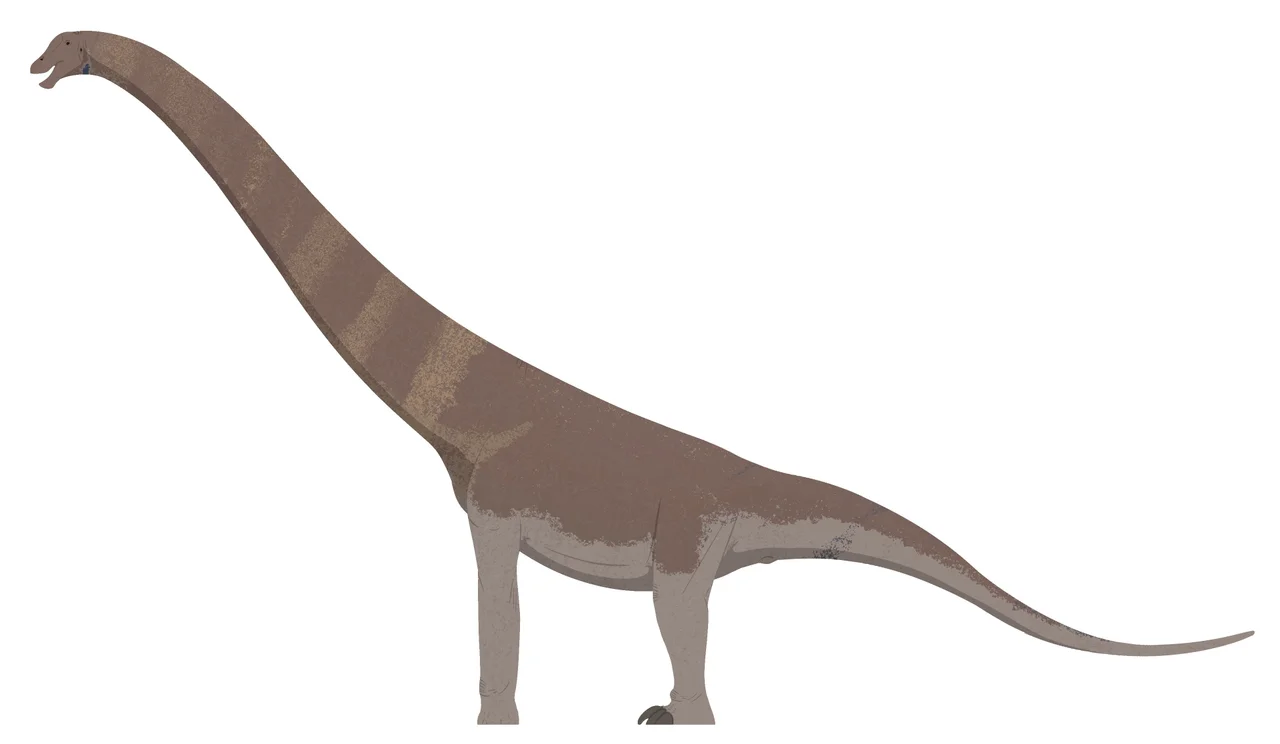
The sauropods of the Adamantina were titanosaurs, the last great lineage of long-necked dinosaurs. Maxakalisaurus topai was reconstructed from a remarkably complete skeleton - a fragmentary maxilla with teeth, cervical and dorsal vertebrae, ribs, limb bones, an osteoderm suggesting skin armor - and a mounted cast was displayed in Rio de Janeiro's National Museum before the catastrophic fire of September 2018 destroyed most of that institution's collection. Adamantisaurus and Gondwanatitan round out the lithostrotian lineage. Brasilotitan had a distinctive jaw that has given paleontologists clues about its feeding style. Antarctosaurus brasiliensis represents a colossosaurian titanosaur, part of a clade whose largest relatives approached the size of the biggest land animals that ever lived. The theropods - the two-legged meat-eaters - are less well preserved here. Abelisauroid remains suggest short-snouted predators related to the Carnotaurus of Argentina. An unenlagiid theropod, a cousin of the famous dromaeosaurs, adds another dimension to the predator guild.
Why This Record Matters
The Adamantina is one of the best windows we have into what Gondwanan ecosystems looked like in the final act of the Cretaceous. South America was by then an island continent, drifting westward from Africa, and its fauna was taking on distinctive shapes - sphagesaurid crocodiles instead of carnivorans, abelisaurids instead of tyrannosaurs, notosuchians in roles that would have gone to mammals elsewhere. Recent decades have produced a flood of new species descriptions from these rocks: Epoidesuchus tavaresae in 2024, Caryonosuchus in 2011, a new vocalizing crocodyliform published in 2024 that may have used sound for communication. Each new specimen revises the phylogenetic trees and fills gaps in what we thought we knew. Western Sao Paulo is covered in fields and cities now, but beneath the soil lies a buried Mesozoic world - and paleontologists working the Monte Alto and Marilia outcrops are still pulling it into the light.
From the Air
Located at 21.60 S, 50.10 W in western Sao Paulo state, with principal outcrops around Monte Alto, Marilia, and Adamantina. Nearest airport is Marilia Airport (SBML), with larger hubs at Bauru-Arealva (SBAE) and Sao Jose do Rio Preto (SBSR). The terrain is gently rolling cerrado and agricultural land at about 400-600 meters elevation. Red-colored soils and exposed road cuts reveal the sandstones on the ground. Best visibility November-April outside the rainy season afternoons.
Nearby Stories
- Pompeia, São Paulo 36 km away
- São José do Rio Preto 54 km away
- Bauru Station (NOB) 77 km away
- Presidente Prudente 87 km away
- Votuporanga 95 km away
- Bauru 102 km away
- Tietê River 121 km away
- Cisalpina Private Natural Heritage Reserve 139 km away